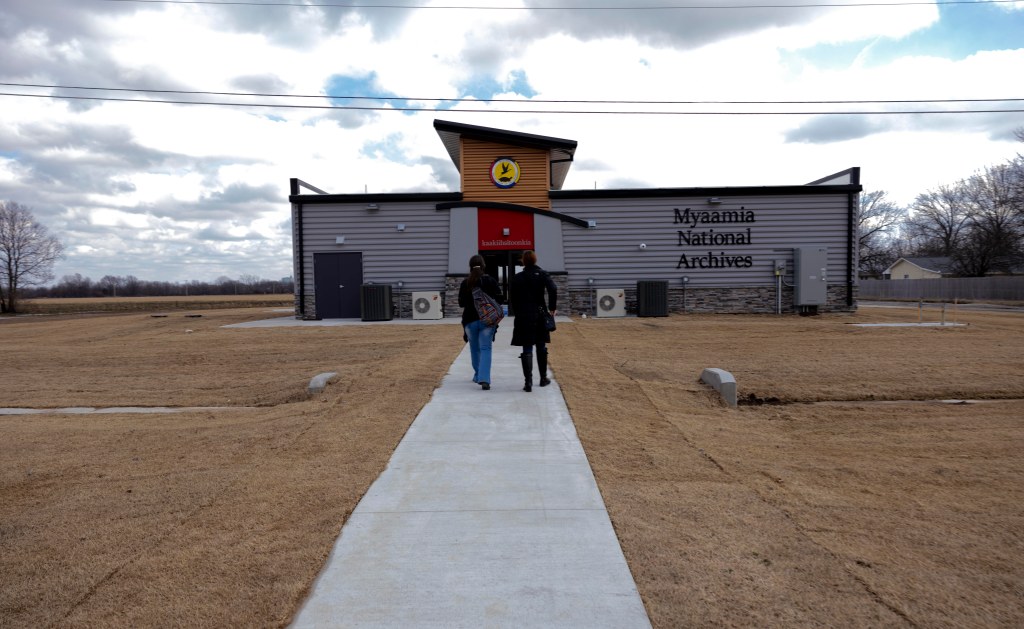
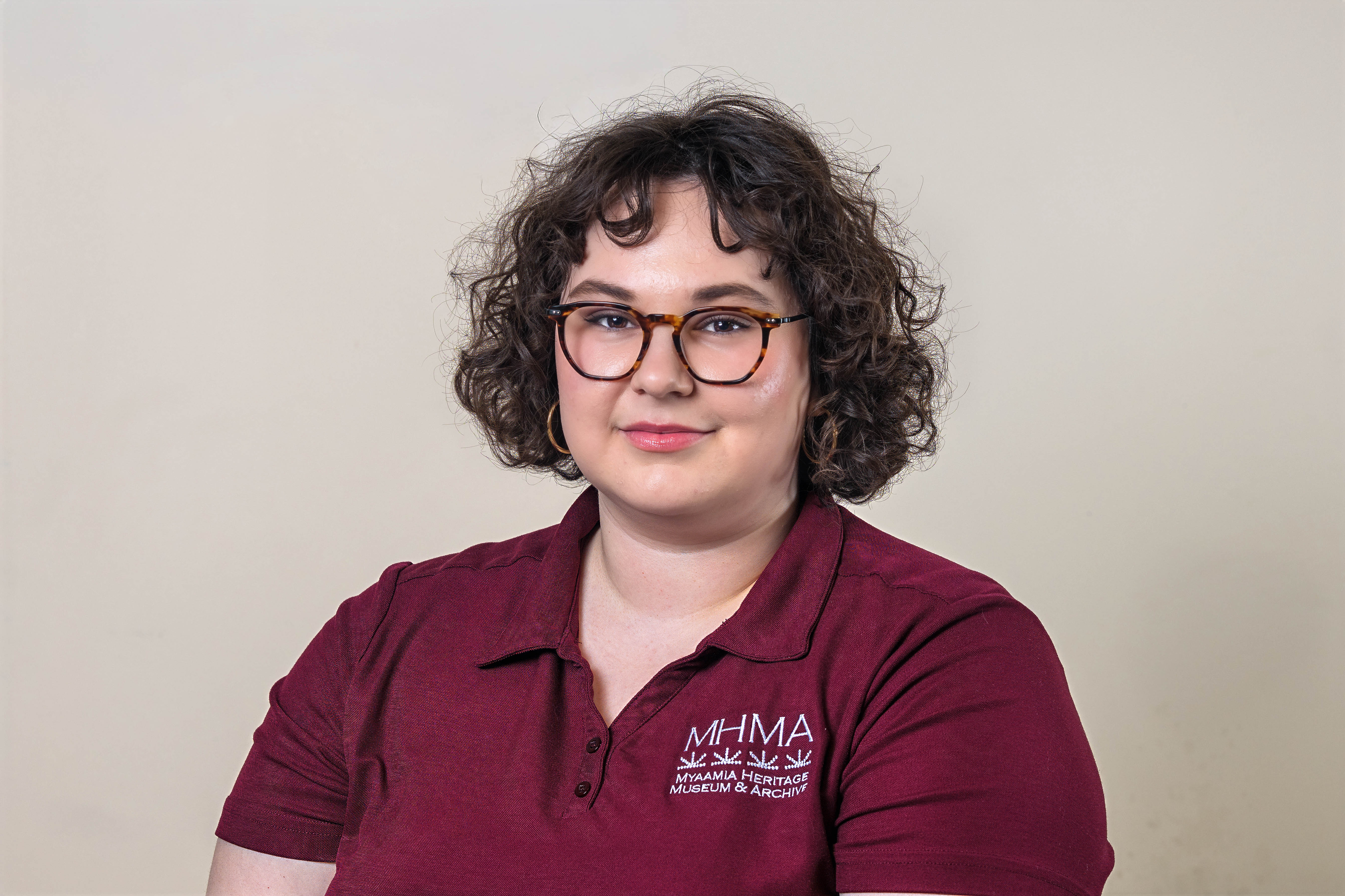
Jacey Vangel began her role as Collections Technician with the Myaamia Heritage Museum & Archive [MHMA] in early December 2025. In this position, she supports the care, documentation, and accessibility of cultural materials stewarded by the Miami Tribe of Oklahoma. Her work combines professional museum practices with respect for traditional cultural knowledge and tribal protocols, helping ensure that culturally significant materials are handled and preserved appropriately for future generations.
Jacey works under the supervision of Meghan Dorey, Manager of the MHMA, and alongside Morgan Lippert, Curator of Exhibitions. In this role, she supports Meghan and Morgan in a variety of collections management tasks, including rehousing materials, maintaining the collections database, conducting inventories and condition checks, and assisting with the processing of incoming acquisitions and previously unprocessed collections.
In this role, Jacey will also work with Angela Matyi, the Myaamia Center’s new digital archivist, to determine the best long-term storage and organization solutions for language and cultural materials produced at the Myaamia Center.
Tell us a bit about yourself.
aya, my name is Jacey Vangel, and I am a non-Native history professional. I was born and raised about 30 minutes from Miami, Oklahoma, in Joplin, Missouri. I received my education from Missouri Southern State University in Joplin, MO. I graduated Cum Laude in December 2022 with a Bachelor of General Studies, a Studio Art minor (with a fibers/textile emphasis), and a Certificate of Public History. I currently live in Joplin, Missouri, with my husband, Mike, and our three cats.
What experience have you had in museums and archives before coming to work for the Miami Tribe?
I’ve worked in public history since 2018. My first professional position was Museum Assistant at the Joplin History & Mineral Museum in Joplin, MO. Shortly after beginning in that role, I realized I wanted to pursue a career in the museum/archive field. Working for a small museum gave me the opportunity to try my hand at varied tasks, including object research and exhibit creation, selection and acquisition of new collections, policy creation, data entry into collections management software, physical collections care, and strategic planning, amongst other things. I also served as a liaison for the Joplin Historical Society during this time and oversaw a deaccessioning committee that suggested removal of collections that did not meet the museum’s mission.
After graduation, I accepted a position as Tribal Archivist for the Peoria Tribe of Indians of Oklahoma, where I worked for just under two years. In my role, I laid the framework for the tribal archive, museum, and reference library. I spent substantial time writing foundational policy and working to build relationships with tribal citizens, academic professionals, and archival repositories. I greatly enjoyed serving the tribal community and taking part in cultural learning opportunities, including learning Peewaaliaataweenki ‘Peoria language’ through educational classes. The Reclaiming Stories Project was in full swing when I started my position with the Peoria, so through travel, workshops, and events, I was introduced to the Myaamia community.
In the fall of 2024, I accepted a position as Park Guide (ranger) with the National Park Service at George Washington Carver National Monument in Diamond, Missouri. I led educational programming and provided guided interpretation to school field trips and the visiting public. My long-term goal in the National Park Service was to build a career where I could serve tribal communities from within the federal government and work to bridge shared stewardship opportunities and ethical returns. The mass federal terminations of early 2025 cut those goals short. In reevaluating what my future held, I felt drawn back into the tribal community and happily applied for this position.
What projects are you currently working on, and what are your plans for the future in this role?
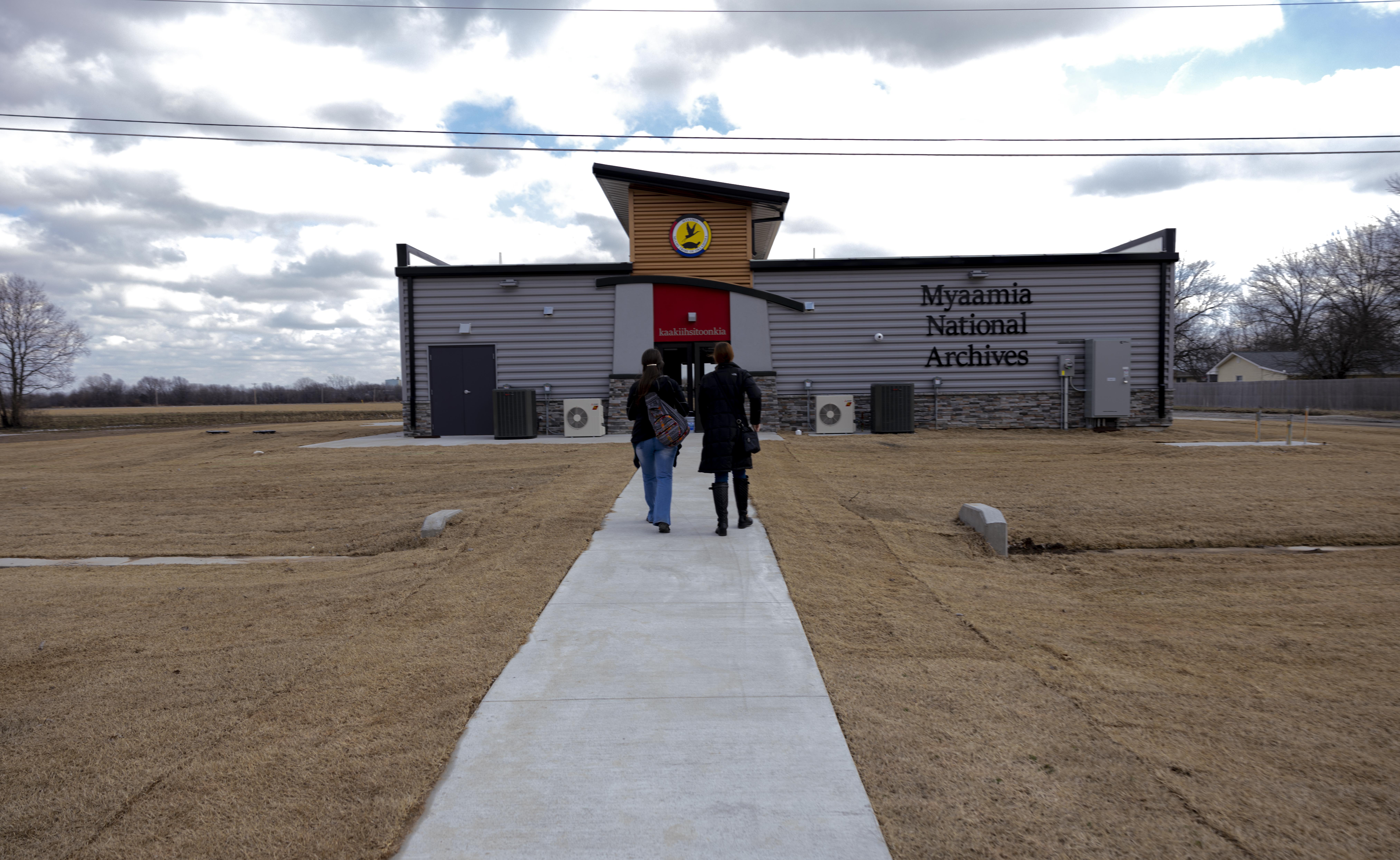
My role provides oversight and care for the archival and museum collections held by the Myaamia Heritage Museum & Archive. Good stewardship and collections care included documenting objects well, housing them appropriately, monitoring environmental controls and pest activity, and ensuring objects can be easily located. Ideally, these goals will be fully realized in the coming years, strengthening internal workflow and intellectual control.
The first steps to realizing these goals begin with a collections assessment, where collections are analyzed, and their needs are assessed. The assessment aims to match documentation and provenance to physical objects, then details the work previously done or that needs to be done for each object. By creating a checklist, I can get a general idea of the overall health of the collections and can establish priorities for next steps.
Something exciting in the works is upgrading our existing collections management software to a cloud-based program. In addition to more intuitive functions, the cloud-based software will allow staff working from multiple locations to access the database.
In the coming years, we hope to streamline internal operations, which in turn will make external operations (such as museum exhibits, research, etc.) more accessible to citizens and more feasible for staff to manage.
What is something you have enjoyed about your work with the Tribe so far?
I’ve really enjoyed working here so far. Everyone is very welcoming, and I’ve had fun getting to know folks better and learning more about the Tribe’s history.
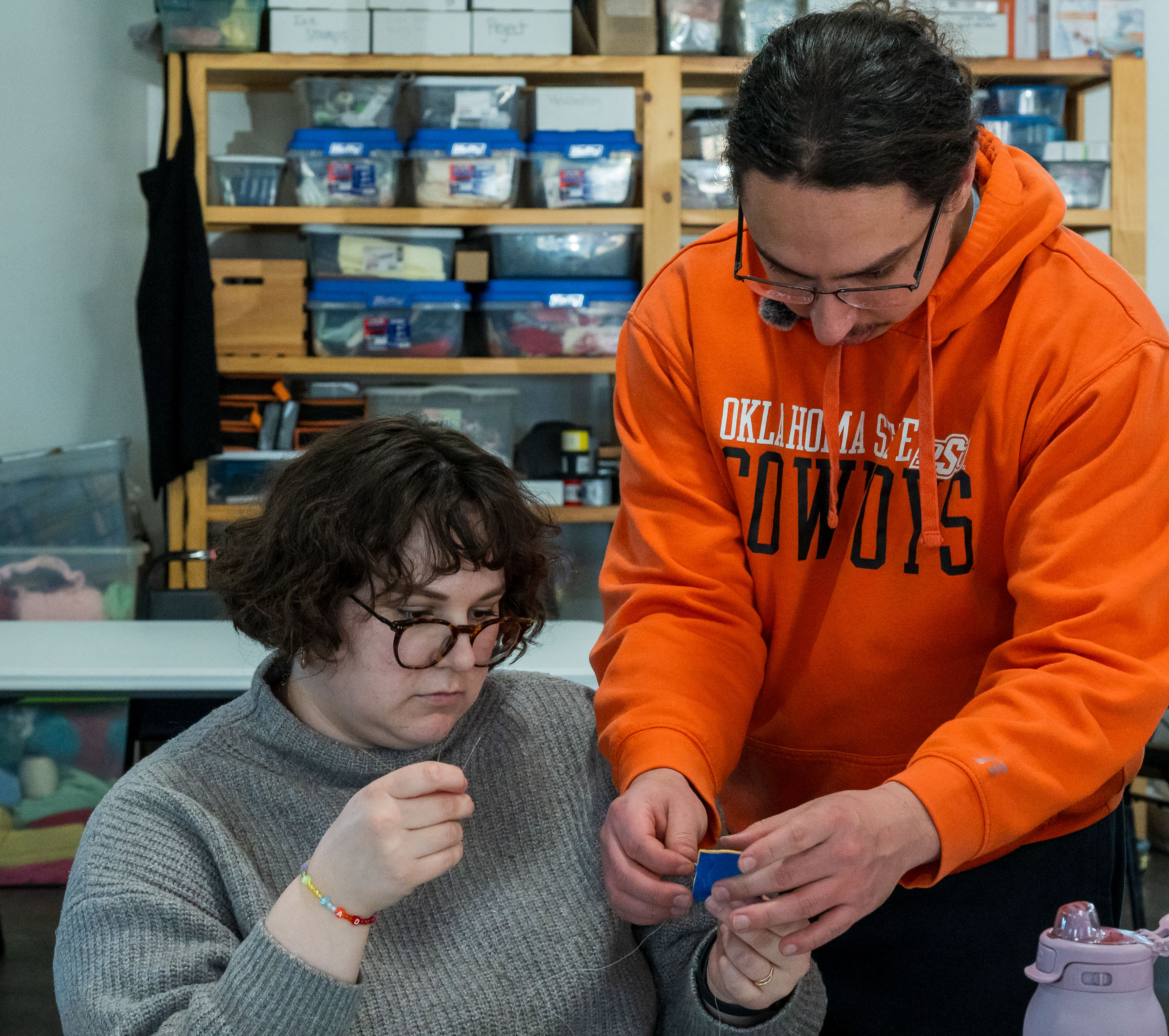
Recently, I got to take part in a quillwork workshop led by Caleb Garcia (Wyandotte Nation). Caleb gave us a brief historical and contemporary overview of quillwork and instructed us in sorting, selecting, dyeing, and stitching quills onto hide and other materials. Even as someone who considers themselves skilled in hand sewing, I found quillwork to be extremely challenging and finicky. Physically working with the quills and with some of the stitching techniques (such as linework, which, when done well, looks like individual beads) helped me actualize beadwork’s substitution for quillwork historically. I came away from the workshop with a greater appreciation for the skilled labor that goes into creating quillwork, and a deeper understanding of quilled objects in museum collections.
 Aacimotaatiiyankwi
Leave a comment