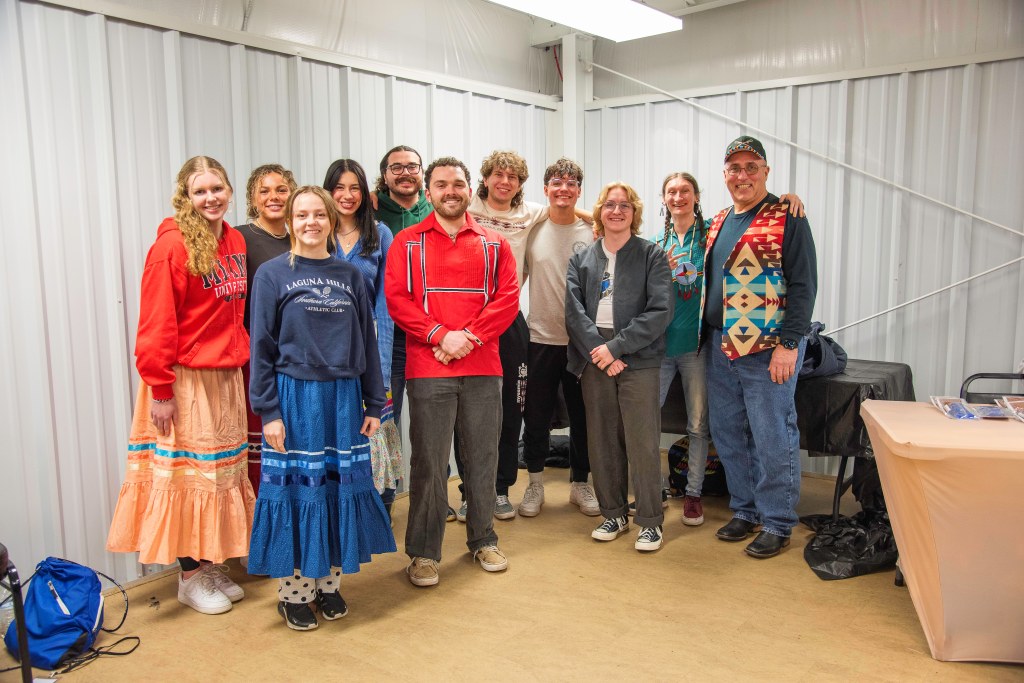
As part of my work within the Office of Assessment and Evaluation, our team has the honor of meeting with every single Heritage Award Program (HAP) student before they start the program their first year at Miami and again after their final semester. During both of these meetings, we are “interviewing” them about their personal experiences with the tribe, their Myaamia identity, and the heritage program itself. The goal of these interviews are threefold:
- To understand the student experience within the HAP so that we can continue to improve the program over time.
- To understand how intensive language and cultural education impacts Myaamia students.
- To understand change within the HAP community across time.
These interviews are transcribed and examined for themes or important trends that come up in many of the interviews to make conclusions about these three goals.

At the same time, we also give HAP students a survey called the connectedness scale to better understand how connected they feel to their Myaamia community and to their own Myaamia identity at the two timepoints. This survey asks questions about their participation in tribal events, intentions to seek knowledge/support, looking to the tribal community for guidance, and much more. We hope to understand how the HAP impacts their own sense of connectedness as a Myaamia person.
Overview of findings
Through this work, we have identified that the HAP generally has a significant positive impact on the students’ identity and sense of connectedness within the Myaamia community. While there are of course individual differences in experiences, these are conclusions based on patterns in the interviews.
Theme #1: Identity
There really seem to be about three “typical” student profiles. First includes students who enter the programming having little or no exposure to the tribal community. Most of these students report knowing they are Myaamia (or “Native”) but don’t know much beyond that. However, there are a few still who report learning they were Myaamia during their college search when a family member tells them about the HAP. The second type of student includes those who knew they were Myaamia growing up and sporadically attended tribal events. Often, these students will say they remember going to family events/reunions or different educational opportunities, but there was little continuity between them. The third and final profile includes students who grew up knowing they were Myaamia, had family members who encouraged their identity exploration, went to the Eemamwiciki Summer Programs, and regularly attended tribal events.


From these profiles, you can see that the likely identity from a Myaamia perspective differs based on which group they align with at the “pre-test” or their initial interview prior to attending the HAP. However, regardless of the group they are in, most students (if not all) report significant improvements in their Myaamia identity after they have been through the HAP. In particular, they feel they can communicate their identity and information about being Myaamia with other people – both within and outside of the tribe. They feel more confident and comfortable in who they are as a Myaamia person and are more able to express that in ways that feel genuine compared to the pre-test. Much of this comes from improvements in their understanding of the Myaamia knowledge system
Theme #2: Knowledge
The second major theme that arises from these interviews is a significant increase in Myaamia knowledge as a result of the HAP. Even those who reported having some knowledge prior to attending (those who went to Eemamwiciki Summer Programs growing up, for example), report that the program goes much more in-depth than they anticipated. Students feel they gain an understanding of Myaamia history, ecology, language, art, food, and much more. This knowledge sets them up to be able to educate others (friends, family, classmates, etc.) about Native people generally and about Myaamia people specifically. Interestingly, students share that no single piece of knowledge is “critical” to being Myaamia. What they mean by this is that knowledge is necessary but not sufficient to being Myaamia and you must personally connect and engage with the knowledge in order to fully “be” Myaamia.
Theme #3: Community
Another important theme from the interviews is that students gain a sense of community both at Miami University and within the tribe during their time within the HAP. Again, the pre-existing sense of community when they enter the HAP depends on their experiences to date, but all report an increase in sense of community. This exists within the Miami University community, feeling particularly unified with and connected to one another. Going through three years of content with all students together and engaging in activities outside of classes helps them get to know one another as well as promote a sense of community. Additionally, we also take a group of students to Miami, Oklahoma for Winter Gathering each year and students serve as our counselors for the Eemamwiciki Summer Programs. As a result of these types of extracurricular opportunities, students also report a greater connection to the broader tribal community.

We even have quantifiable data to support these claims from the interviews. Since we give students the connectedness scale both before and after the HAP, we compare their responses at the two timepoints. Consistently, we have observed a statistically significant difference between pre-test and post-test scores on this scale, with students indicating a greater sense of connectedness after going through the program.
Theme #4: Pride
To me, this is one of the more interesting findings of our interviews. Throughout the years, we have noticed that students talk about pride in being Myaamia significantly more at pre-test compared to post-test. It could be easy to say that the program decreases a sense of pride, but I don’t think that’s the case. Our team’s hypothesis on this is that this stems from multiple generations of trauma and cultural loss. Since our community lost a lot of the knowledge and cultural information that we once held near to our hearts, the thing we had to hold onto is and was our pride in being Myaamia. Parents and grandparents teach, and taught, us that we should be proud of being Myaamia and this is what helped us to stay connected and survive as a people. So, when students attend the HAP at Miami, they now have much more to ground their identity in than just their sense of pride in being Myaamia. While the pride has not decreased, it isn’t the thing they hold onto as tightly anymore.

Closing the loop
The most important part of our team’s work is in what we call “closing the loop” with feedback. Our interviews and surveys don’t mean much if they don’t inform future programming or what we do moving forward. So, after we conduct research on an annual basis, we then gather with relevant parties and provide them with our feedback on how to improve year over year. This helps to put in place mechanisms for change and improvement. One example of how this has been implemented within the HAP specifically is that we noticed during interviews that students were not aware of (at least explicitly) the Myaamia community values. We knew this wasn’t the case, but the education team then began explicitly discussing Myaamia values and how those show up in our everyday lives, calling out the language we use to express them. This is just one small example but has a big impact on the way the Myaamia community understands and expresses our community values.
 Aacimotaatiiyankwi
Leave a comment