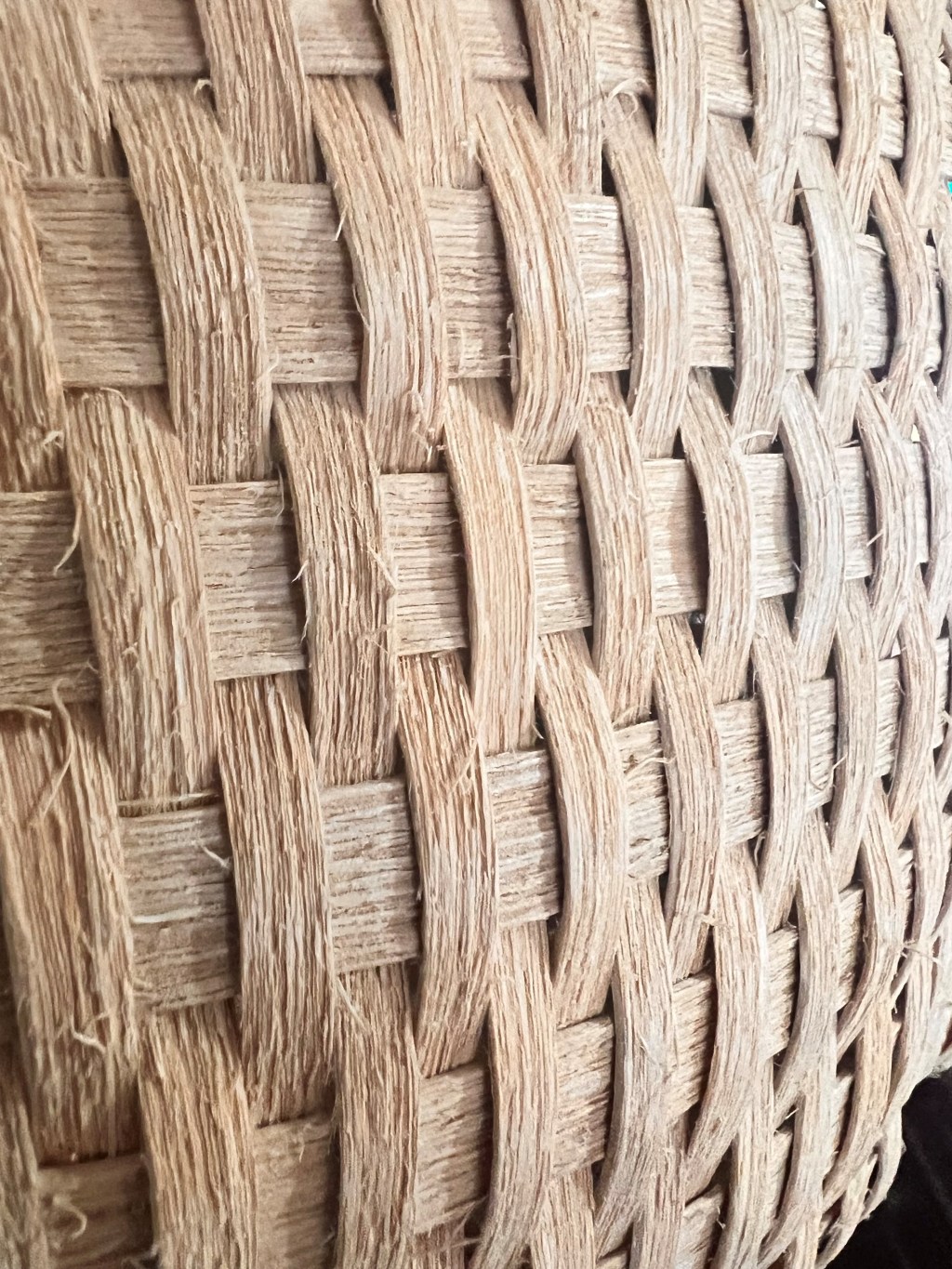
In mid-June of this year, I was invited by the Wyandotte Nation Cultural Center to participate in a workshop aimed at teaching the harvesting and use of peepahkwilaakiikia ‘Black Ash Trees’ to make baskets the same way that our ancestors have made them in the past. Tonia Galban (Mohawk, Bear Clan), who specializes in making Black Ash baskets, led a two-day workshop alongside her husband Micheal and their children Tsioianiio and Rotsirohawi aimed at teaching the process of harvesting and utilizing peepahkwilaakiikia for the creation of utilitarian baskets.1 Over two days, we pounded logs to split the separate layers, cleaned and cut the splits, and eventually weaved the wood into a basket. Since my experience with these excellent teachers, I have reflected and tried to learn more about the process of basketmaking. Below is information on Black Ash Trees, basket making, and a reflection on reestablishing this practice within our community.
Basket Making in The Great Lakes
The age-old peepahkwilaakiiki kiihkalaakani ‘black ash basket’ weaving practice has existed in kihkcikama ‘Great Lakes’ region for many generations. Myaamiaki ‘Miami people’ lived in areas that would have had a plethora of Black Ash trees, like low-lying wetlands surrounding the lakes and rivers in the Lower Great Lakes. Other communities that once lived amongst us, such as the waahoonahaki ‘Potawatomi people’, still live in areas with Black Ash trees where they can maintain the practice of harvesting trees and making baskets.2 In Great Lakes communities, practices such as basket-making involved both men and women and would have required time and effort that helped to strengthen social and communal bonds. Men would have found, harvested, and pounded trees, while women would have focused on cleaning, splitting, and weaving the harvested wood to create baskets. This process required both genders to work together cooperatively. Black Ash Basketry: A Story of Cultural Resilience is an excellent documentary on the history and importance of the Black Ash Basket making within a Potawatomi community in Michigan. This documentary is particularly relevant due to the history of intermarriage among Myaamiaki and waahoonahaki. Our intermarriage with the waahoonahaki dates hundreds of years, and the practice of weaving different materials to make baskets has been shared between our two communities.
Myaamiaki are not the only people to have experienced a huge loss in the communal knowledge of basket weaving and the process of harvesting materials. However, this does not diminish the importance in re-learning and increasing the spread of such knowledge within our community. Many communities, such as our own, that have faced removal experienced a drastic loss of cultural identity and connection to our traditional homelands. This has removed the ability to pass on traditional knowledge based on our environment and its resources. It is our responsibility to preserve and pass on this knowledge, regardless of where we may live, as Black Ash has become a scarce resource and requires much more work to access and harvest. Other types of kiihkalaakana ‘baskets’, such as elm bark baskets, have appeared in the historical record dating back to well before removal. Elm bark baskets, which are currently being made within our community, appear to have become more common in the historical record in the 19th century, and have become a more convenient option for basketmaking due to availability.3 An important difference between Elm and Black ash baskets is that the Elm baskets do not require weaving.
As our environment continues to change, new and invasive species are being introduced in our traditional homelands as well. Although these species are harmful to our environment and native species, they can potentially be used in artisanal ways. Invasives such as Asian Honeysuckle have become common and widespread throughout the Great Lakes region. Community members have taken initiative in removing invasive species on tribal properties but also in experimenting potential uses of such species.
Learning from a Basket Weaver Family
The opportunity to learn from Tonia Galban was a great chance to increase my knowledge from someone from a family of basket makers located in an environment similar to that of our homelands in the Lower Great Lakes. Working with the Galban family alongside Wyandotte and Seneca-Cayuga tribal citizens was an eye-opening experience for me in multiple ways. The time and effort in pounding the log and harvesting the split wood helped me understand and feel the rooted connections to this process we, as Native people have. As we pounded the wood, it was a rhythmic “music” that I imagined as a soothing sound once heard outside our villages. The rhythmic pounding of the logs by the men, alongside the women talking and laughing while cleaning and cutting the wood splints, created an environment that one could imagine sounded like our villages would have hundreds of years ago. Sitting in groups and working on baskets would have presumably been a place for communal growth. Women would have perhaps gossiped or taught each other or youth, which would have been a practice that helped create tools to make the daily collection of food or storing goods much more manageable.
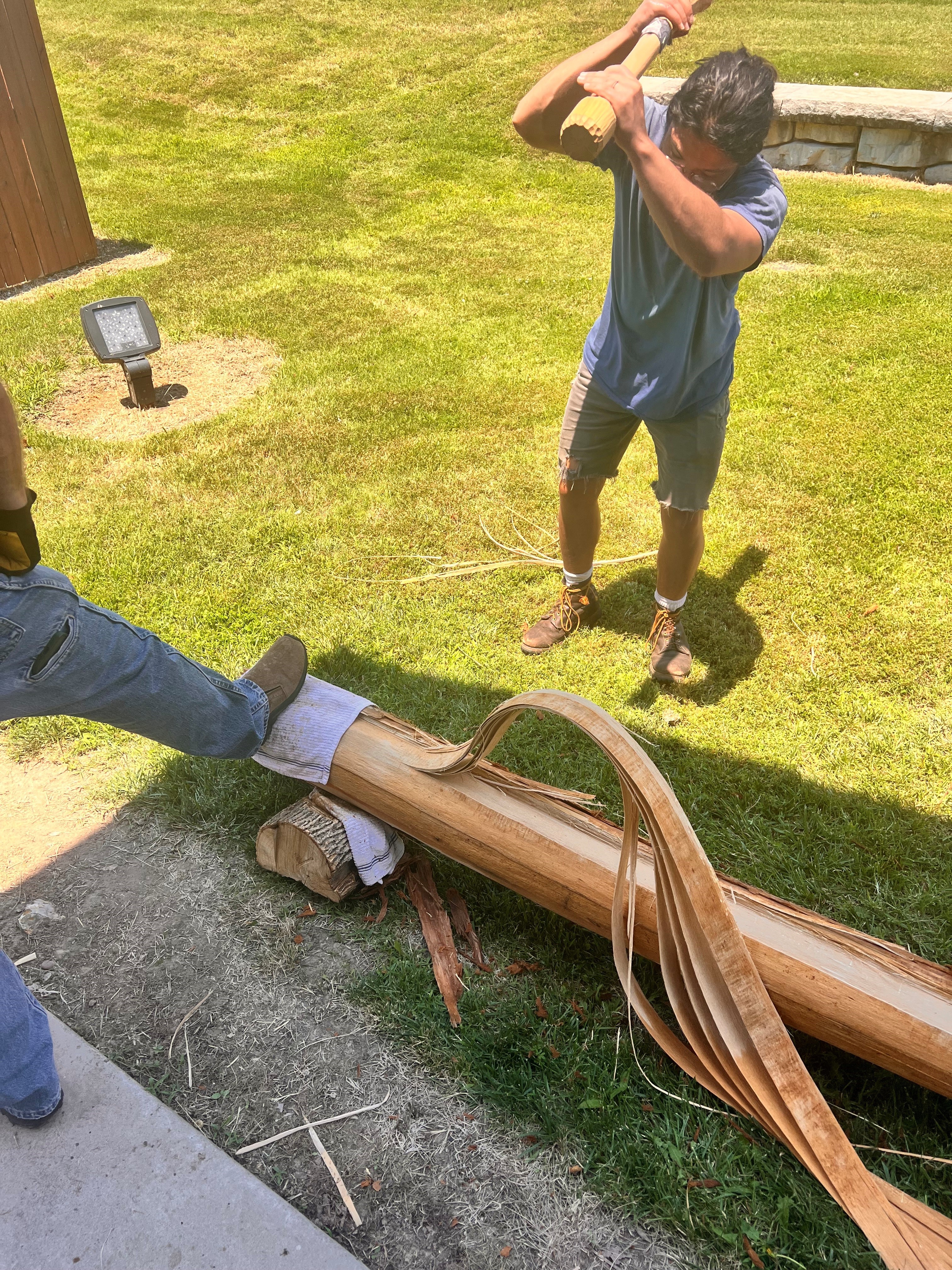
On June 14th, Tonia and family began by demonstrating the process of harvesting and pounding the black ash logs for splits. The log, about 8 feet long, was soaked for a few days in water to soften the layers of wood and was then pounded using a large wood bat (wood or even the flat end of an axe would suffice here). A small cut is made at the end of the log about 3 inches wide and 6-9 layers/rings of wood deep so that when the wood is pounded loose, it can slowly peel off the log itself. This process takes significant physical exertion and time, thus making it much easier with multiple men pounding. As soon as we removed our first splints, the women and some of the men began working on separating the splints by splitting the individual splints into thinner layers.
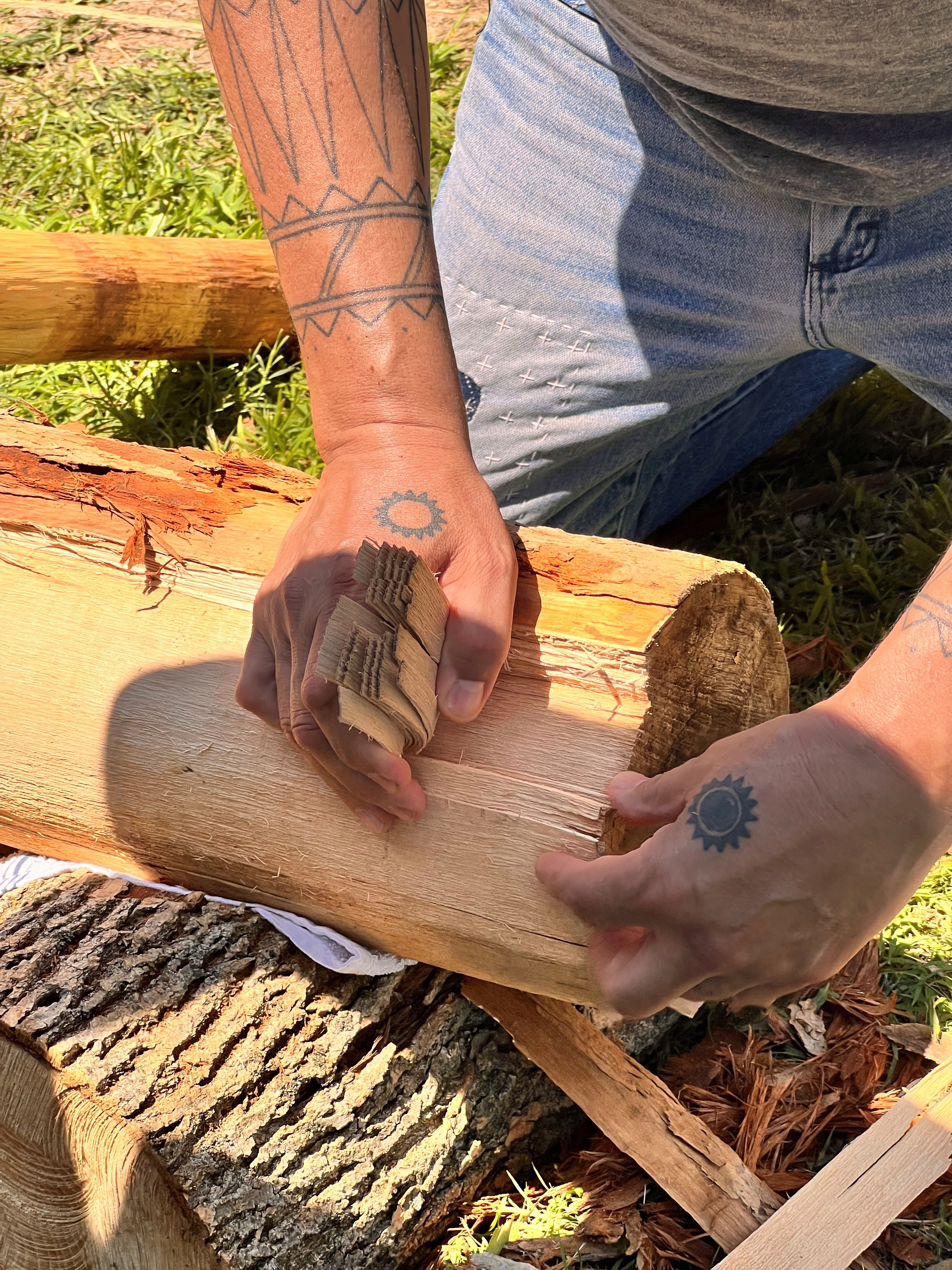
Following the separation of the splints, using a pruning knife and draw knives to scrape the loose wood shavings is the next step. This process (see photo) requires the scraper to repeatedly and gently scrape the splints until they become smooth to the touch and of a similar surface touch of a processed and treated 2×4 board of lumber. Following the scraping of excess material, the splints are cut into thinner strips (depending on the size of your weaving and spoke strips) to begin the basket construction. These are then soaked overnight.

The next day, we cut our weavers to the desired lengths for our baskets and began weaving. As we weaved, we shaped our baskets with protruding front sides for increased size and the desired style, then finished the process by lashing the tops and adding handles. This two-day workshop demonstrated the intricacy of this type of basket making and the very apparent importance of communal effort in creating such baskets. The baskets we made took just over 12 hours of work from start (pounding logs) to finish (lashing tops), which would not have been possible without the time and effort in creating the tools we used and the actual location and harvesting of the logs themselves. A process that I can imagine looked different during past times when we as a people lived closer to readily available black ash trees and made the trees without using metal tools.

Our finished baskets.
A Changing Environment
Black Ash baskets have been used as a tool amongst tribes of the Great Lakes for thousands of years. Black ash trees have long been considered the most important basket-making tree in the northeastern woodlands and great lakes. Their importance is demonstrated in that the Black Ash tree has been given other names signifying its uses, such as Heep Ash and Basket Ash trees. Black Ash trees thrive in moist and low-lying bottomlands of the eastern woodlands and have thrived in wetlands, swamps, and water sources, making the Great Lakes a place for healthy growth and eventual use by Native Americans.4 Destructive forestry and the invasion of the emerald ash borer have greatly diminished the availability of Black Ash trees and threatened basket makers’ favorite resource.5 The US Department of Agriculture estimates that over half of the Black Ash Trees in North America have been lost due to emerald ash borer, with the majority of such losses occurring on United States land. With such losses and presumed continuous loss of trees, Native basket makers are fighting a new battle of adaptation: lack of materials for harvesting. Areas where peepahkwilaakiikia ‘Black Ashes (pl)’ were once prevalent are now empty of these resources. As we continue to revitalize and learn practices and art forms that we once commonly held, making peepahkwilaakiiki kiihkalaakani will be dependent on both the learning and practice of harvesting and basket making as well as the availability of logs to harvest and use.

Map showing the shrinking distribution of Black Ash Trees in the Great Lakes Region. Map courtesy of the United States Department of Agriculture, Forest Service.
The US Department of Agriculture estimates that over half of the Black Ash Trees in North America have been lost due to emerald ash borer, with the large majority of such losses occurring on United States land. With such losses, and presumed continuous loss of trees, Native basket makers are fighting a new battle of adaptation. In areas where peepahkwilaakiikia were once prevalent are now empty of these resources. As we continue to revitalize and learn practices and art forms that we once commonly held, making peepahkwilaakiiki kiihkalaakani will be dependent on the battle against emerald ash borer and the continued teaching of black ash basket weaving.
Final Reflections
As continued work towards the revitalization of traditional practices is taking place, we have been fortunate to have the help and support of many people from related tribes. Experiences like my own in basket weaving Black Ash, and the continued practice of making Elm bark baskets by community members is important in our continued growth as a community. As a nation living in such widespread diaspora, working with native species and invasive species for artisan practices in our respective areas of residence will help us continue our understanding of our environment. For another reflection on artisanal practices reference Picking Up the Threads by Deputy Tribal Historical Preservation Officer Jared Nally. For more images regarding various types of baskets, please reference the digital archive here.
- Here is an profile for Tonia that expands on her basket making history: Tonia Loran-Galban – Burchfield Penney Art Center ↩︎
- Reference article on Steve Pigeon: Gun Lake Potawatomi elder and his family of black ash basket weavers – Potawatomi.org ↩︎
- Here is an excellent and short video with Myaamia artisan and current CREO (Cultural Resources Extention Office) employee Dani Tippmann: https://www.youtube.com/watch?v=NMtVYzQv-9g ↩︎
- Species: Fraxinus nigra (usda.gov) See “Botanical and Ecological Characteristics” ↩︎
- Emerald Ash Borer | Animal and Plant Health Inspection Service (usda.gov) “The emerald ash borer (EAB), an invasive wood-boring beetle from Asia, is responsible for the death and decline of tens of millions of ash trees in North America. EAB lays its eggs in the bark crevices of ash trees. The eggs hatch and the larvae burrow into the tree where they feed. This feeding is what damages the trees. We have detected EAB infestations in 36 States and the District of Columbia.” ↩︎
 Aacimotaatiiyankwi
Leave a comment