
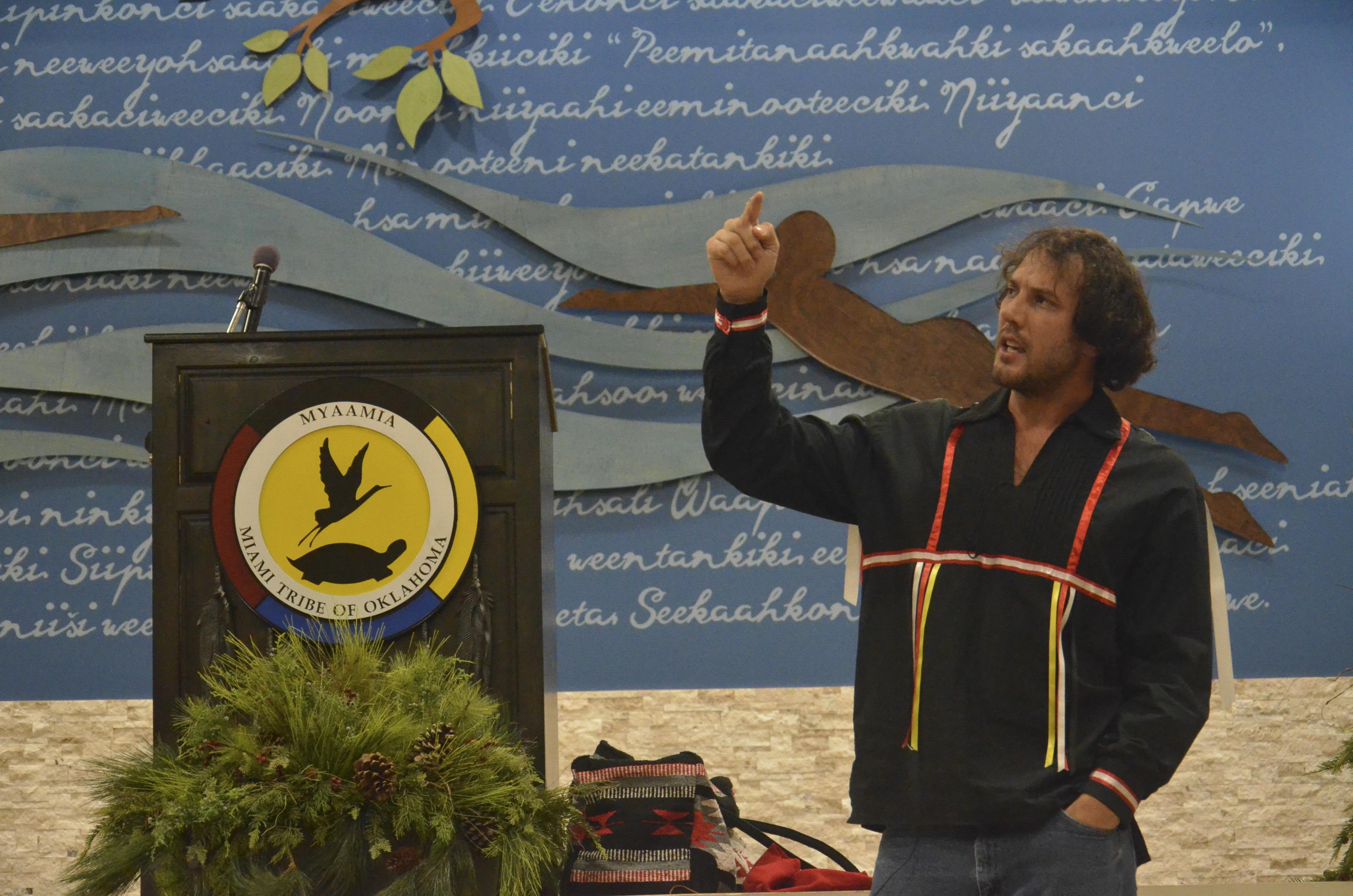
Some of you heard the weehki Aalhsoohkani ‘new Winter Story’, I told at Winter Gathering in January. Wiihsakacaakwa plays his usual bored and spunky self off in search of someone (Mamahkiihsia ‘Toad’) to trick. This story took a long time to write, not only the practical side of sitting down, writing, editing, and translating but also the other side that includes learning about Myaamia storytelling and the character Wiihsakacaakwa. When our language stopped being spoken in the community, Winter Storytelling went with it. In more recent years, the practice has started to be revitalized, along with a relearning of our stories and characters.
I first wrote the story as a kid, probably around 12 or so, and forgot about it until a few years ago when I pulled it from a box of my old homeschool papers. I got a good laugh reading it and decided to turn it into a full-on Wiihsakacaakwa story. Before that happened, I wanted to learn more about Wiihsakacaakwa. Who is he? How does he act? Where does he fit into Myaamia Aalhsoohkaana ‘Winter Stories’? Why is he in our stories at all? So I continued learning and telling his stories from our storybook, As Long as the Earth Endures. I learned about his travels with the Frenchman, running into eemamowia ‘man-eater,’ when he goes visiting, and more. I also read Wiihsakacaakwa stories from related tribes, like the Cree and Meskwaki (Fox), to understand how other communities interact with him.
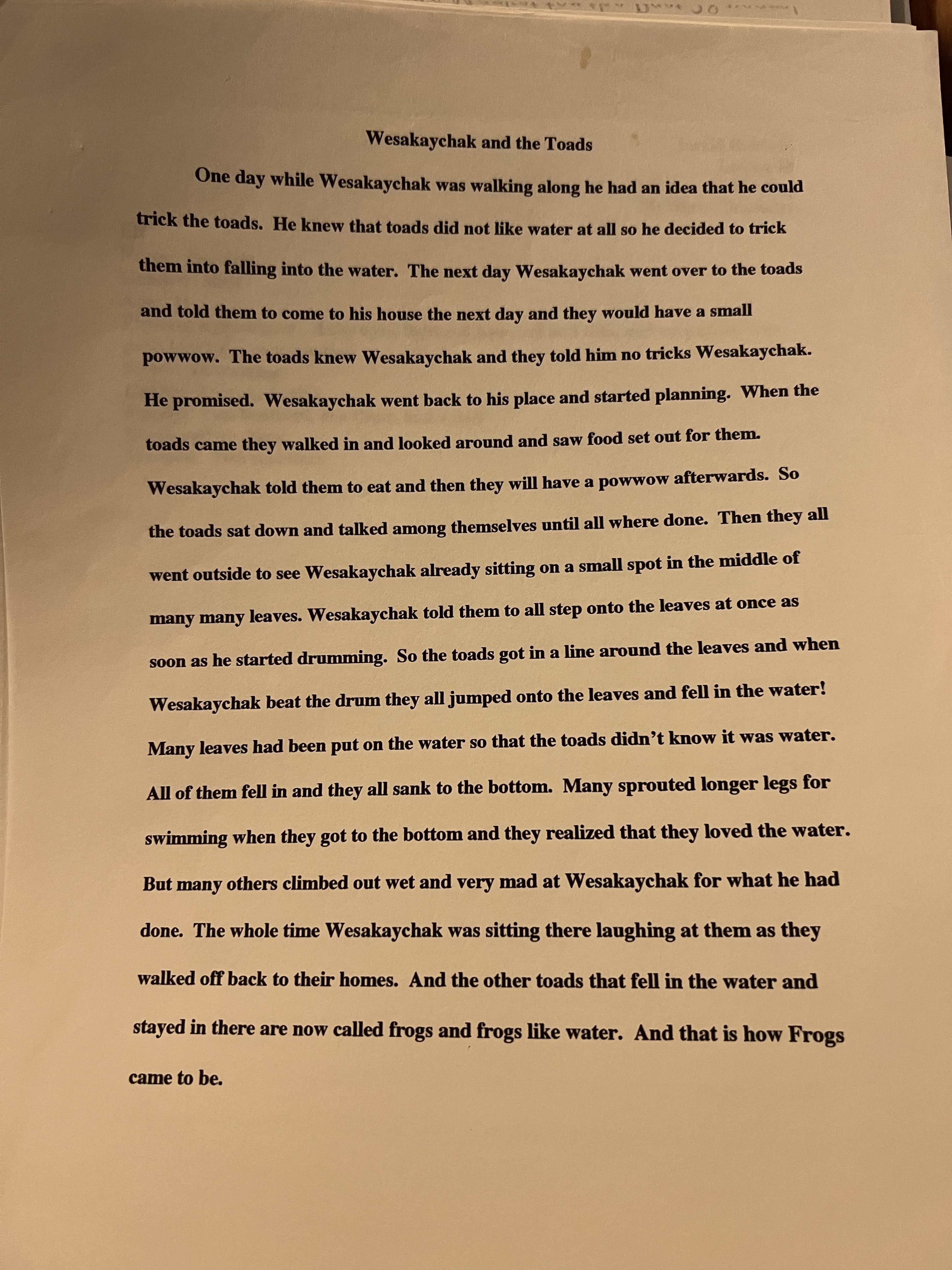
As for the practical side of this process, I broke it down into two parts: (1) writing the story in English then (2) translating it into Myaamiaataweenki ‘the Miami language’. Writing the story in English was the easier part, especially because I already had the first draft done by my younger self. Next, I needed to expand on that first draft and fill in the missing pieces of the narrative. I wanted to add details that brought the listener into both perspectives, Wiihsakacaakwa and Mamahkiihsia ‘Toad’, to give them their own personalities. I had nišihsa Caahceenhsa ‘my uncle George Ironstrack’, and niihkaana Aahkoleeka ‘my friend Chris Bowyer’, help me with the flow of the story and the cultural aspects.
The second part was the more difficult part: translating into Myaamiaataweenki. This involved a lot of help from the Myaamia Center linguistic team; Dr. David Costa and Dr. Hunter Thompson Lockwood. I first went through and translated all the easy sentences. Then set to work on the harder ones.
An easy sentence might be “and then he headed off” (neehi-hsa maacaaci), which is a common phrase used to transition from one part of the story to the next. A hard sentence might be something like “and then Toad sent for the other toads to hold council” (neehi-hsa mamahkiihsia maawatomaaci kotakahi mamahkiihsiahi).
This involves more complicated pieces of grammar and new words that I’m not used to using. In some cases, I had to create new words and string words together in new, unusual ways. Creating new words does not mean coming up with pieces that previously never existed, it just means using pieces of the language (that already exist) and combining them with other pieces in ways that haven’t been documented before.
In revitalizing a culture, like we all are doing today, different things get revitalized at different rates and times. For us as Myaamiaki ‘Myaamia people’, storytelling has been something that we have particularly enjoyed and decided to put a lot of energy into. Writing new stories is taking the next step in that process, it’s us as 21st-century people bringing our culture into our lives today and saying: “It has a place here.”
Updated: 2/24/25
 Aacimotaatiiyankwi
Leave a comment