
Today we will spotlight another myaamia artist in our Artist Spotlight series: Katrina Mitten. Kara and I (Haley) were honored and excited to be able to speak with Katrina for this post about her artwork as she is our aunt, our father’s sister. Though she is a well-rounded artist, she is arguably most well-known both within the myaamia community and the broader Native art spaces for her beadwork. In the following interview, you will read some of the inner workings of her creative mind, evolution as an artist, and identity as a teacher through her artwork.
Can you introduce yourself?
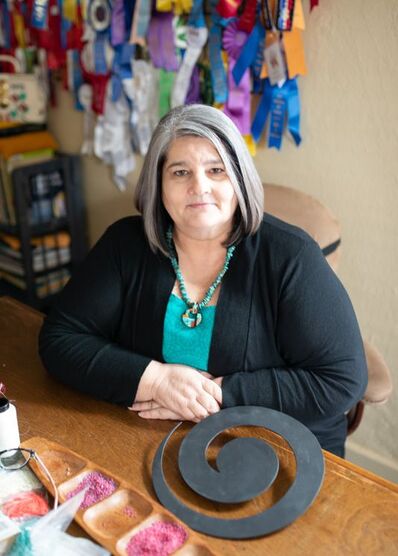
I am Katrina Mitten. I am a citizen of the Miami Tribe of Oklahoma and I am a beadwork artist. I live in Huntington, Indiana.
How would you describe yourself as an artist? What is your aesthetic and what’s your favorite medium to work with?
I don’t think I really have a favorite medium. I really like to work depending on a theme or a message that I’m trying to get out. There’s usually a message or a story that’s involved, and that can kind of push me in different directions as far as what medium I’m going to use if I’m going to do it in pencil or paint, 2D or a 3D medium.
Can you give us an example of how you incorporate a story into your pieces?
Well, there’s a piece that not a lot of people have seen. I did a piece dealing with the boarding school situation. This came to mind for me to work on when a lot of the graves were being found. So, as I was thinking about that, and looking at images and photographs of the children that were being taken into boarding school and having their head shaves and different things. I realized that the camera really is what kept that story going, and the fact that there were images that were being taken of these children as they came in.
So I started thinking about the date of when the boarding schools began, and I found a box camera from that timeframe. I looked into some of the comments that were made by people at that time and decided to use the one that says, “Kill the Indian save the man”, and actually put it on the camera. And then the camera that I found had the actual film cartridges, but they had been exposed. That was even printed on there “exposed”, and so that kind of pushed me to thinking, okay, yes, it’s all been exposed. The film’s been exposed. They’ve been exposed for what they have done. So I knew I needed to put photographs on those and use it as a frame.
That’s how I think–that’s how things go for me. It just continues on. I don’t really plan anything out to an end because it just keeps changing until I figure out, okay, that’s it. I’ve done enough.
When did you first start beading?
When I first started, I was about 12 years old. I saw some pieces at my grandmother’s house. They were not Miami. I don’t even think that they were Ojibwe, or in the floral beading patterns. I believe it was probably something that was gifted to her from or she picked up maybe when she was in the Great Lakes area, maybe a Seneca style raised beadwork piece or a small bag.
I was really intrigued by the beads. I just fell in love with the feel of the beads and decided that that was something that I wanted to pursue. I know it sounds kind of funny at the age of 12, but I think that everybody is born an artist. It’s just that you need to find your medium or find what interests you to make it your art. It can be math or science. Art is something you learn through instruction and practice that becomes your art, so it can be anything that you fall in love with.
So I started working on a piece by going down to our local Craft lady. This was in the seventies and she had strands of love beads which were all different colored beads. I bought whatever I could afford to buy, and I cut them up and separated the colors and decided I wanted to make a beaded strip on a loom. So, I went out back behind the house and found a 2 x 4 and a broom handle and some nails and made my first loom and strung it up, and just by things that I had seen and you know, maybe talked about at Girl Scouts.
I had no instructions on how to do that, so I sat on my bed during spring break and made my first piece of bead work. It was just trial and error. That’s what it’s been for the last 50 years. I’m still learning. Even to this day I learn by mistakes or by talking to other beadwork artists. It’s been a journey for me to learn how to do this art.
How has your view of yourself as a beadworker changed over time?
That’s a really great question, because, in the beginning I would go to pow wows and things, and I would sell necklaces or would make ribbon shirts. Just as early a couple of years ago I saw somebody still wearing one of the ribbon shirts I made 30 years ago, which is awesome. But that would pay for our trip, for me and the kids to go. And I kind of looked at it as just a craft. At that time I didn’t look at it as an art, which is really sad for me when I think about it now. After a while it became my art.
I was at a pow wow and someone told me that I should enter an art show with my work, and I was like, “No”. For the longest time I wasn’t going to do that. And then I decided, Oh, heck! I’m gonna try and see if I can get into one, because they are jury shows. You have to go through the jurying process of them, looking anonymously at your work to see if they qualify for the show. And so the first one I did was at the Eiteljorg Museum. I think it was in 1997. So I filled out the application. I sat with my dad, and we took 35 slides, images of the work. So it’s been a long time, you know. It’s changed quite a bit. Now, I can just take images with my phone that are great enough to do that, but it was a big process, taking images and then having them developed into slides.
I got in, which was huge for me to be able to get into that show, and then I won my first prize at that show. It was an honorable mention for my bead work. That was enough for me, I was jumping up and down. I was ecstatic about that. That really can push you forward, and it did push me forward to do more shows to keep going.
How do you incorporate Myaamia imagery into your work?
I work mostly in Great Lake style beadwork which includes the Upper Great Lakes people’s floral designs, which I don’t know of us doing that style. My understanding is that by the time the beads became very prevalent to be able to do those types of large pieces with the multi colors we were already wearing non-native clothing and experimenting with the fabrics and things that were coming into this area. So just recently, I’ve started working on contemporary pieces that tell our stories more than using Myaamia imagery itself.
I have a new piece that I’m sending to the Eiteljorg this year. It’s inspired by the painted hide robe with a thunderbird on it. It’s got the same feel and the same look but it’s different. It is my interpretation of it. Thats on one side of the bag and on the other side is an interpretation of our ribbon work designs, with diamond patterns. It’s incorporating the feel of Miami artwork because I can’t recreate Miami bead work unless it’s in very small amounts, you know, edge beading or you know, small portions of a piece of our work that I’ve seen.

Can you tell us about a recent piece that you created?
Well, I just finished a small piece for a museum in Lafayette, Indiana. It’s a piece for Traditional Arts Indiana. They’re bringing together their traditional artists that they’ve had over the years, and it will be a moving exhibit that will all stay together. As long as I’ve been doing my work, especially when I start going into museums and talking to people in the school system, I’m talking with people about our people. That’s why I do my work. Because when I go to a show, I’m the only Miami there showing at it. And nobody’s ever heard of us. If they have, it’s because of our language revitalization, and what’s going on at Miami University, and with the Tribe. They don’t see Miami artists there. So I see myself as a teacher because if they come up to look at what pieces I’m working on, I can talk to them about the Miami people and the fact that we’re here.
So I made this piece and I titled it ‘I teach’, which I can’t say in our language, but I did look it up in the dictionary and use that as the title of this piece. I have a white crane made out of leather and beads and it has sterling silver kind of curly queues coming up representing the plants. It’s starting off into flight, coming up out of the land, and it’s made like a bolo tie. So it’s kind of big. It’s a kind of a statement piece,
I’m also starting another piece. It’s very small and this will be for the Eiteljorg also. There’s a beautiful picture of my great grandma when she was in her late teens, early twenties. I found a 1920s compact for powder and so I’m beading her face on it. I love doing imagery pieces where I’m beading faces and people, but I’m changing it up a little. In the image, I’m putting a little bit of red in the part of her hair and along the top along her hair line. And then I’m putting vermilion inside the compact instead of powder. She’s dressed in that time period, the early 1900s or 1920s clothing, but they didn’t take everything away from her. When she opens it up there’s that mirror and vermilion that she could put in her part, or, you know, on her forehead for the traditional element to it. I don’t know what I’ll call that yet, it hasn’t come to me.
How do you pass along your beadwork knowledge to future generations?
It started with Sayiah, my oldest granddaughter at the age of 7, when we started with Traditional Arts Indiana. I thought she was mature enough and that she really wanted to start working on it, which is number one. I think children need to be around and see what’s happening for them to have some interest in it. And then a little later on, I think they can decide for themselves what they want to do and have an interest in it. And I thought she did, and I think she had a really good time, but she’s kind of pulled away. She’s more working on her writing. She’s a writer. She really likes to make up stories, and she always was a reader, so that doesn’t surprise me.
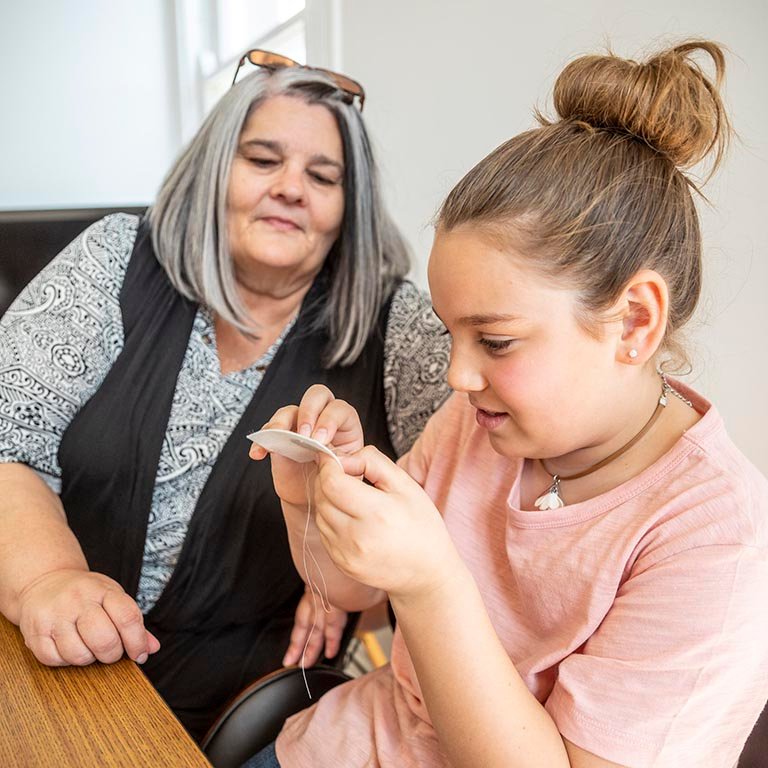
But then a few years after Sayiah, I had the chance to do it again, and I decided to work with Josie, Rachel’s daughter. Josie has really grabbed on to it. She really loves the arts, and she loves beading. I think she loves learning about where beadwork comes from and it also gives me a chance when we’re beading to talk to her about other things. While we work, she’s trying to teach grandma the language. She’s done the language camp for 5 years now, so she’ll say words to me and then I mess them up and then she corrects me, and I try to say it again. So we’re not only working on beadwork. We’re working on other parts of our culture, too, while we’re sitting together. And then I’ll tell her stories, because even my story, from when I was younger, that’s part of our history. What you girls are doing at Miami University is becoming our history, and it’s a huge part of our history. Our history is being made right now.
We were at one of the meetings at CREO [Cultural Resources Extension Office in Fort Wayne, IN] last summer, and a woman came up to me. I was just sitting watching lacrosse, and she wanted to ask some questions. She had some questions about beading, and she had brought her beading with her. So we were sitting there, which was really great to sit there and teach her. I let her know that because I’m self-taught my way of doing it is my way of doing it. So everyone can do something different and it will be beautiful.

What else do you want people to know about you and your art?
I hope that I can continue this and continue working with our people and the kids and that’s why I’ve always done what I do. When I had Robert, my oldest and he started to go off to school, and I thought, how could I make it easier for him to identify as a Miami young man? to talk with other kids in his class about who he is so that he doesn’t lose that? When I was at the Myaamiaki Conference last year, and I’m not sure who said it. But you had the students on the dais, and a young man that said “I always knew I was Miami. But now I know I’m Myaamia”. That hit me so hard. That is the most profound statement I think I’ve ever heard, I mean from within our people.
I don’t want my kids growing up, and my grandkids just knowing that they come from Miami people. I want them to be a Myaamia person. I want them to grow up knowing who they are. And so when Robert went to school, I thought, I’ve got to start doing school programs and let these children know that–we are still here. It’s easier for my children, each time you go out and you educate someone to the fact that we are still here, and that yes, we’ve lost a lot of things. We pushed them to the side for survival and now we have the chance to remind them that we’re here. We never went anywhere. We still are working on these things. So that’s why I started doing school programs. And I did that for about 30 years and still do that. So that to make it easier on those generations coming up.
 Aacimotaatiiyankwi
Leave a comment