In August 2022, we announced the receipt of a grant from the Robert Wood Johnson Foundation intended to develop a conceptual understanding of, and a tool to measure, living well for Myaamiaki. Recently, Stella Beerman of the Myaamia Center posted an update on that project.
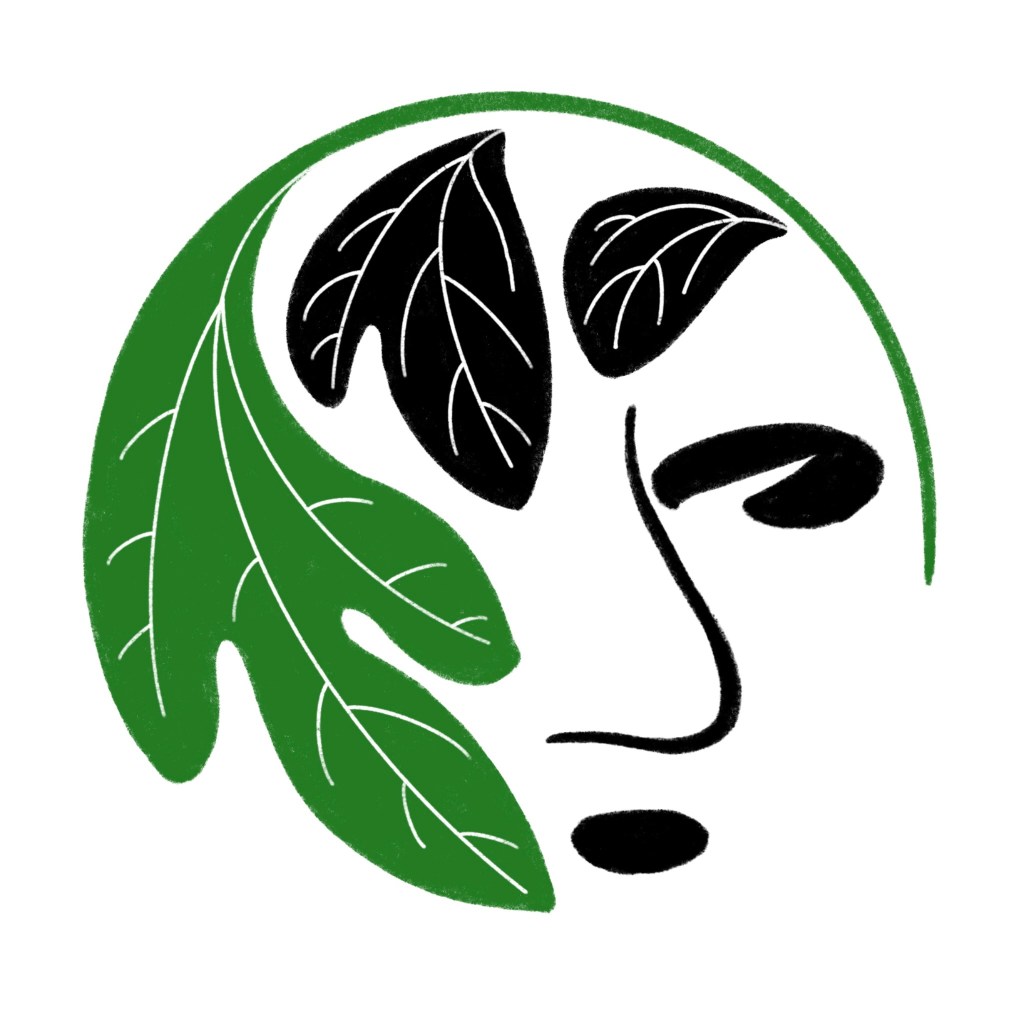
Out of this growing body of work has emerged a new image, created by Megan Sekulich, that we intend to use within educational and outreach programming to help Myaamiaki understand what wellness means from a Myaamia perspective. In this blog post, we will describe the meaning behind the imagery.
Significance of Imagery
In creating an image that corresponds to the wellness model, it was important to us that we capture something that connects to the 3 components of wellness, is recognizably Myaamia, and has ties to a cultural perspective on wellness. While we went through many drafts, we ultimately settled the following image.

Sassafras leaves
The three leaves within this image depict those of the mankiišaahkwi ‘sassafras’ tree, which we intentionally chose because our community knows it as mankiišaahkwi ‘the medicine bush’. We chose three leaves to correspond to the three components of nahi meehtohseeniwinki, which I will go into more depth on in a future blog post.
Sassafras, specifically, has been purported to have many health benefits, with the oil from the sassafras roots being used as aromatics, stimulants, diaphoretics, diuretics, aseptic and astringent.[1] Tribal elder Barbara Mullin told Dr. Michael Gonella (botany consultant for the Myaamia Center) during a visit in the early 2000s[2]:
“My grandfather said on the first day of February that you had to have a cup of sassafras every day through the month of February and then you would not be ill all year . . . And he lived to be 93.”

This comment from a late tribal elder points to the knowledge that moderation is important when using sassafras since large doses can lead to health complications, including problems with circulation and breathing.[3] In fact, the FDA cautions against the use of sassafras as it contains a chemical compound called safrole, which the FDA considers a carcinogen and toxic to humans. At the same time, the FDA does acknowledge that there is limited research on the plant to make any conclusive claims.[4] Regardless, it is important to remember knowing the proper ways to cultivate and use this plant as an extension of myaamia knowledge that has been passed down through generations.
Central Concepts and the Color Green
Understanding wellness in the context of Myaamia language and culture requires an understanding of two central components that serve as foundational concepts for Myaamia wellness. Additionally, the color green used in this logo also has a deep historical and cultural context which we will explain below.
The myaamia word for health comes from the stem pelakii– which means both ‘heal’ and to ‘be in a good condition’. We see this in words like peelakiita ‘s/he is cured, healed’, aancipelakiita ‘s/he makes life change, improvement,’ and peelakiihenci ‘liberate him/her, make whole.’ The commonality across these examples is that health is a process in which people are striving for improvements and making intentional changes to strive for holistic wellbeing. The stem pelakii-, when inflected as a noun, is pilakioni and can be translated as a general notion of ‘health.’
A second concept that is central to our understanding of wellbeing, in our language is captured by the stem aweem– which means ‘be related’ and ‘be grateful’. We see this concept in words like eeweemaki ‘I am related to him,’ nintaweemaakana ‘my fellow tribesman,’ or eeweenkiita ‘s/he is thankful.’ Across these terms, we recognize that relationships and gratitude are embedded in everything we do. After all, we often greet one another with aya eeweemilaani ‘hello my relative.’ When this stem is inflected as a noun, as in aweentioni, it is generally translated as meaning ‘peace.’ The concepts embedded in both pilakioni ‘health’ and aweentioni ‘peace’ make up the inseparable and foundational notion of wellness from a Myaamia cultural perspective. These two concepts together form the idea that we, as humans, must always strive to achieve nahi meehtohseeniwinki ‘living properly, well’.
A person who attempts to live out their lives as a Myaamia person cannot live properly without the practice of healing or without relationship building and maintenance. These two concepts of health and peace are inextricably linked.
The color green was historically used as a symbol of peace and strengthening relationships within our community and externally in diplomacy with other nations. Many times when we would declare peace with other tribal nations, we would present them with something (a blanket or pipe, for example) that incorporated the color green on it to symbolize peace and maintenance of the relationship. In one recounting of a speech given by a Myaamia leader in order to make peace with another community, we presented a beaver blanket with a green circle in the middle along with the following translated statement,
“Brothers: We perceive that your country is all smooth and clear like this blanket, and that your hearts are good, and the dwellings of your governors are like this green painted spot in the middle of the blanket, which represents the Spring in its bloom.” [Gave the beaver blanket.]
We continue the tradition of using color and images to express ourselves and have chosen the color green as the circular outline of the image with the sassafras leaves to represent the interconnected notions of health and peace/relatedness.
Community Symbol
Finally, we decided to use a face inspired by the community symbol that was originally created by Julie Olds within the center of the circle. Together with the sassafras leaves we hope these two images are identifiably Myaamia in the context of our wellness model. We also hope this symbol represents the fact that this entire notion of wellness is rooted in the community itself. Without our community, knowledge, and value system, we would struggle to retain our unique identity as myaamia people and would not be able to engage with the world around us as a distinct culture. The community and its health serve as the central unit that unifies this entire notion of wellness.

Be on the lookout for this image across various programs, educational initiatives, and on signage moving forward. After all, nahi meehtohseeniwinki is simply the process of living life in a good and proper way, so it’s part of everything we do as a Myaamia community.
[1] Coulter, S. (1932). Pharmacology of the medicinal agents in common use. Indianapolis, Indiana
[2] Gonella, M.P (2003-2006). Field Notes.
[3] Coulter, S. (1932). Pharmacology of the medicinal agents in common use. Indianapolis, Indiana
[4] Ajmera, R. (2019, May 3). Sassafras tea: Health benefits and side effects. Healthline. https://www.healthline.com/nutrition/sassafras-tea-benefits#benefits
[5] William Trent, Journal of Captain William Trent from Logstown to Pickawillany, A.D. 1752., ed. Alfred Thomas Goodman (Cincinnati: W. Dodge, 1871), 96.
Updated Nov 28, 2023


 Aacimotaatiiyankwi
Leave a reply to Kristen Morio Cancel reply