
As peepoonki ‘winter’ transitions into neepinwiki ‘summer’, many Myaamiaki ‘Myaamia people’ have closed their siihsipaahkwikaana ‘maple sugar camps.’ Maple sugaring season tends to be during Mahkoonsa Kiilhswa ‘Young Bear Moon’ and Aanteekwa Kiilhswa ‘Crow Moon’ which roughly corresponds with January through April on the Gregorian calendar.

During this time of the year, temperatures tend to rise during the day and drop at night. The temperature change causes ahsenaamišipowi ‘sap’ to flow from the roots of the trees up to the branches and back down. Once collected, the sap is boiled until most of the water has evaporated, leaving a sweet syrup or sugar behind. It typically takes 40 gallons of sap to make one gallon of syrup.
This year, the Myaamia Center (Oxford, Ohio), the Cultural Resources Office (Miami, Oklahoma), and the Cultural Resource Extension Office (Ft. Wayne, Indiana) each hosted their own sugar camps.

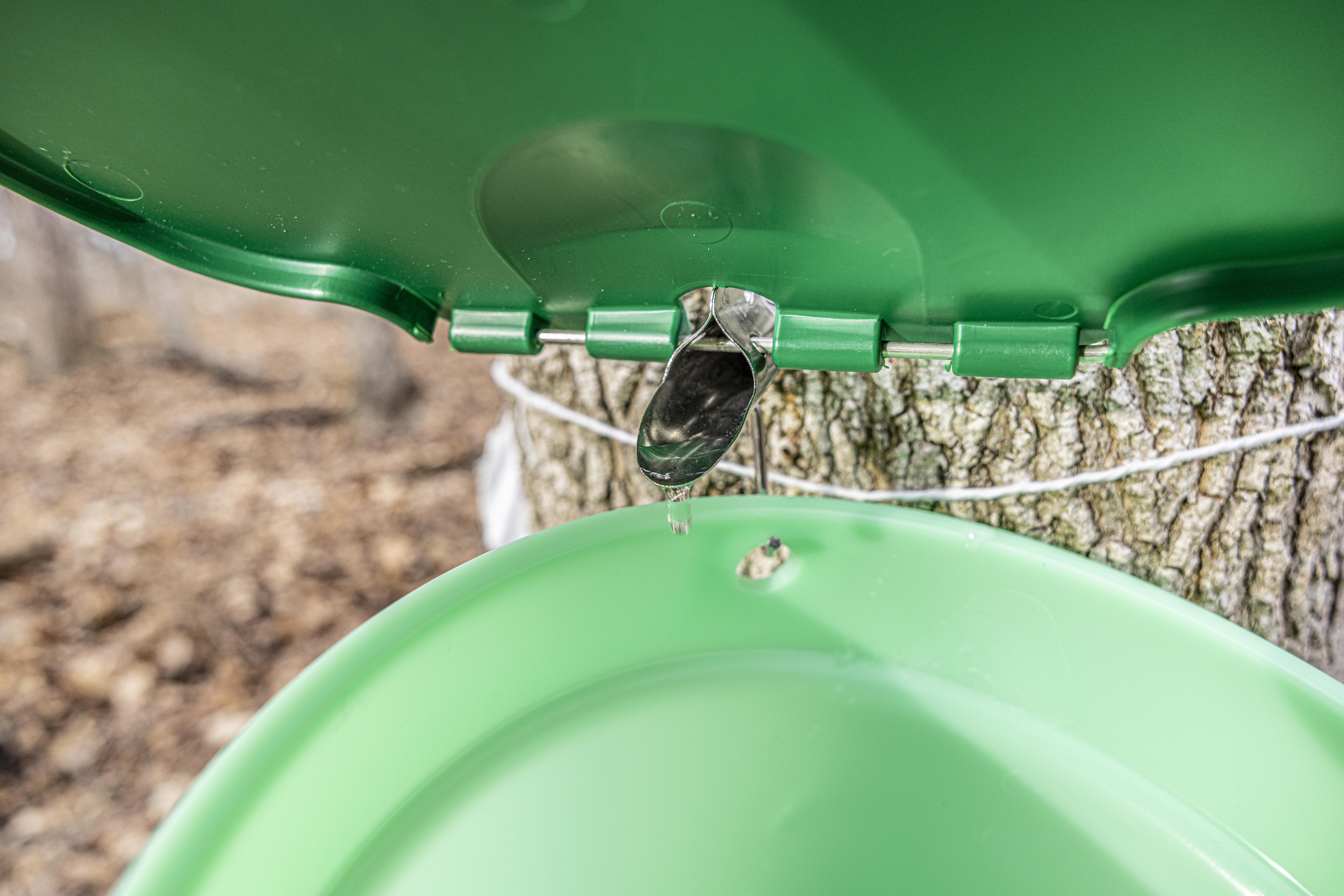
For over 10 years, Myaamia Center staff and Myaamia Heritage students have tapped ahsenaamiša ‘sugar maple trees’ on Miami University’s campus. This year, we collected around 50 gallons of sap which were processed into roughly 1.25 gallons of syrup. We experienced an unseasonably warm winter that did not provide the needed temperature changes for strong sap flow. All of us at the Myaamia Center are looking forward to our annual pancake and waffle feast where we share and enjoy the fresh syrup with the campus community.
In Miami, Oklahoma, there is a lack of sugar maples available locally for tapping. Instead, the Cultural Resources Office (CRO) staff has worked with the Peoria Tribe’s Cultural Preservation Department and the Oklahoma State University Department of Horticulture and Landscape Architecture to tap black walnut trees. Tapping black walnut is similar to sugar maple, with some differences in processing the sap into sugar and syrup. Black walnuts tend to have a smaller yield, closer to 50 gallons of sap to 1 gallon of syrup ratio rather than the maple’s 40:1 ratio. The CRO collected around 250 gallons of sap, which they processed into low and high-sugar-content syrups, a paste, and sugar.
Over at the Cultural Resource Extension Office (CREO), staff tapped three different types of trees; silver maple, amur maple, and black walnut. Around 11 gallons of sap were collected from the silver maple and 14 gallons from the amur maple, these were combined and processed into seven pints of syrup. Nearly 11 gallons of walnut sap were collected to produce three pints of syrup which was the favorite flavor for CREO staff to try. Like the Myaamia Center, both the CRO and CREO experienced warmer winter temperatures this year, resulting in smaller sap yields than usual.

Despite the small collections, we are still looking forward to enjoying this syrup throughout the year. Neewe ‘thank you’ to those who spent the past several weeks collecting and processing sap to share with the community throughout the summer months. Did you set up a sugar camp this year? Be sure to tell us about it in the comments below!

 Aacimotaatiiyankwi
Leave a comment