
Myaamia History on Lake Michigan’s Southern Shores
Introduction
Myaamionki, ‘The Miami Homelands,’ is the place, or places, that Myaamiaki ‘Miami people’ have called home. The core of Myaamionki has been the Waapaahšiki Siipiiwi ‘The Wabash River’ and the valley where it sits. Historically, this valley has had the most significant influence and the most substantial population centers of Myaamiaki. Our homelands stretched from what are now the states of Michigan and Indiana, west to Illinois and Wisconsin, and east into Ohio. Depending on the period, Myaamiaki moved to different areas based on warfare, quality of the land, forced removals, and other reasons.1 In a post-contact world of heightened competition, the predominant reason for relocation was violence. Over this post-contact period, Myaamiaki actively moved from region to region within the lower Great Lakes. The Saakiiweesiipiiwi ‘St. Joseph River,’ a tributary of Kihcikami ‘Lake Michigan,’ is the river of our origin, and was often referred as the “River of the Miamis.”2 One of the important regions of Myaamionki has been along the southern shores of Kihcikami and in the general region around Kinwikami ‘Calumet River’ and Šikaakonki ‘Chicago.’3
When researching the early recorded history of our people, we are forced to use limited sources that often have low levels of reliability. French Jesuits often had trouble differentiating various groups of Native peoples, and, at times, struggled to understand the languages, cultures, and societal practices of the people they encountered.1 Historians writing about this period (1640-mid 1700s) are forced to rely on limited fragments of a seventeenth-century world ravaged by disease, famines, warfare, and massive human displacement.2 Each of these influenced Myaamia life near southern Kihcikami.
Moving West: Beaver Wars and French Interactions
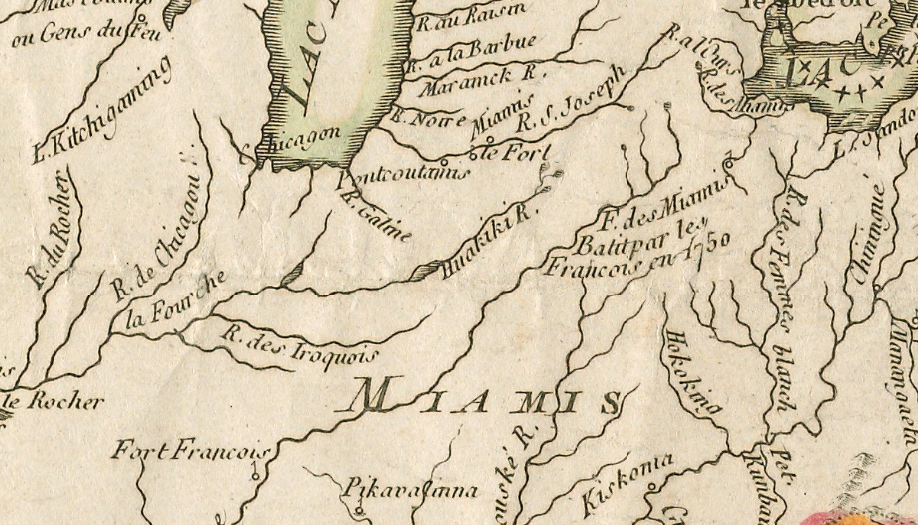
Large political shifts and an influx of guns through British and Dutch trading enabled the Haudenosaunee to increase their incursions into the western Great Lakes and Myaamionki.6 These repeated invasions west forced Myaamiaki to seek refuge among related tribes on the edges of their far western homelands. French colonists first encountered Myaamiaki along the Fox River in today’s Wisconsin, where we were living with relatives such as the Mascoutens.7 Familiarity with this region west of Kihcikami was aided by Myaamia relationships with Mascoutens and our siblings, the Inohka ‘Illinois’.

1755 Map created by Jacques Nicolas Bellin. This map shows Pays d’en Haut from a French perspective and where the Miami and our once close relatives and neighbors, the Mascoutens, lived.
As the French influence began to stretch further into Illinois and Indiana, later interactions between Myaamiaki, Jesuit missionaries and French people would continue. French explorers, traders and missionaries recorded almost continuous movements of people throughout the Great Lakes. The constant turmoil and ever-changing political landscape of the time resulted in a great deal of Myaamia settlement near Kihcikami. For example, Father Allouez recounted that in the 1670s, a large population of Myaamiaki moved near the Kankakee-St. Joseph portage in southwestern Michigan. Then in the early 1680s, Sieur de La Salle, likely alongside our Inohka and Shawnee relatives, convinced hundreds of Myaamia families to move to his post called Fort St. Louis in north-central Illinois along the Illinois River.8 Around this time, another Myaamia village was formed at the junction of the Kankakee and Des Plaines Rivers following dispersals from a larger Myaamia contingent that collectively began to move eastward and northward.9 Records of both Myaamiaki moving to the French, and French people moving to where Myaamiaki were located are present in the historical record. The more common of the two events is the latter, while the former only occurred in a few instances where the French invited Myaamiaki and other nations to increase the size of their coalition against British backed Haudenosaunee.
Šikaakonki ‘Chicago’ is another example of Myaamia settlement near southern Kihcikami.10 In 1696, Father François Pinet established the Guardian Angel mission near a village predominantly occupied by Myaamiaki.11 This site, along with records and a dictionary written by Pinet, has aided in understanding Myaamia history and the revitalization of Myaamiaataweenki ‘The Miami Language.’ Linguistic records such as these show traditional names for this region and confirm our established relationships to these places.
Records of Myaamiaki living near and around the Kankakee, Illinois, Chicago, Des Plaines, Calumet, Little Calumet, and St. Joseph Rivers, all near the southern shore of Lake Michigan, signify the regular presence of Myaamiaki there. Continuous relocations took place at times just a few years apart. As a significant Myaamiaki population lived around Chicago and the Illinois River valley in the 1690s and early 1700s, other groups of Myaamiaki were moving to the Kankakee, Calumet, and St. Joseph’s Rivers in a reversal of migrations, back to the east. Analyzing the placement of villages on the Kankakee, Des Plaines, St. Joseph’s, and Wabash River, the core of Myaamionki in the early 1700s was the northeast of the state of Illinois, southern Michigan, and northern Indiana.12 The Calumet Region, stretching from Chicago, south to Indiana Dunes and eastward to the St. Joseph River was a key part of Myaamionki in the early 18th century.

This map shows Miami villages scattered west, south, and east of Ft. Chicago throughout the last decades of the Beaver Wars. Miami villages are signified by a green triangle with “MI” next to them. Tanner, Atlas of Great Lakes Indian History, pages 32 and 33.
A Myaamia Worldview
Myaamiaki were not the only ones impacted by war, disease, instability, and displacement. Myaamia relationships with neighboring people created complex networks and living arrangements. Myaamiaki concepts of territory and homelands conflicted with colonist maps drawn with firm borders and defined ownership. In other words, Myaamionki ‘the Miami homelands’ was not exclusive to Myaamiaki.
Rather than exclusive ownership of territory with firm borders, kinship networks–based on marriage, cultural and linguistic ties, and, more simply, proximity–shaped Myaamionki. The Inohka ‘Illinois’ were younger siblings, and the Waahoonahaki ‘Potawatomi’ and Šaawanooki ‘Shawnee’ were seen as elder siblings. These relationships continue today. Understanding them aids in the interpretation of texts that explain our history. For example, Myaamiaki and Waahoonahaki had neighboring villages near South Bend, Indiana, along the St. Joseph River where our “Coming Out Place,” or place of origin is. Recognizing the layered ownership of various places, Myaamiaki viewed many places as co-inhabitable. As clarified in a recorded conversation between Pinšiwa (Myaamia) and Five Medals (Waahoonahaki), the point of view that the Waahoonahaki were the elder siblings, resulted in Myaamia conceptions of how to label or title shared spaces.13 Since neighboring villages shared this area at St. Joseph, and our elder siblings were there, we recognized the layered connections while passing the title to the Waahoonahaki.
Miamis on the St. Joseph. Eliot, 1783.
Like our relationship with our relatives the Waahoonahaki, shared spaces were common and, in many areas, the norm. This was to protect from invasion, increase security, and build kinship networks. Myaamiaki used kinship networks for social, political, and security advantages to create alliances and networks that protected many Great Lakes tribes from violence seen during the Beaver Wars and, eventually, American military invasions. These networks created an intricate system of shared communities and spaces that do not match our current American understanding of land ownership. Myaamiaki may have been the primary stewards of the Wabash River Valley for most of post-contact history before removal, but this does not mean other people did not consider this area their extended homelands. This is how one can explain such overlapping homelands within Myaamionki and neighboring communities. Boundaries were placed during treaty-making to take land and destroy these kinship networks.
Continuing Connections to Kihcikami
Conflicts, plagues, alliances, and natural migrations of people have impacted where we Myaamiaki have lived. Moving west during the Beaver Wars of the 17th century (Check out this blog post on the Beaver Wars and Treaty of Montreal, 1701, by George Ironstrack) and back east until our forced removal in 1846, the shores of Kihcikami remained a place for villages and travel for hundreds of years. Citing the recent recognition given to the Miami Tribe of Oklahoma at Indiana Dunes National Park on the Indigenous Cultures Trail, our connection to our Kihcikami homelands remains strong.14 Hundreds of Myaamiaki still call the southern shores of Kihcikami and the states of Illinois and Michigan home. This connection to the region, shared with numerous other federally recognized tribes, means it remains and will forever be a shared place.

British Map, Dated 1754.
Strengthening our connections to Myaamionki is a never-ending effort for the Miami Tribe of Oklahoma. We work to continually increase cultural knowledge and social outreach to maintain and grow our understanding of our history and culture. For further information regarding Myaamia history, please reference more articles here.
- Hunter, Diane. The History and Archaeology of Fort Ouiatenon: 300 Years in the Making. Purdue University Press, 2024. Chapter 9: Myaamiaki (Miami People): A Living People with a Past. In this chapter, former Miami Tribe of Oklahoma Tribal Historic Preservation Officer Diane Hunter provides a condensed history of Myaamionki, Myaamia movements within the Lower Great Lakes, and the many villages that existed there. Notably around the southern shores of Lake Michigan. ↩︎
- Jacob E. Lee. Master of the Middle Waters: Indian Nations and Colonial Ambitions along the Mississippi. Harvard University Press, 2019. Page 89: “At the turn of the eighteenth century, some Miamis lived on the southwest shore of Lake Michigan, near the mouth of the St. Joseph River, which early French travelers called the “River of the Miamis.” ↩︎
- Pierre François Xavier de Charlevoix (1682-1761), in 1721, during his stay at Fort Saint-Joseph in August and September, he studies the Miami Tribe and writes “Fifty years ago the Miamis were settled on the southern extremity of Lake Michigan, in a place called Chicago, from the name of a small river that runs into the lake.” ↩︎
- Tracy Neal Leavelle. The Catholic Calumet: Colonial Conversions in French and Indian North America. University of Pennsylvania Press, 2012. Page 11. ↩︎
- Robert Michael Morrisey. People of the Ecotone: Environment and Indigenous Power at the Center of Early America. University of Washington Press, 2022. Pages 179, 205. ↩︎
- Parmenter, Jon. The Edge of the Woods. Michigan State Press, 2010. Mourning Wars, Pages 45-46. Dutch and English are growing suppliers of arms for the Iroquois Confederacy and shifting foreign policy and relations resulted in widespread violence and human replacement campaigns. Parmenter also argues that mourning wars to replace lost people were more of an indigenous reason for military campaigns rather than Dutch or British coercion. ↩︎
- Richard White. The Middle Ground: Indians, Empires, and Republics in the Great Lakes Region, 1650-1815. Cambridge University Press, 1991. Pages 6-9. Page 6, “In the 1660s, the Miami and Mascouten refugees who had settled inland from Green Bay invited Nicolas Perrot and a companion to visit them.” ↩︎
- Cartographer Jean-Baptiste Louis Franquelin drew a map in 1684 with information provided by La Salle that helped to place people from various tribes in specific locations and with estimated population numbers. ↩︎
- Temple, Wayne C. 1977. Indian Villages of the Illinois Country. Scientific Papers Vol. 2, Part 2. Illinois State Museum, Springfield. Pages 57-61. Marquette, Allouez, La Salle, Hennepin, and others, document Miami people throughout the regions around the southern, western, and eastern shores of Lake Michigan, as well as areas in present day Michigan, Illinois, Indiana, and Wisconsin. ↩︎
- Michael McCafferty, “A Fresh Look at the Place Name Chicago,” Journal of the Illinois State Historical Society, July 1, 2003. “The term that we today write “Chicago” is a French spelling that represents “šikaakwa,” the word for the striped skunk in Miami-Illinois, and Eastern Great Lakes Algonquian language.” “Šikaakwa also translates to “Wild Ramp’’ in Myaamiataaweenki, which was a plant common in the wetlands along the shores of Lake Michigan. This further emphasizes our physical connection to this place and also shows French recognition of our presence there. ↩︎
- Grover, Frank R. (Frank Reed), b. 1858; YA Pamphlet Collection (Library of Congress), Father Pierre François Pinet, S. J., and his Mission of the guardian angel of Chicago (L’Ange gardien) 1696-1699. Page 164-. ↩︎
- Tanner, Helen H. (editor) 1987. Atlas of Great Lakes Indian history. University of Oklahoma Press, Norman. Maps of village placements on Map #6, pages 32-33, and Map #9, Pages 40-41.
↩︎ - William Hypolitus Keating. Narrative of an expedition to the source of St. Peter’s River, Lake Winnepeck, Lake of the Woods, &c. &c. performed in the year 1823, by order of the Hon. J.C. Calhoun, Secretary of War, under the command of Stephen H. Long, Major, U.S.T.E. Page 93. “When the Miamis first met with the Potawatomis, they applied to them the title of younger brothers; but this was afterwards changed, and their seniority acknoledged, from the circumstance that they resided further to the west; as those nations which reside further to the west of others are deemed more ancient. This was settled in a council of the two nations, held sometime after their first meeting; the Potawatomis being at present acknowledged and styled elder brothers, and the Miamis younger brothers: But the council fire is always held with the Miamis.” ↩︎
- https://www.indianadunes.com/explore-the-dunes/experiences/indigenous-cultural-trail/
↩︎

 Aacimotaatiiyankwi
Leave a reply to BREND Cancel reply