Written by: Andrew Sawyer, Myaamia Center
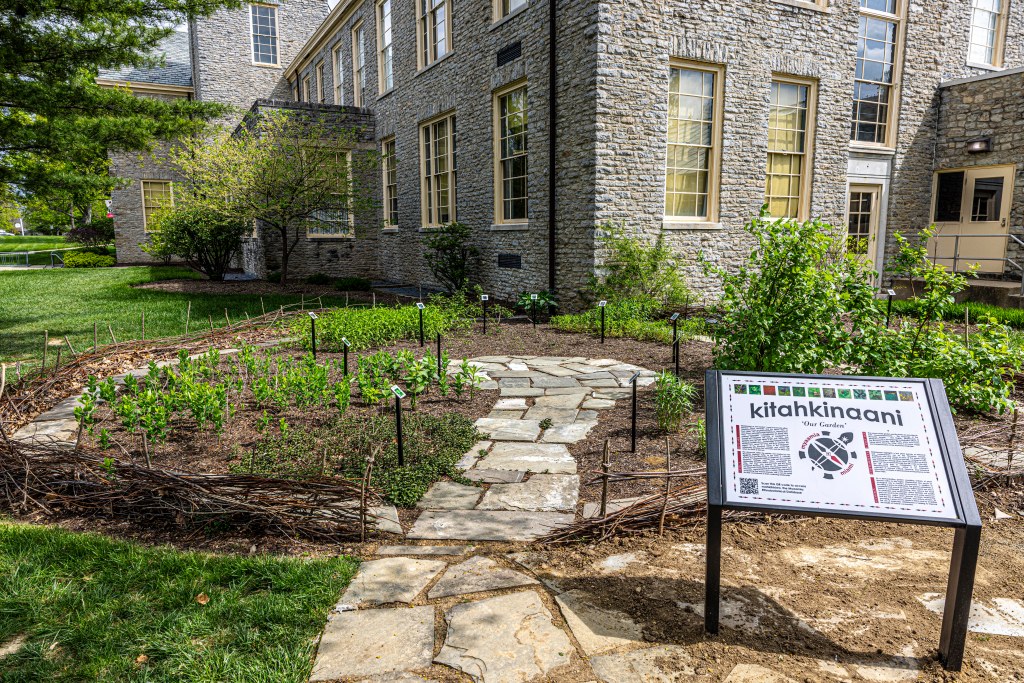
In the spring of 2021, the Myaamia Center began working with Dr. Sarah Dumyahn and students in her Sustainability in Practice course to develop a Myaamia Demonstration Garden on Miami University’s Oxford campus. Two of the primary goals of the project were to provide opportunities for Myaamia students to further engage in their tribal heritage while on campus and also for non-Myaamia students to learn more about indigenous plants, especially some that are culturally significant for Myaamiaki ‘Myaamia people.’
In order to do this they proposed that their class would design and build, and future classes would maintain a garden on campus that includes plants indigenous to the area that are documented in mahkihkiwa, the Myaamia Ethnobotanical Database. Along with the inclusion of indigenous plants, the students also wanted to focus on environmentally friendly and sustainable gardening practices, which they felt could best be demonstrated by including plants native to the area that were common before the use of modern fertilizers and pest repellants.
Working with Miami University’s Physical Facilities department, the students identified a location adjacent to the Boyd Hall greenhouse on the Western Campus that offers the amenities needed to maintain a garden and would not obstruct university grounds crews as they worked there. Once this was identified, the students and staff began the work of removing the sod and preparing the area for planting. The students also wanted a Myaamia name for the garden. Working with the Office of Langauge Research at the Myaamia Center, the term kitahkinaani ‘our (inclusive) garden’, was chosen to recognize that this garden was for everyone to appreciate. Once all of this preliminary work was taken care of the students began the process of planting.


The plants selected for the garden have many uses including medicinal and edible. The name of the garden and the plants within it are labeled both in Myaamiataweenki ‘the Myaamia language’ and English on the garden signage that was also designed by the students, with a QR code linking to each plant’s entry on mahkihkiwa for visitors to learn more about how they were used.

The initial planting of kitahkinaani included twelve plants, with wiinhsihsia ‘nodding wild onion,’ and ateehimini ‘wild strawberries,’ and wild ginger being added this past year.
Plants included in kitahkinaani are:
| Myaamia Name | Common Name |
| – | Wild bergamot |
| – | Wild ginger |
| aahsanteepakwi | Wild grape |
| ahsapa | Dogbane |
| ateehimini | Wild strawberry |
| eepiihkanita | Groundnut |
| kiišiinkwia | Ironweed |
| leninši | Common milkweed |
| maamilaniwiaahkwia | Pokeweed, pokeberry |
| makiinkweemina | Blackberry |
| neehpikaahkwi | Red osier dogwood |
| oonsaapeehkateeki | Sunchoke, Jerusalem artichoke |
| peecihsakahki | Peppermint, wild mint, mentha spp. |
| wiinaahkatwi | Spicebush |
| wiinhsihsia | Nodding wild onion, nodding onion |

Kitahkinaani serves multiple roles, including teaching visitors about the history and culture of the Miami Tribe and their relationship with Miami University, the ongoing language and cultural revitalization efforts of the Tribe, the cultural significance of each plant, and the ecological importance of native plants and sustainable gardening. They also hope that this will be a resource that more instructors and organizations across campus will be able to incorporate into their courses and programming.
For Sarah Dumyahn’s Sustainability in Practice students, kitahkinaani provides an opportunity for learning outside the traditional classroom. Spring 2024 student Anna Finkell reflected on working in kitahkinaani: “I have always liked gardening because it was something my mom and I did together a lot when I was younger. I chose this project partially because of that aspect and because I was interested in learning more about the Myaamia people and culture. This project allowed me to learn a lot more about the language and culture of the Miami Tribe that I would not have known otherwise. I hope kitahkinaani will continue to grow in the future and become a meaningful resource for the Myaamia community as well as Miami University.”

These sentiments have been echoed by many of the students who have worked on various aspects of kitahkinaani and had a chance to interact with the Myaamia Center over the last three years. As kitahkinaani has started to mature and the need for maintenance, and possible expansion, of the garden has increased Dr. Dumyahn has been able to recruit additional volunteers from classes whose students were seeking out experiential learning opportunities. This has helped to broaden the exposure of kitahkinaani and expand the number of Miami University students who are learning more about the Miami Tribe, indigenous plants, and sustainability. This fall students from Dr. Matthew Zundel’s Italian Food Cultures in Context and Dr. Jacque Daugherty’s Synthesis and Action courses have also been helping with the garden efforts.
mihši neewe to Dr. Sarah Dumyahn and her students for designing and maintaining kitahkinaani and for helping get additional classes, including Dr. Zundel’s and Dr. Daugherty’s classes, involved, and to Jay Hammer and Miami University’s Physical Facilities department who have been instrumental in making space on campus for this effort and making sure we have the resources we need to maintain kitahkinaani.
If you get a chance to visit the Myaamia Center and Miami University we encourage you to take some time and visit kitahkinaani to see the work that the students, staff, and faculty have put into it.
 Aacimotaatiiyankwi
Leave a comment