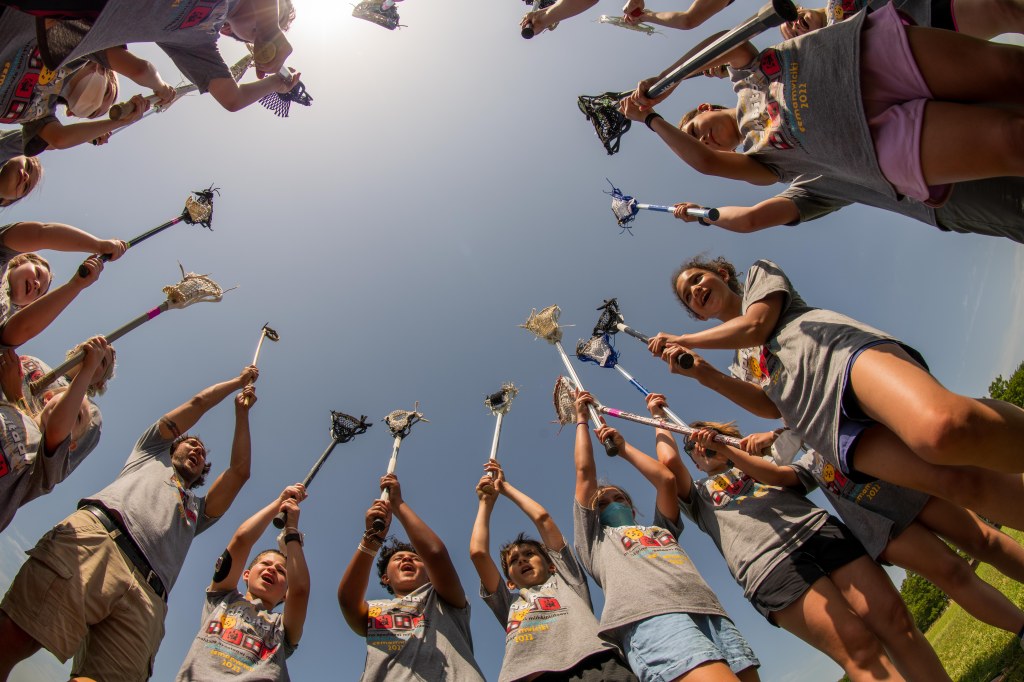
On June 28, 2019, almost sixty Myaamiaki ‘Myaamia people’ took to the field ready for a fierce game of peekitahaminki ‘stickball/lacrosse.’ For the first time in over two hundred years, each player was holding a wooden pakitahaakani ‘lacrosse stick’ made by a member of their community. The crowd quickly divided into two teams and gathered at the center of the ball field to hear a short speech that focused everyone on the importance of the day. It had taken over two decades of work to arrive at that day, and the positive energy generated by that game is still rippling forward, impacting the Myaamia community in a positive way.
What follows is a recounting of my personal experience participating in the revitalization of peekitahaminki ‘lacrosse’. I do my best to describe my role in this story, and the important roles played by other Myaamiaki as well as friends and allies from other communities. I apologize if I’ve left anyone or anything out of this story, and encourage community members who were a part of the process to correct or add anything through the comments feature on this blog.
More than two thousand persons assembled in a great plain, each with his own racket; and a wooden ball, as large as a tennis-ball, was thrown into the air. Then all that could be seen was the flourishes and motion through the air of all those rackets, which made a noise like that of weapons which is heard in a battle. Half of all those… endeavored to send the ball in the direction of the northwest, the length of the plain, and the others tried to make it go to the southeast; the strife, which lasted half an hour, was doubtful.
—Nicolas Perrot, 1667
Beginnings
In the mid-1990s, I began attending Myaamia language and culture camps with noohsa ‘my father’ George Strack. At these camps, I met many of the people who are still central to my life today as a Myaamia person. Daryl Baldwin, the primary teacher of Myaamiaataweenki ‘Myaamia language,’ was one of those people. At one of these early camps, Daryl asked Scott Shoemaker and me to help with organizing children’s games that we could play while using the language.
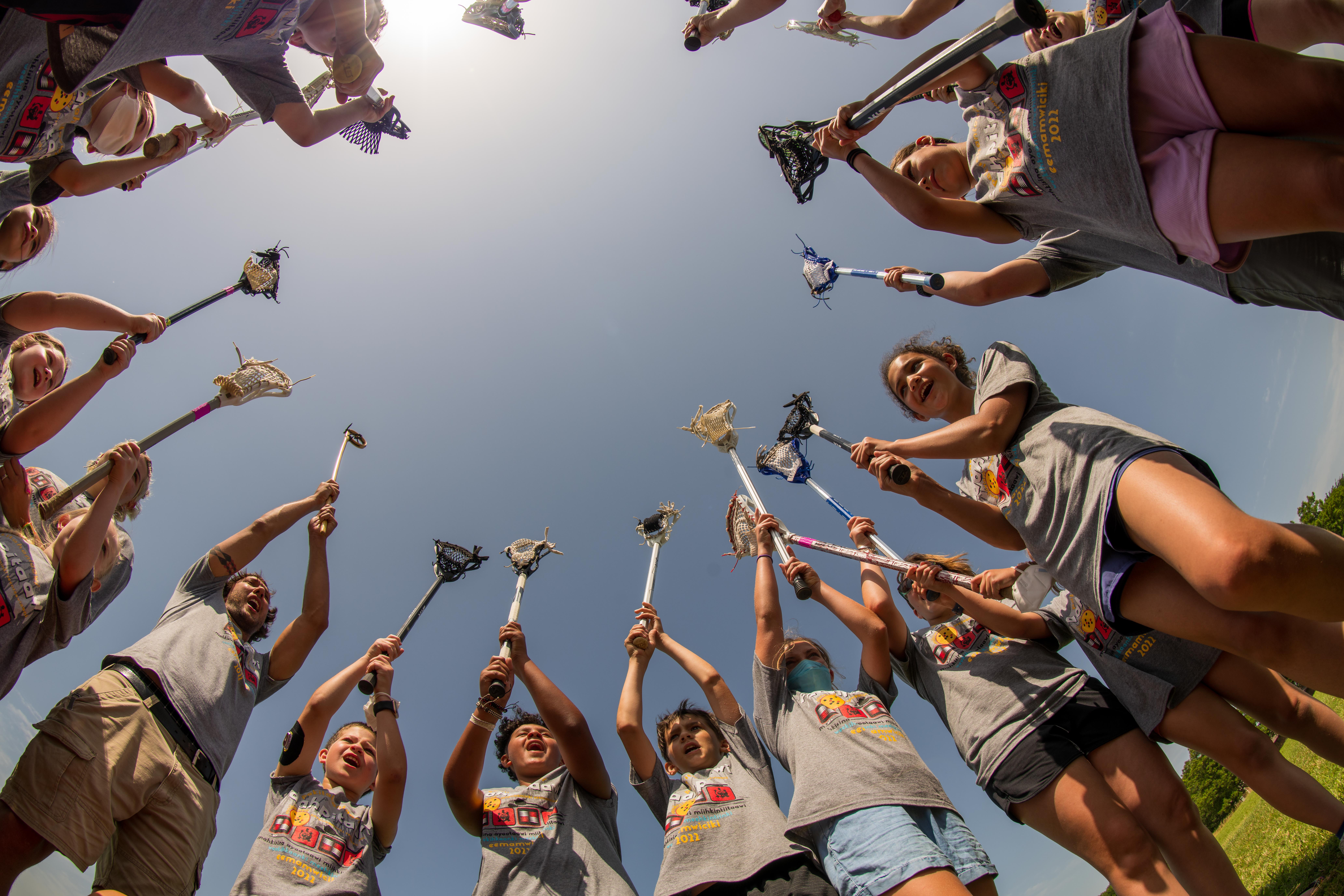
In the process of researching the history of Myaamia games, I bought a copy of Steward Culin’s Games of the North American Indians. Culin’s volume includes descriptions of many different Myaamia games. Each entry usually includes a short quote or snippet from a primary source describing Myaamia people playing each game. Culin’s book includes two quotes describing Myaamia peekitahaminki ‘lacrosse’ and many really good images of the type of pakitahaakana ‘lacrosse sticks’ used by our ancestors. 1 I remember being blown away by one of Nicolas Perrot’s quotes (see above). Over two thousand players in one game! Even if Perrot was exaggerating a little, which he likely was, it still painted an impressive picture in my imagination. At the time, we didn’t have the equipment necessary to teach peekitahaminki ‘lacrosse’ at our language camps, but the seed of an idea had been planted. This was long before YouTube and Amazon.com, so learning how to do something and acquiring the right equipment took a bit more effort than it does today.
A few years later, I began my studies to become a high school history teacher at the University of Illinois Chicago (UIC). One day, while walking to class on a crowded sidewalk, I spotted someone in the crowd wearing a backpack with a lacrosse stick threaded through the straps. I chased him down and asked where I could learn more about how to play lacrosse. This is how I first met Adnan Darr, who was just in the process of starting a lacrosse club at UIC. Despite having no experience, he invited me to come out and join the club’s first practices. Within seconds of picking up a stick, I was hooked. Adnan and other more experienced players taught me the basics of the game and connected me with mail-order catalogs where I could buy all the equipment needed to get started: stick, gloves, helmet, and other pads. It was also in these catalogs that I found instructional VHS tapes produced by US Lacrosse, which I purchased in order to deepen my knowledge of lacrosse fundamentals (yet another reminder of how the internet has changed things!).
First Steps in Community
The very next summer after I met Adnan and started playing at UIC, I brought what I was learning back to the Myaamia community. I quickly began to collect used sticks from local Play it Again Sports and eBay (which was brand new at the time). With this limited equipment and the little bit of experience I had gained, I began to teach others how to throw, catch, cradle, and shoot. When we played at our language camps, we did not use protective equipment, a practice that we maintain to this day.
With time, more community members bought their own sticks, and our pile of community sticks continued to grow. Within a couple of years, we had enough equipment to play fairly large games at language camps, pow wows, and other community gatherings.
We found that peekitahaminki ‘lacrosse’ was a really effective environment for teaching language. Our youth were often shy about using Myaamiaataweenki in a public setting. However, if you threw them onto the pakitahamahki ‘lacrosse field’ and told them that they weren’t going to get the ball unless they screamed “miililo” at the top of their lungs, then, sure enough, they’d be screaming “miililo” like their life depended on it within minutes of taking the field. Over the years, our peekitahaminki ‘lacrosse’ vocabulary has expanded, and if you come to one of our games, you’ll often hear folks yelling “naaši!” ‘get ‘em!,’ “maahanto” ‘scoop it,’ “ahtoolo” ‘put it (shoot it),’ and sometimes “ankihi” ‘kill ‘em!’ (said in a joking tone when someone needs a hard bump or stick check so they stop showing off).
By the time we started the Eewansaapita youth language and culture program in 2005, we had a solid group of young adult players and a really good sense of how to teach the game. We found pretty quickly that peekitahaminki ‘lacrosse’ was a big draw for our youth. Many of our young people, especially pre-teen and teen boys, told us that the game was a motivating factor for them to attend our camps. Eventually, they would fall in love with other aspects of language and culture learning, but peekitahaminki ‘lacrosse’ was the big hook that got them started.
Growth and Intertribal Competition
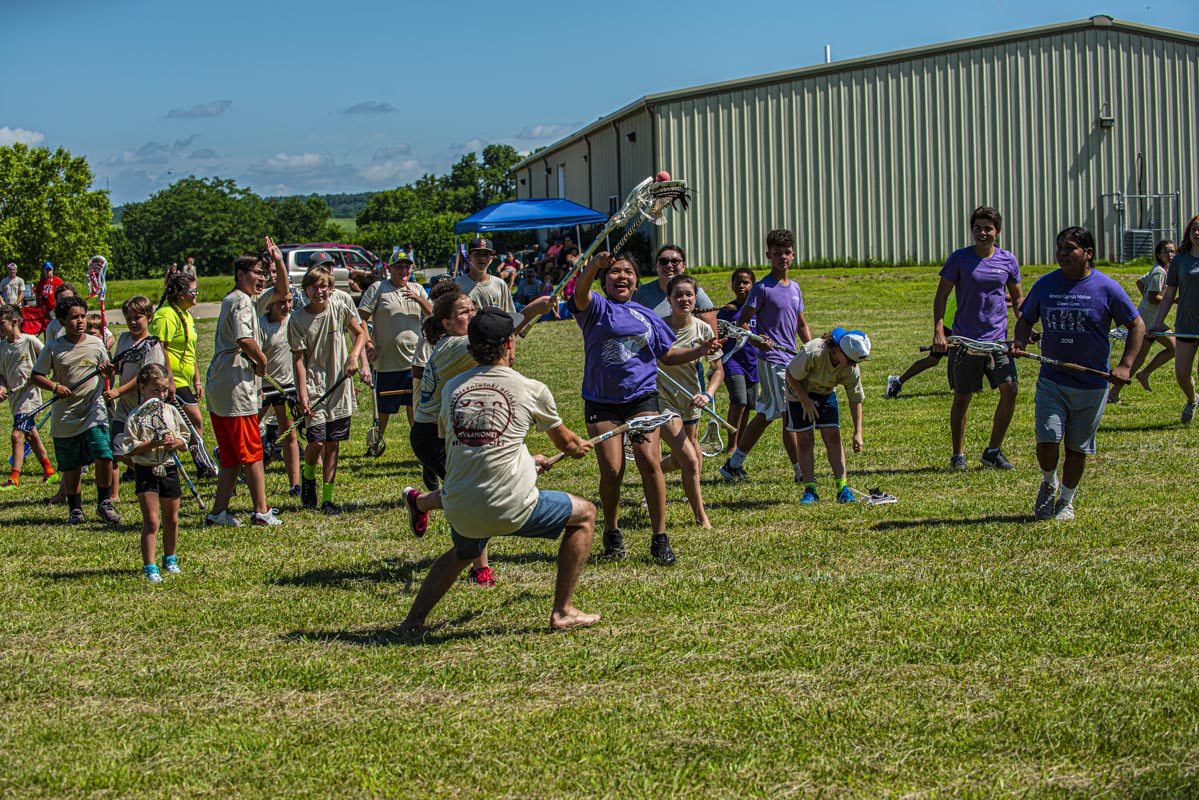
In the mid-2000s, our summer language and culture programs grew rapidly. This growth increased the number of Myaamiaki who would return to our homelands in Oklahoma and Indiana from our vast diaspora. As a result, our summertime games got bigger and more intense. Folks would often leave these games a little battered and bruised, but always looking forward to the next game. As youth who first learned the game at summer programs grew into young adults, the level of play in our community really took off. Some of the best games in our community occurred at Siipiihkwa Awiiki ‘Jane Drake’s House’ on the Miami Tribe’s reservation during the week of summer programs in Noošonke Siipionki ‘Miami, Oklahoma.’ These games occurred in the early evenings in the open yard under the pecan trees and drew in counselors and staff from the programs as well as other Myaamiaki who lived in the area. These games were half jokingly given the title of The Drake House Lacrosse League (DHLL) by tribal spouse Jonathan Fox. These Drake House games still happen every summer and continue to be known as the most competitive and hard-nosed peekitahaminki played in our community.
As our community increased in ability and desire to play peekitahaminki ‘lacrosse’, we were also presented with a new opportunity with one of our neighbors: the Seneca-Cayuga Nation. This opportunity developed because noohsa ‘my father,’ was serving our nation as Tribal Historic Preservation Officer (THPO) and through this work became friendly with Paul Barton, who was serving in a similar capacity for the Seneca-Cayuga Nation. The two of them came up with the idea of bringing together our youth language and culture program participants with their youth to play a game of peekitahaminki ‘lacrosse’. In 2012, the Seneca-Cayuga formally invited us to join them for a lacrosse game at their ball field on their reservation in Grove, Oklahoma.
These intertribal games include elements that help our youth learn about nation-to-nation diplomacy. Before the game, gifts are exchanged, ceremonial wagers are placed, and short formal speeches are given by representatives of each nation. This past summer, the elected leaders of each nation spoke about the importance of the friendship between our nations and the importance of the game.
In 2013, Seneca-Cayuga elder Patty Shinn made a beautiful yarn sash, which is used to keep a record of the game. Each year, the winner of the intertribal game was instructed to take the sash home with them and add a pin or some other marker to serve as a record of that year’s game. The sash is then presented prior to the start of each year’s game as both a record of the history of the game and a sign of the care required to maintain our nation-to-nation relationship. Sadly, Patty passed away in 2024, but the Myaamia community will never forget the important role she played in the establishment of this important game as well as how generous and kind she was to our people whenever we interacted with her in the Miami, Oklahoma area.
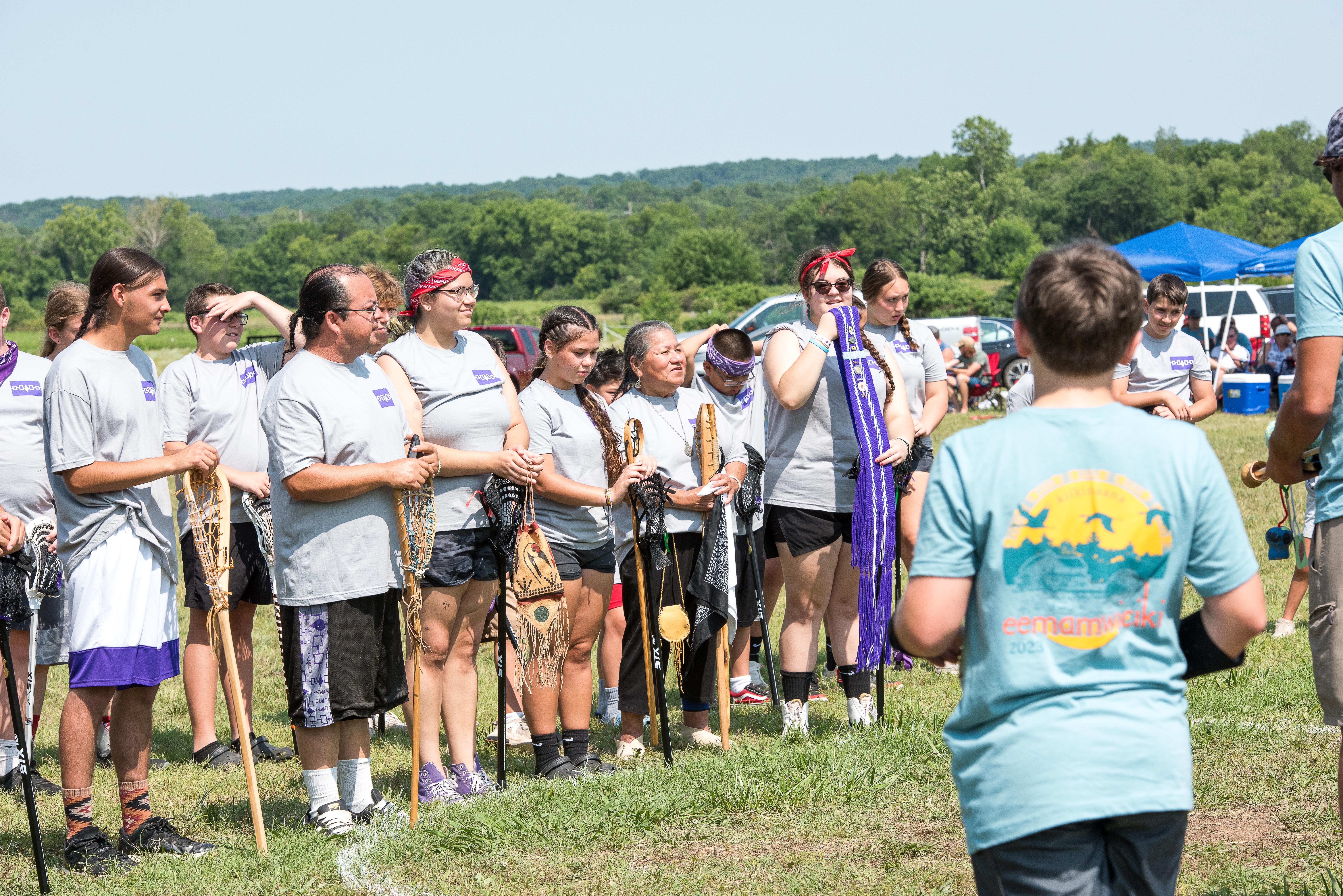
Our game with the Seneca-Cayuga took a break during COVID, but was brought back as soon as we resumed face-to-face summer programs. Peekitahaminki ‘lacrosse’ can get rough at times, but the game can help teach our youth that by competing together, we make each other stronger. Through this competition, we also hope that our youth come to see the similarities in our nations’ work to revitalize our languages and cultures.
Reclaiming Stick Making
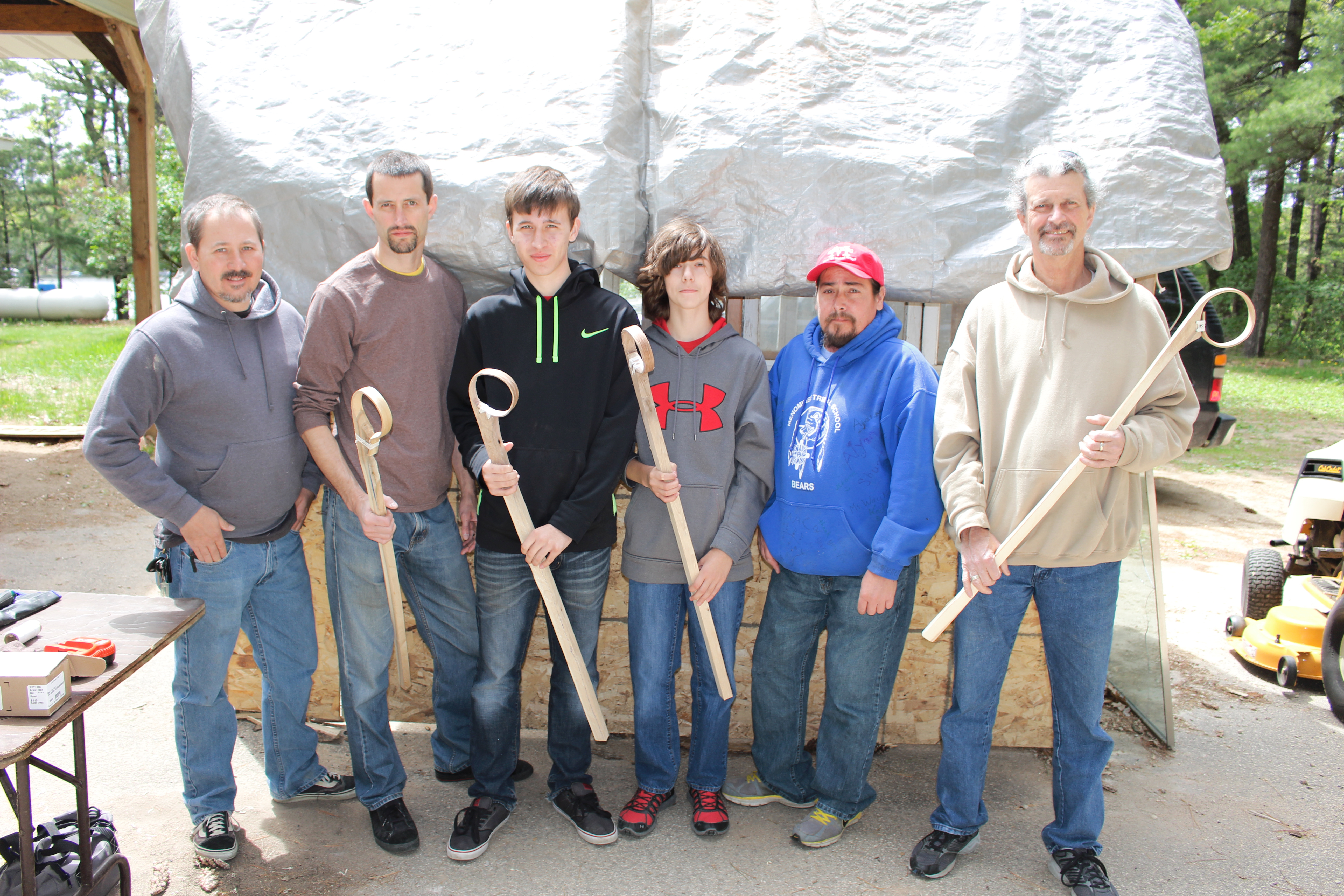
From the very beginning of our efforts to revitalize the game of peekitahaminki ‘lacrosse’, we knew that our community originally used the “Great Lakes” style wooden lacrosse stick. In 2015, we started down the path to reclaiming the art of making this style of stick for our community. We tried experimenting on our own making sticks, but it wasn’t until noohsa ‘my father’ met Joey Awanohopay at a stick-making workshop in Šikaakonki that we started making real forward progress. In 2015, Joey was the Director of Menominee Language & Culture for his nation (a position that he holds to this day). This year, Joey was elected to the role of Chairman of the Menominee Indian Tribe. Noohsa asked Joey if he’d be willing to host a small group from our nation to teach us his methods for making peekitahaakana ‘lacrosse sticks’, and Joey generously agreed.
In May 2015, a team of five of us made the trip up to the Menominee Reservation in Wisconsin (see the photo below). Joey was a wonderful host and over a number of days, he took us through all the steps of making a peekitahaakani ‘lacrosse stick’: harvesting a tree, splitting a log into staves, shaping a stave into a stick blank, steaming and bending the hoop of a stick, shaping the handle, and making the leather pocket. Each of us walked away with a completed stick and enough knowledge to run a stick-making workshop at our Eewansaapita youth program the following summer. To this day, we continue to be ever grateful to Joey for his willingness to share his knowledge and experience of stick-making with us.
In the years that followed, tribal spouse Larry Hedeen developed a method for using easily available green (not kiln-dried) lumber. Larry taught this method to Doug Peconge, who works for the Miami Tribe’s Cultural Resource Office as the Kiihkayonki ARPA Project Manager. At the request of Akima ‘Chief’ Douglas Lankford, Doug Peconge took on the monumental task of making enough wooden sticks for our nation to play a large game using only wooden sticks made in the Great Lakes style. In the summer of 2019, we were finally ready to bring together the strands of two decades of work to revitalize peekitahaminki ‘lacrosse’ for our nation.
The “Big” Game
At the time, the 2019 game was one of the biggest that the Myaamia community had ever played. There were almost sixty players on the field, and their ages ranged from seventy-six to five. There were over eighty community members in the crowd watching that day. Before the game, each player selected a wooden pakitahaakani ‘lacrosse stick’ from a supply of sticks made by Doug Peconge from wood that came from our homelands in what is today northern Indiana and southern Michigan. The gathered players were divided into two teams, and each team was given a colored ribbon to tie to the hoop of their stick: one team had black ribbons and the other yellow. Black is connected metaphorically with both elders in our community and those who have passed on. Yellow is connected with the youth of our nation and thoughts of our future.

Once the teams were ready, Akima Lankford gathered everyone together and explained the purpose of that day’s game. He reminded everyone of all the work that it had taken us to get to that day, and he recognized key individuals who helped us along the way. He also asked all those playing to keep those who had recently passed away and our living elders in our hearts and minds as we played. He also reminded us to think of our youth and to protect our elders and the little ones when the game got rough (which it always does). Players then gathered at the center of the field and sang our community song, before the first toss-up got the game started.
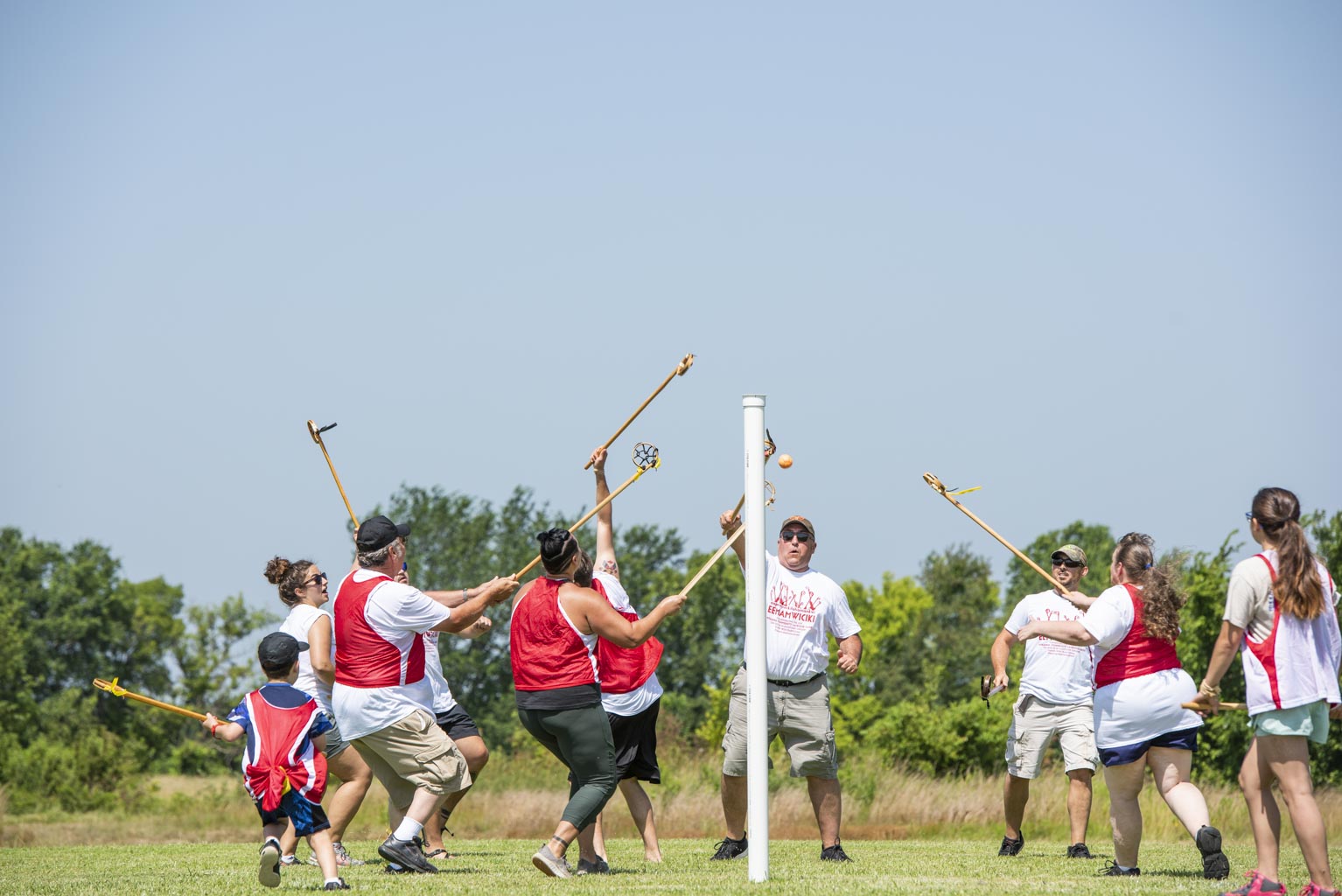
I have very strong memories of this game, but for the life of me, I can’t remember whether the yellow team or the black team won. What I remember is how much fun we had, all the bumping and pushing, the shouting of Myaamiaataweenki up and down the field, and the beautiful sound of all those wooden sticks clacking off each other as the two sides fought for the ball. This big community game is always the highlight of every summer for me. At the conclusion of every summer’s game, I always hear our people saying that they can’t wait until next year’s game, and I couldn’t agree more!
It has been an honor for me to play whatever role I could in the reclamation and revitalization of peekitahaminki ‘lacrosse’ for Myaamia people. Many of us had a vision of what we were hoping for when we began to research Myaamia games in the 1990s. Yet, I think it’s fair to say that even on our most hopeful day, we couldn’t envision the growth of peekitahaminki in our community and the strength that the game brings to us today.
ayaakwaamisiko eeweemilakakoki, aahpitesitaawi pakitahantaawi!
- Stewart Culin, Games of the North American Indians (New York: Dover Publications Inc, 1975), 569. For more on the style of stick used by Myaamia ancestors, see Thomas Vennum, American Indian Lacrosse: Little Brother of War (Washington, D.C.: Smithsonian Institution Press, 1994),79-80. Vennum calls this style of lacrosse stick: “Great Lakes sticks.” ↩︎
 Aacimotaatiiyankwi
Leave a comment