The Miami, or Myaamia, language (also known as Myaamiaataweenki) is a member of the Algonquian language family. The languages of the Algonquian family are found over a very large area of North America, including the Great Lakes, Canada, the Great Plains, and the Eastern Seaboard. In writing about the Myaamia language, I usually use the cover term ‘Miami-Illinois’. This term was specifically coined by linguists to include several different forms of speech that are all considered to be the same language. Specifically, ‘Miami-Illinois’ is intended to include the speech of not only the Myaamiaki, but also the Peewaaliaki (Peorias), Waayaahtanooki (Weas), Peeyankihšiaki (Piankeshaws), Kaahkaahkiaki (Kaskaskias), and any other Inohkaki (Illinois) tribes. The name ‘Miami-Illinois’ seems to have been coined in the 1970s:1 it was created because there has never been a word in Myaamia or Peewaalia (or any other Native language) that takes in all these different groups. Using the term this way, the speech of the Myaamiaki, Peewaaliaki, Waayaahtanooki, Peeyankihšiaki, Kaahkaahkiaki, and Inohkaki are all assumed to be ‘dialects’ of a single Miami-Illinois language.
The word ‘dialect’ gets used in different ways, but here I am just using it to mean the various forms of speech of a single language, differentiated from others based on factors such as geography, ethnicity, social class, etc. For example, one can speak of different regional or ethnic dialects of American English, and in turn, ‘American English’ can be viewed as a dialect of English, and so on.
Deciding whether or not two different forms of speech are two different languages or just two dialects of a single language is often not straightforward, and linguists often struggle to decide when two dialects are different enough to be counted as two different languages. The most common basis for whether two forms of speech are two different languages or just dialects is mutual intelligibility: that is, whether speakers of one form of speech can readily understand the other. But this criterion is not foolproof either, since sometimes two forms of speech are not mutually intelligible to speakers at first, but become more so after a certain amount of exposure. For example, most speakers of American English cannot immediately or totally understand certain types of Scottish English if they have not been exposed to it before. However, these dialects quickly become understandable the more experience one has hearing them. For this reason, people might be hesitant to call American English and modern Scottish English “different languages”, since this would imply a level of difference between the two languages like that of English and, say, German, Dutch or Swedish, where massive differences of pronunciation, grammar and vocabulary are found at all levels, and where speakers of one can generally understand none of the other unless they are specifically taught it.
Viewed this way, Myaamia, Peewaalia, Waayaahtanwa, Peeyankihšia, and Kaahkaahkia are unquestionably dialects of a single language, and not different languages. This is because the differences between these dialects are quite minor, and speakers of any one of them can easily understand the others. This is explicitly stated in the historical records; for example, Charles Trowbridge, who spent the winter of 1824-1825 living in a Myaamia community in Indiana, recording the customs, language, and history of the Myaamiaki, wrote the following:
“the Miamies understand perfectly the Kaskaskias, Peorias, Weas & Piankeshaws, because those tribes have all descended from them. And the difference of dialect is scarcely more than between the present Parisian and the Canadian French.” (Trowbridge 1938: 2)
Likewise, Jacob Dunn, who did extensive fieldwork on Myaamia, Peewaalia, and Waayaahtanwa, wrote an unpublished report for the Bureau of American Ethnography in 1909 specifically comparing the differences between these three dialects. In writing this report, he compared the speech of Thomas Richardville, a Myaamia, George Finley, a Peewaalia, and Sarah Wadsworth, a Waayaahtanwa.2 In this report, Dunn made the clearest, most explicit statement comparing the Myaamia, Peewaalia, and Waayaahtanwa dialects ever written by anyone who had ever gotten to work with native speakers of them:
In most of the cases all three of these people (Richardville, Finley and Wadsworth) were familiar with the differing words of the three dialects, and confirmed each other as to them. They also confirm Godfroy’s assertion that there is a slight difference in pronunciation in the different tribes – each says the others have a ‘brogue’ – but it is too slight for an outsider to distinguish. Otherwise they have a common language, with a comparatively few differing terms, and these almost wholly referring to things introduced by the whites. (Dunn 1909: 2)
This summary is very valuable, since it is clearly taken from what Richardville, Finley and Wadsworth themselves told Dunn. Dunn is saying here that Myaamia, Waayaahtanwa and Peewaalia basically differ by slight details of pronunciation that are too subtle for nonspeakers to even detect – what Dunn calls here a ‘brogue’, an old-fashioned word from the 19th century equivalent to what would now be called an ‘accent’. Dunn also says that the vocabulary differences among the dialects are minimal, mostly for concepts not present in the language before European contact, and that there are even fewer examples of different words for ‘precontact’ concepts. Indeed, Dunn points out that the vocabulary differences among the three dialects are so few and easy to understand that speakers of each dialect were able to volunteer words found in the other dialects which are absent from their own dialects. From my time studying the Miami-Illinois language, this description matches what I have been able to find out about the dialect differences in the language. Written records of Miami-Illinois from the various speakers are so similar that if they are not identified as to which speaker they came from, it is usually impossible to tell which dialect or speaker they represent. The vast majority of Miami-Illinois words are the same for all dialects and all speakers.
At this point, I would like to summarize the handful of differences between Myaamia and Peewaalia.
Pronunciation Differences
Very few consistent differences in pronunciation can be detected among Miami-Illinois dialects. (That is, cases where a certain sound is always pronounced one way in one dialect but a different way in the other dialect.) No doubt, the great majority of phonetic differences between a Myaamia and a Peewaalia ‘accent’ were far too subtle for the English-speaking and French-speaking recorders of the language to hear and record. The most obvious pronunciation difference between Peewaalia and Myaamia is that a number of words which begin with n in Myaamia instead begin with l in Peewaalia. Some typical examples are given below:
Table 1
| English word | Myaamia | Peewaalia |
| ‘it is cold weather’ | neepanki | leepanki |
| ‘he/she breathes’ | neehseeci | leehseeci |
| ‘shirt’ | naapinaakani | laapinaakani |
| ‘necklace’ | naapihkaakani | laapihkaakani |
| ‘also’ | naapiši | laapiši |
| ‘between’ | nalakwe | lalakwe |
| ‘it is dusk’ | neehkanki | leehkanki |
| ‘take care!’ | nipwaahkaalo | lipwaahkaalo |
| ‘it melts’ | neenkiteeki | leenkiteeki |
| ‘sand’ | neekawi | leekawi |
| ‘it is soft’ | noohkanki | loohkanki |
| ‘it is light in weight’ | naankiciiki | laankiciiki |
However, not all words beginning with n in Myaamia begin with l in Peewaalia. A much larger number of words always begin with n in all dialects, which means that these words are the same in Peewaalia and Myaamia:
Table 2
| English word | Myaamia | Peewaalia |
| ‘two’ | niišwi | niišwi |
| ‘three’ | nihswi | nihswi |
| ‘four’ | niiwi | niiwi |
| ‘now’ | noonki | noonki |
| ‘song’ | nakamooni | nakamooni |
| ‘horse’ | neekatikaša | neekatikaša |
| ‘he/she sleeps’ | neepaaci | neepaaci |
| ‘doctor’ | neepihkia | neepihkia |
| ‘he/she dies’ | neepiki | neepiki |
| ‘old’ | nakaani | nakaani |
| ‘blood’ | niihpikanwi | niihpikanwi |
| ‘water’ | nipi | nipi |
| ‘he/she sings’ | neehineeci | neehineeci |
Despite the fact that not all Miami-Illinois words follow this pattern, the presence of words which begin with l in Peewaalia but with n in Myaamia is by far the most important marker distinguishing Peewaalia and Myaamia pronunciation. However, a big complication here is that at least one very important Peewaalia speaker does not pronounce the words in Table 1 with l at the beginning, but rather with n, making his pronunciation of these words the same as that of Myaamia speakers. This speaker is George Finley, the Peewaalia speaker we have by far the most data from – more than all other modern (nineteenth and twentieth century) Peewaalia speakers put together. Every other modern Peewaalia speaker ever recorded shows the l pronunciations in Table 1, including Frank Beaver, John Charley, Bill Skye, Nancy Stand, and James White.3
The fact that Finley’s dialect does not match that of other Peewaalia speakers in this regard might be because even though Finley self-identified as a Peoria and was enrolled in that tribe, he was in fact of Peeyankihšia ancestry, and so it is possible that the dialect he learned while growing up was actually closer to Peeyankihšia rather than Peewaalia or Kaahkaahkia. Unfortunately, we cannot confirm this, since we have almost no language data from anyone self-identifying as Peeyankihšia.
Vocabulary Differences
As Dunn noted, the vocabulary differences between Myaamia, Peewaalia, and Waayaahtanwa are extremely minor. The great majority of words in modern Miami-Illinois are the same in all its dialects, and there are very few words for basic, pre-European contact concepts that are exclusive to one dialect or another. Most of the examples of words that are different across the dialects are names for things: Myaamia has mihšipakwa for ‘leaf’ while Waayaahtanwa and Peewaalia have kaakipakwi (or sometimes kaakipakwa). The Myaamia name for the dogwood tree is aakantemiši, but this is iihkalwi in Peewaalia. And apparently mahkiikwi meant ‘marsh’ in Myaamia and Waayaahtanwa, but ‘lake’ in modern Peewaalia. But examples like this, with totally different names for basic things not introduced by Europeans, are very rare. It is more common for words for concepts introduced after European contact to vary in the different dialects.
For example, the old Miami-Illinois word for ‘sled’, šoohkwaakani, can still mean ‘sled’ in Myaamia, but it has come to mean ‘wagon’ in Peewaalia and Waayaahtanwa.4 ‘Saddle’ is wiiwaši for most speakers, but Dunn claimed naahkiipioni was the name for this object with some Peewaaliaki. In turn, naahkiipioni is the normal word for ‘chair’ for all Myaamia speakers and most Peewaalia speakers, but some Peewaaliaki used apinayi to mean ‘chair’. In turn, apinayi is the normal word for ‘bed’ for Myaamia and most Peewaalia speakers, but the usual word for ‘bed’ for Waayaahtanooki and some Peewaaliaki was teehsooni, a word which means ‘scaffold’ or ‘shelf’ in Myaamia. Dunn claimed that masaanikaani specifically meant ‘tent made of mats’ in Myaamia (probably its original meaning), but was the name for any kind of tent in Peewaalia. In Myaamia and Waayaahtanwa, naloomini is ‘rice, oats’, while in Peewaalia, this noun means ‘wheat’, and maloomina means ‘rice’. And ahsawaankatia means ‘large feather, plume’ in all dialects, but can also mean ‘pen’ in Peewaalia. But it should be emphasized that words like this, which vary from dialect to dialect, are still not very common, and represent only a small fraction of the tens of thousands of words in the Miami-Illinois language.
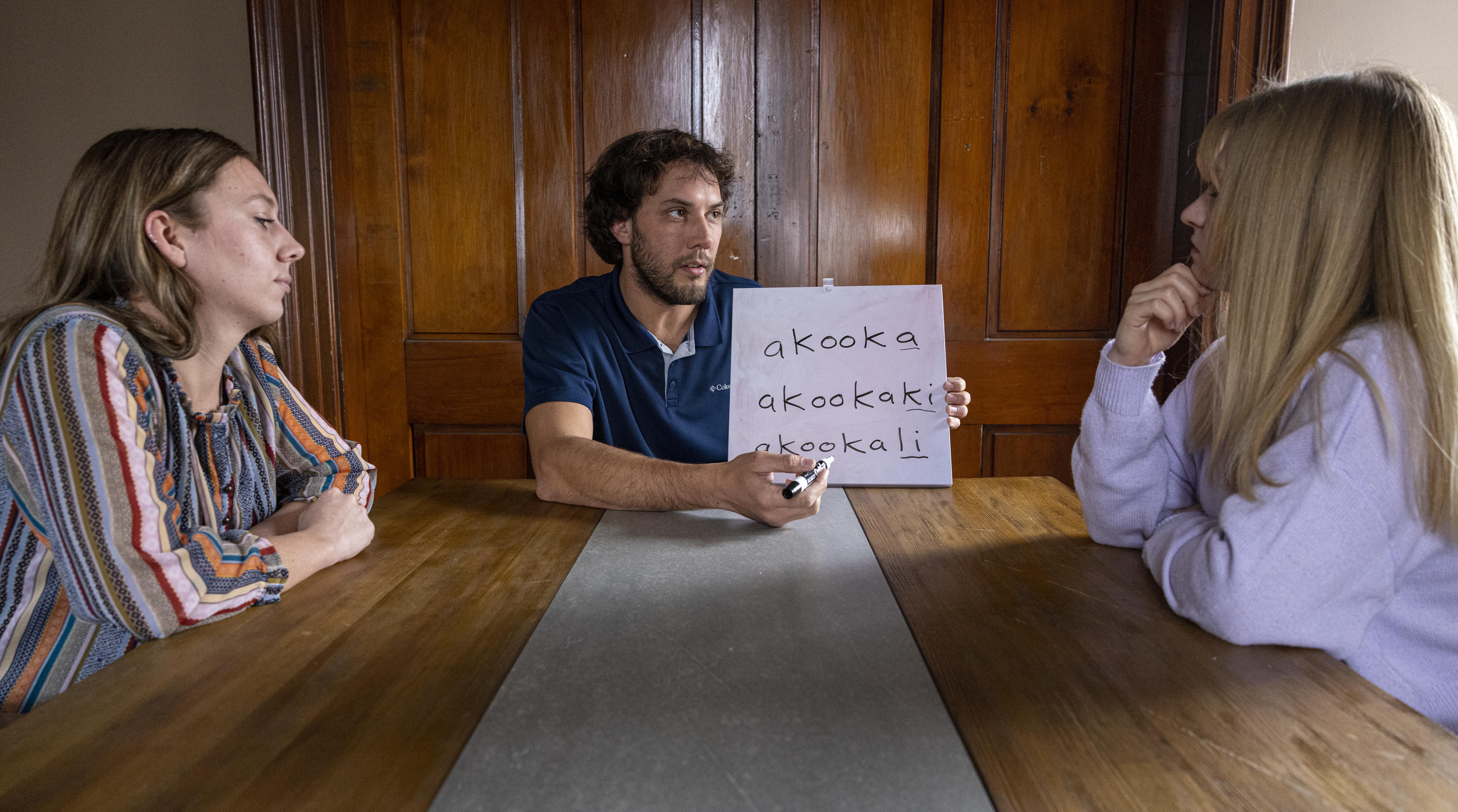
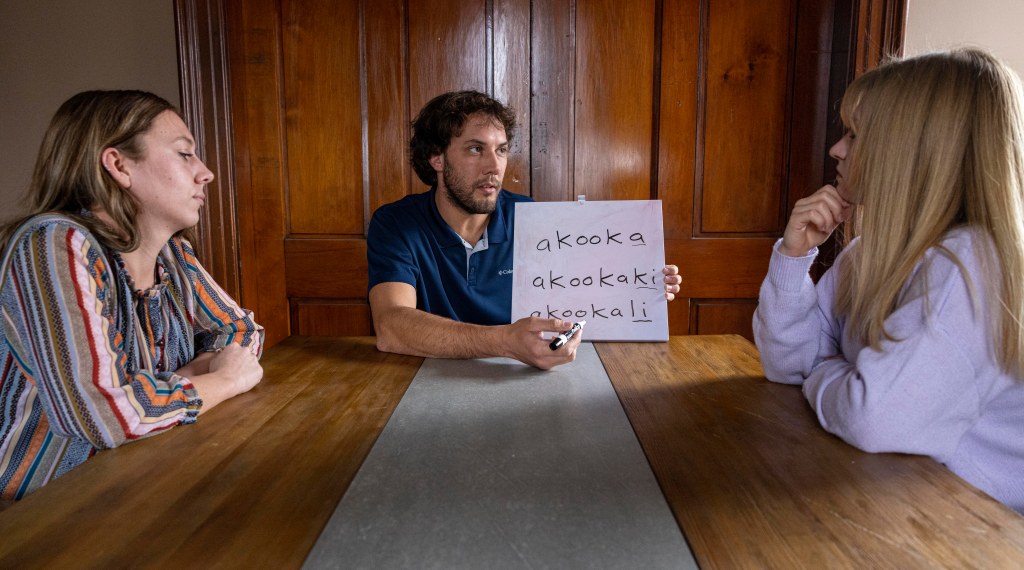
Sometimes, two similar but slightly different forms of a word will be used in one dialect or another, but with no difference in meaning. For example, the Waayaahtanwa word for ‘window’ is poohkihtaakani, but Peewaalia and Myaamia both have poohkišaakani. The word for a knot of a tree, or a burl, is atehkwi for at least some Myaamia speakers, but atehkoni in Peewaalia and Waayaahtanwa. At an even more subtle level, the word for ‘below’ or ‘down’ is mihtahki in Myaamia and Waayaahtanwa but mahtahki in Peewaalia. And Dunn claimed that the word for ‘yes’ is iihia in Myaamia and Waayaahtanwa, but iihi in Peewaalia.
Hockett vocabulary
In getting an overall picture of how different the vocabularies of Myaamia and Peewaalia are, a useful source is the Miami-Illinois wordlists collected by Charles Hockett. Charles Hockett was a linguist who is best known for his work on the Potawatomi language, but in 1938, he made a brief side trip to Ottawa County, Oklahoma to do fieldwork on Miami-Illinois. Hockett worked with two speakers: Nancy Stand, a speaker of Peewaalia; and a female speaker of Myaamia whose name Hockett failed to record. Hockett himself admitted that this fieldwork was very brief, and that he spent only ‘a few hours’ with each speaker. However, Hockett’s fieldnotes are still valuable since he was the best-trained linguist who ever wrote down the language.
Hockett’s method for his Miami-Illinois fieldwork was very simple: he composed a list of 328 English keywords for basic concepts, and asked his speakers how to say those English words in Myaamia and Peewaalia. Since the two speakers Hockett worked with no longer used the language very often, there are many English words in Hockett’s vocabulary where one or the other of the two speakers could not remember a Miami-Illinois equivalent: for example, Hockett got the word eelaakwiki for ‘evening’ from the Myaamia speaker, but evidently Nancy Stand could not remember the Peewaalia word for this concept. Conversely, Hockett got a word for ‘turtle’, wiinicia, from Nancy Stand, but apparently the Myaamia speaker could not remember a Myaamia word for that concept. All in all, of the 328 English keywords in Hockett’s list, 145 are missing either a Myaamia or Peewaalia translation (44%). Subtracting these out, this leaves 183 English keywords with translations from both speakers. These 183 sets are the relevant forms here, since they form a handy point of comparison for how similar the two dialects are.
Of these 183 sets, the Myaamia and Peewaalia speaker gave basically the same word or stem 171 times. This is about 93% of the relevant forms. Of the remaining 7%, there are nine cases where the Myaamia and Peewaalia speaker gave genuinely different words, but only because they interpreted the question differently. (That is, the speakers actually gave words for different things.) An excellent example of this is the words Hockett got for the English word ‘lie’, for which the Peewaalia Nancy Stand gave the word kilaahkiihkilo, an imperative verb which literally means “tell lies!” However, the Myaamia speaker gave the word taahtakiihšinka, a verb literally meaning ‘he/she is lying down’. Or as another example, for the English keyword ‘back(bone)’, the Peewaalia speaker gave nimpahkaami, which means ‘my back’ (especially ‘my lower back’), while the Myaamia speaker gave nihpehkoošikani, which literally means ‘my spine, my backbone’. So, while in these cases both speakers gave valid Miami-Illinois words, obviously these sets tell us nothing about whether Myaamia and Peewaalia had the same word for the same concept.
In Hockett’s entire list, there are only three instances where the Myaamia and Peewaalia speakers appear to have given genuinely different words for the same thing. For example, for ‘turkey’, the Myaamia speaker gave nalaawahkia, while the Peewaalia speaker gave the word waapipilia. Thus, of the 183 words that Hockett asked for Myaamia and Peewaalia equivalents of, and for which he got answers from both speakers, only 1.6% represent genuinely different words for the same objects or concepts.
Conclusion
The fact that less than 2% of the words Hockett got from his Myaamia and Peewaalia speakers represents genuine differences between the two dialects very strongly supports the notion that the vocabularies of Myaamia and Peewaalia are almost the same, with very few words distinguishing them. This, along with the extremely minor number of pronunciation differences between the two dialects, and the fact that speakers of both dialects could understand the other with ease, confirms that Myaamia and Peewaalia (and Waayaahtanwa) are by no means different languages, but merely different dialects of a single language (and not even very different dialects). Importantly, this also confirms that the same materials are appropriate for the study and teaching of both Peewaalia and Myaamia: that is, that the same dictionaries, grammars, and stories are appropriate to learn both dialects.
- The first writer that I am aware of to use the term ‘Miami-Illinois’ is the Smithsonian Institution linguist Ives Goddard (for example, see 1977: 248 and 1978: 585). ↩︎
- Dunn had previously done extensive language work with the Indiana Miami Gabriel Godfroy as well. ↩︎
- Additionally, in her fieldwork with both Albert Gatschet and Jacob Dunn, the Waayaahtanwa speaker Sarah Wadsworth said that although she herself had n at the beginning of words like those in Table 1 (making her Waayaahtanwa dialect like Myaamia), she volunteered that Peewaaliaki pronounced them with l. ↩︎
- The animate form of this noun, šoohkwaakana, is now used to mean ‘car’ in Myaamia. ↩︎
References
Dunn, Jacob P. 1909. A Comparison of Gatschet’s Peoria and Godfroy’s Miami. Manuscript 1696, National Anthropological Archives, Smithsonian Museum Support Center, Suitland, Maryland.
Goddard, Ives. 1977. The Morphologization of Algonquian Consonant Mutation. Berkeley Linguistics Society Proceedings 3: 241-250.
Goddard, Ives. 1978. Central Algonquian Languages. Handbook of North American Indians, ed. by Bruce G. Trigger, v. 15: Northeast, pp. 583-587. Washington: Smithsonian Institution.
Hockett, Charles F. 1985. Notes on Peoria & Miami. Algonquian & Iroquoian Linguistics, 10/4: 29-41.
Trowbridge, Charles. 1824-5. Notes on the Miami. Manuscripts at the Burton Historical Collection, Detroit Public Library, Detroit, Michigan.
Trowbridge, Charles C. 1938. Meearmeear Traditions. Vernon Kinietz, ed., University of Michigan Museum of Anthropology, Occasional Contributions 7. Ann Arbor.

 Aacimotaatiiyankwi
Leave a reply to Peepinšihšia (Nate Poyfair) Cancel reply