Introduction and Overview
In November of 2025, a team of Myaamiaki took another important trip to Paris, France for a series of historic events. This was the fourth trip that Myaamia teams have made to Meetihkoošionki since we launched the Reclaiming Stories Project with our Peewaalia ‘Peoria’ relatives. That project’s focus is the revitalization of hide painting for our communities. Earlier trips to Paris focused on connecting with the examples of Peewaalia ancestral hide painting art that are cared for in the collections of the Musee du Quai Branly Jacques Chirac in Paris.
The most recent trip to France was organized to celebrate the opening of an exhibition at the Palace of Versailles, which resulted from collaborative discussions and investigations that date back to 2021 when the Reclaiming Stories Project team linked up with our friends at the quai Branly who worked on their CRoyAN project team. Additionally, this trip coincided with the 300th anniversary of the visit of a delegation of Native leaders to France. French institutions planned a gathering during this time to commemorate that historic visit.
Who Traveled to France?
The Myaamia team that traveled to France for this trip included: Nate Poyfair (Second Councilperson and Noošonke ARPA Project Manager), Logan York (Tribal Historic Preservation Officer for the Miami Tribe), Doug Peconge (Tribal photographer and Kiihkayonki ARPA Project Manager), and George Ironstrack (Assistant Director of the Myaamia Center). All four of us have been involved in various aspects of the Reclaiming Stories project. Logan and George collaborated directly with the team that curated the exhibit that opened at Versailles. Nate had the responsibility of representing our tribal government in France, and Doug had the extremely important role of documenting the exhibit through photography.
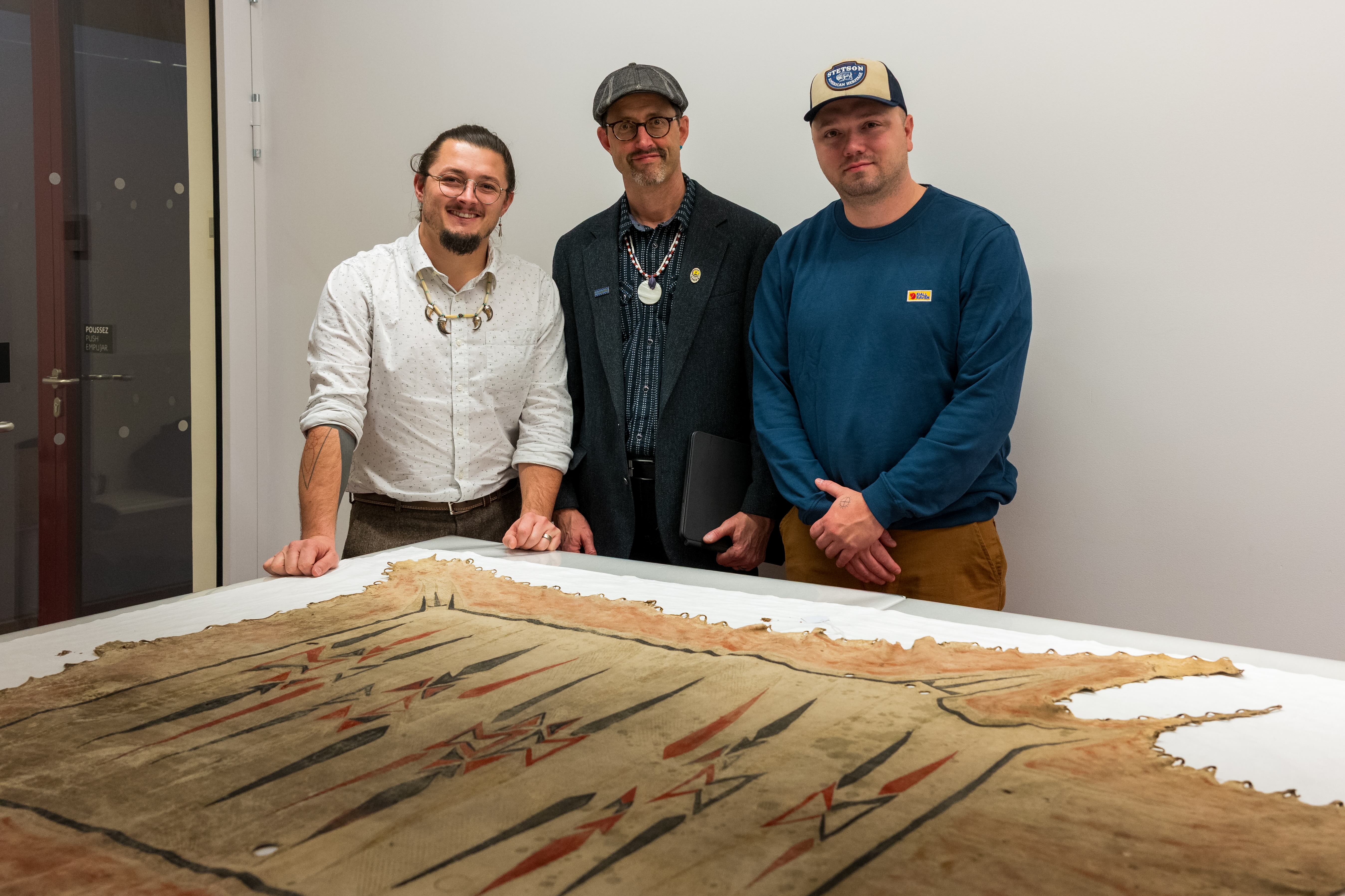
Logan York, George Ironstrack, and Nate Poyfair (L-R) pose with a minohsaya ‘painted hide’ created by ancestors of the Peoria Tribe. Photo by Doug Peconge, Miami Tribe of Oklahoma. 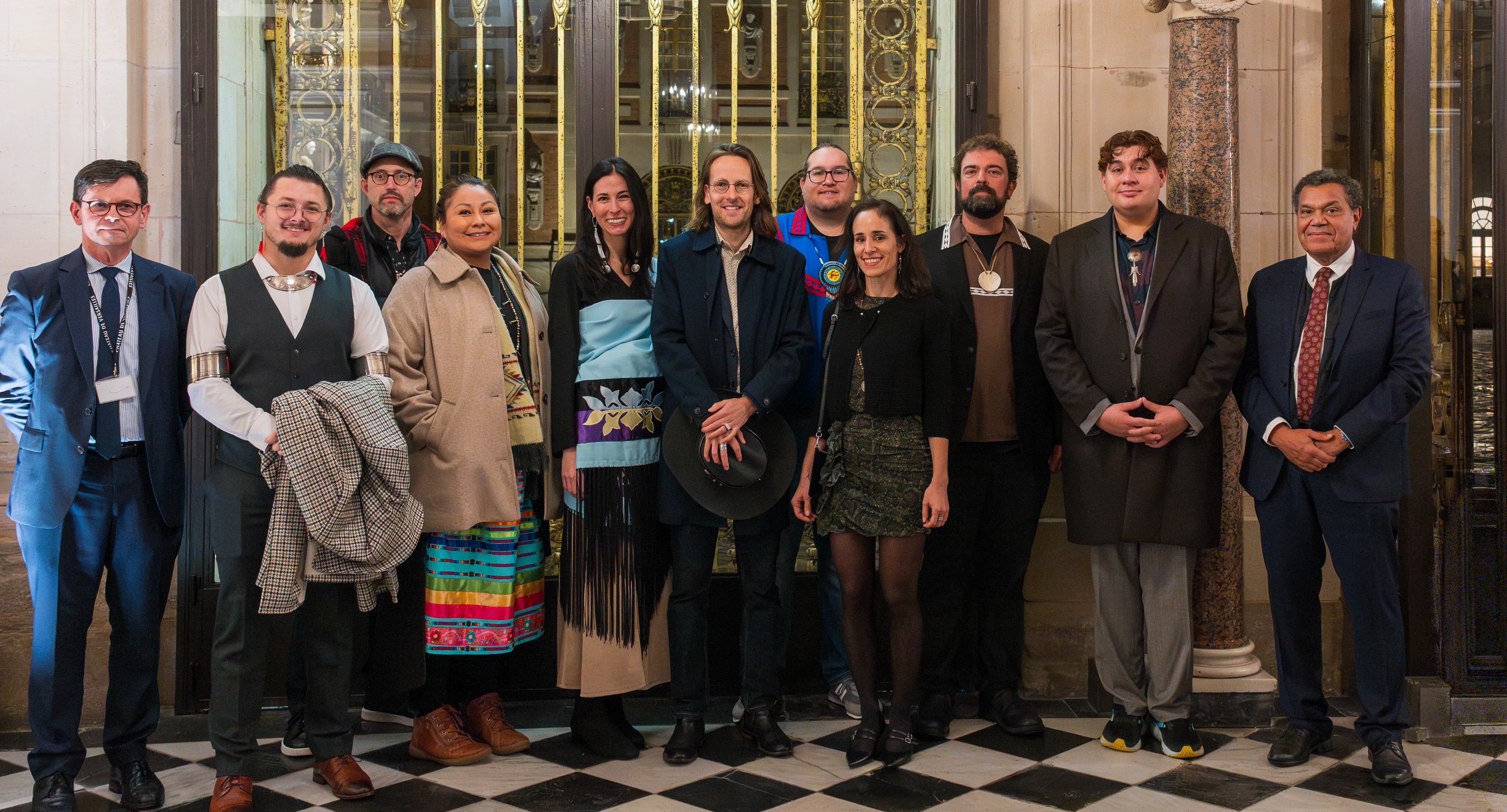
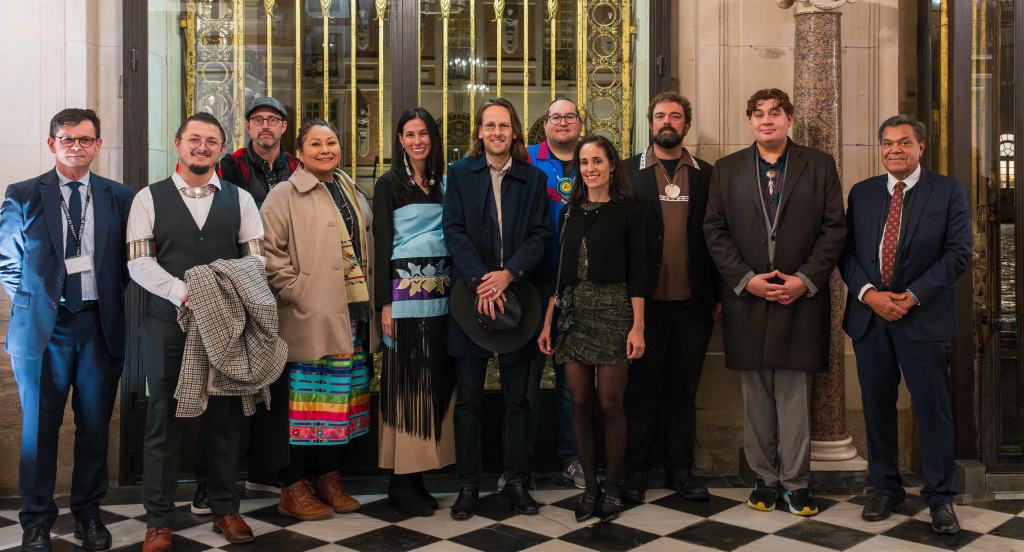
Christophe Leribault (President of Château de Versailles), Logan York, George Ironstrack, Elsie Whitehorn (THPO, Otoe-Missouria Tribe), Elizabeth Ellis (Peoria Tribe of Indians of Oklahoma), Jonas Musco (Exhibition Curator), Ryan Spring (Choctaw Nation), Paz Núnez-Reguiero (Exhibition Curator), Ian Thompson (THPO Choctaw Nation), Everett Bandy (Quapaw Nation), and Emmanuel Kasarhérou (President of Musée du quai Branly – Jacques Chirac). Photo by Doug Peconge, Miami Tribe of Oklahoma.
The Myaamia team was just one amongst many tribal representatives in France for these events. As with our previous trips, our relatives from the Peoria Tribe of Indians of Oklahoma made the journey. They were represented by staff from their cultural office and by a number of their elected officials. Other tribal nations that sent delegations included the Quapaw Nation, the Choctaw Nation, the Osage Nation, and the Otoe-Missouria Tribe.
What Sites Did We Visit?
During the trip, the group visited three main locations in France. The first was the Musée du quai Branly – Jacques Chirac (MQB-JC) which hosted a symposium discussing museum collaboration and offered groups an opportunity to visit in private with many objects of ancestral art from North America. The MQB-JC is located in the heart of Paris about a 10 minute walk from the Eiffel Tower along the Seine (the river that runs through the center of Paris). The second was the Château de Versailles (Palace of Versailles) for the unveiling of the exhibition “1725. Native American Allies at the Court of Louis XV.” Today, Versailles is a western suburb of Paris about 30-40 minutes away via train. Our group participated in both the private and public openings of the Versailles exhibition. The third location was the Château de Fontainebleau (Palace of Fontainebleau) where the group commemorated the 1725 visit of Osage, Otoe-Missouria, and Peoria leaders. Fontainebleau is about an hour and a half south of Paris via train.
Symposium – November 19 & 21
The official visit began with a two-day symposium titled “Sharing collections, Co-Writing History: New Collaborative Practices within Indigenous North American Contexts.” The gathering was tightly focused on collaborations between museums and North American Indigenous scholars and knowledge bearers. Logan and George participated in a panel session together with our relative and colleague, Dr. Elizabeth Ellis from the Peoria Tribe. Our panel was titled: “Visiting with Ancestral Art: Minohsayaki (Painted Robes) at the Musée du quai Branly – Jacques Chirac.” During the session we talked about the work of the Reclaiming Stories project and the importance of reclaiming from the archives the knowledge and practice of hide painting.
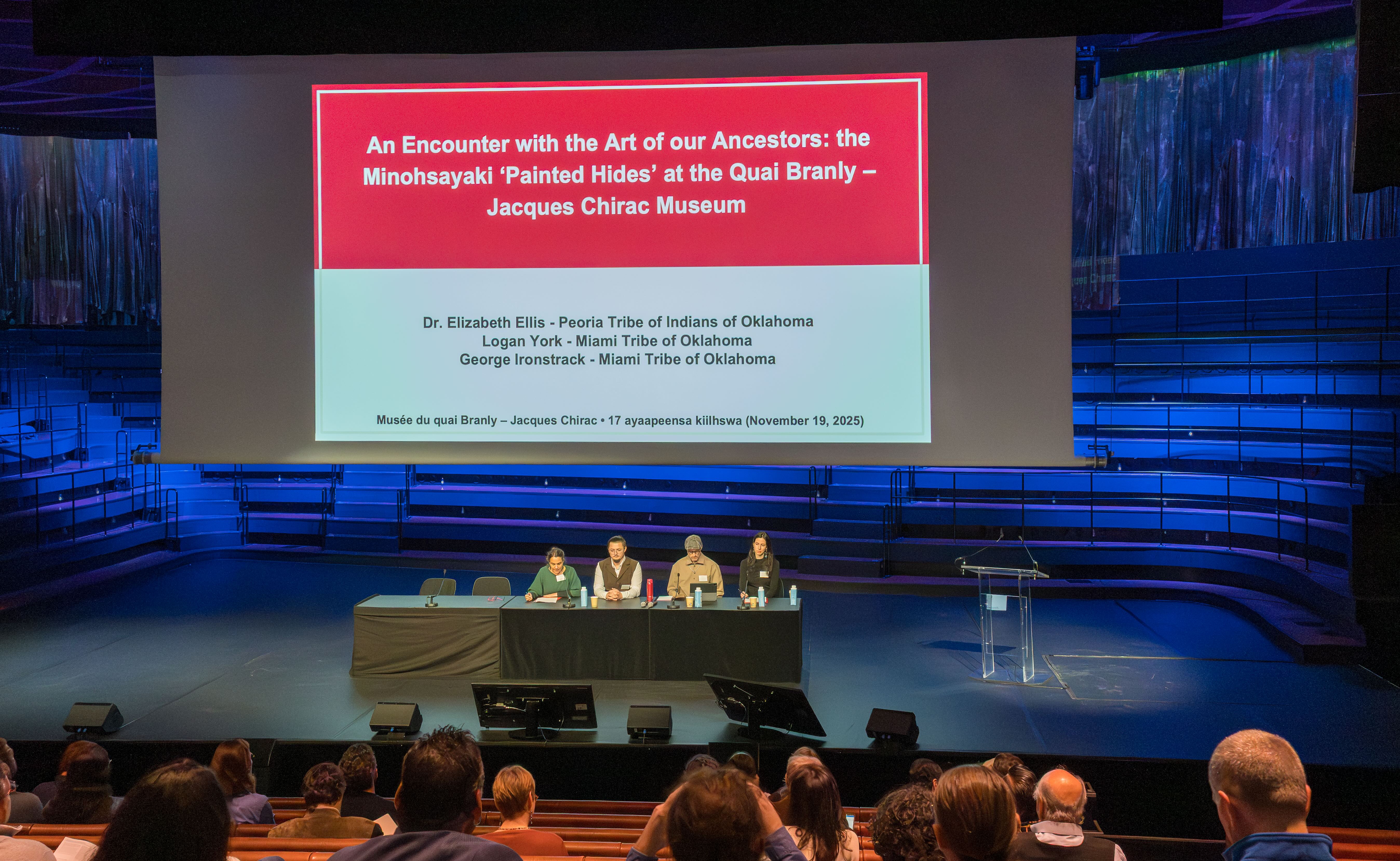
Jessica de Largy, Logan York, George Ironstrack, and Dr. Elizabeth Ellis (L-R) on stage at the MQB-JC during their symposium presentation. Photo by Doug Peconge, Miami Tribe of Oklahoma. 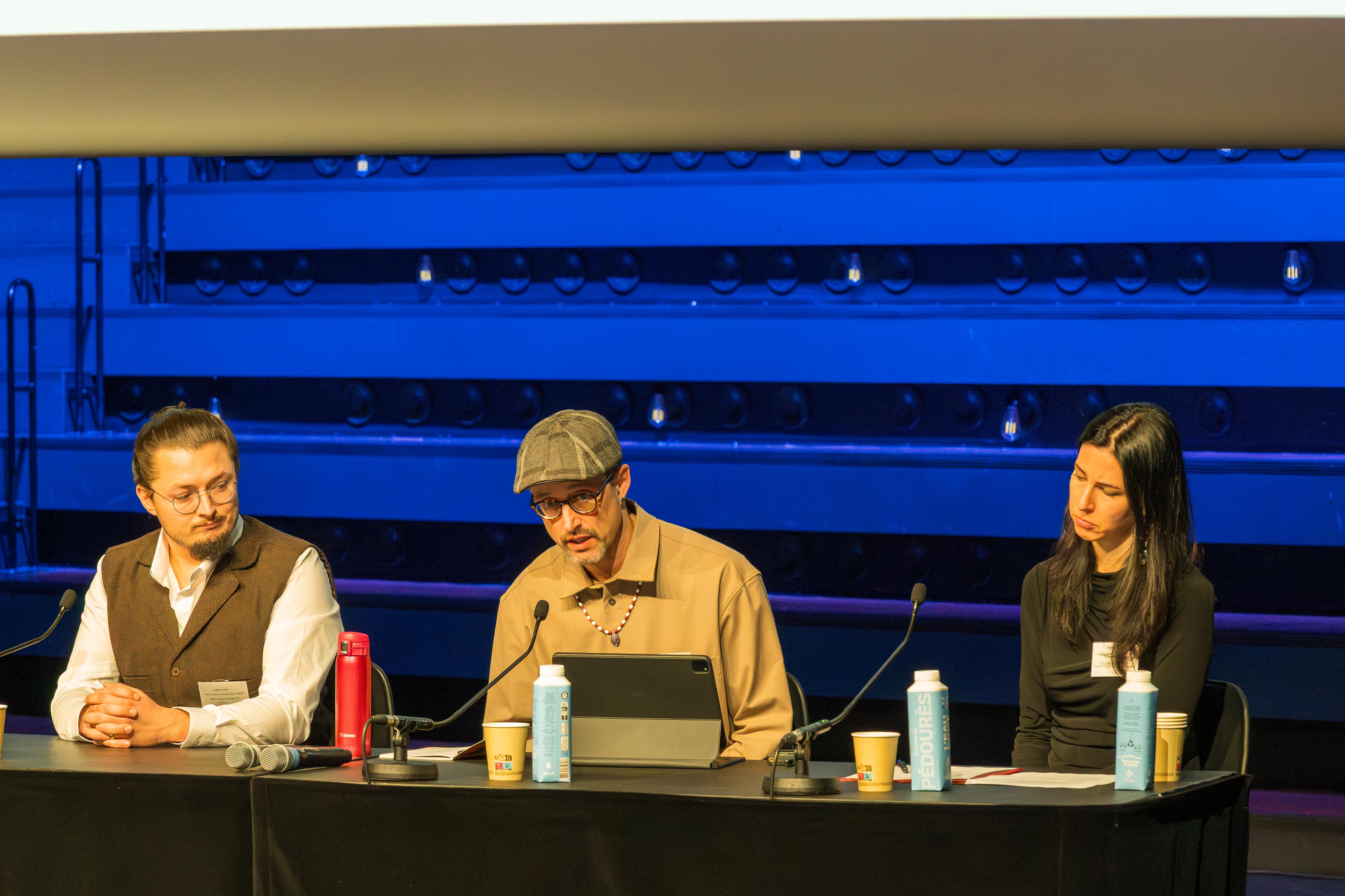
Logan York, George Ironstrack, and Dr. Elizabeth Ellis (L-R) during their symposium presentation at the MQB-JC. Photo by Doug Peconge, Miami Tribe of Oklahoma.
Nine other panels covered an array of collaborative work. Of particular note were the sessions that included our good friends from Seneca country: Michael Galban (Washoe and Mono Lake Paiute and the Director of the Seneca Art & Culture Center at Ganondagan State Historic Site); Jamie Jacobs (Tonawanda Seneca Nation and the Curator of the Rock Foundation at the Rochester Museum & Science Center); and Peter Jemison (Seneca Nation and the former Director of the Seneca Art & Culture Center at Ganondagan State Historic Site).
The symposium was an amazing globe-spanning summary of the wonderful work that can happen when museums collaborate with the descendant communities that have ties to the ancestral objects in their care. Each discussion highlighted how Indigenous communities, the museum, and the general public all benefit from this collaboration. Museums gain a better cultural and communal context for their interpretations of their collections, which leads to new exhibitions that allow the museum-going public to have a richer experience. Indigenous communities benefit from learning from objects of ancestral art through time spent visiting with the objects and by learning from the scientific investigations conducted by museum professionals.
Versailles – November 21 & 23
One of the highpoints of the journey for the entire Myaamia team was participating in the opening of the exhibition at the Château de Versailles (Palace of Versailles). The exhibit, 1725. Native American Allies at the Court of Louis XV, had at its centerpoint the story of the leaders of the Peoria, Osage, and Otoe-Missouria who visited France in November of 1725. Around this center curators wove the story of the context of the ambassadorial visit. This context included Indigenous and European concepts of place through the display of maps from the period; ancestral objects of art, many of which were given as gifts to the French as a part of Indigenous diplomacy; early European representations of Indigenous peoples; and a history of the evolution of the relationship between Native Nations and the French empire.
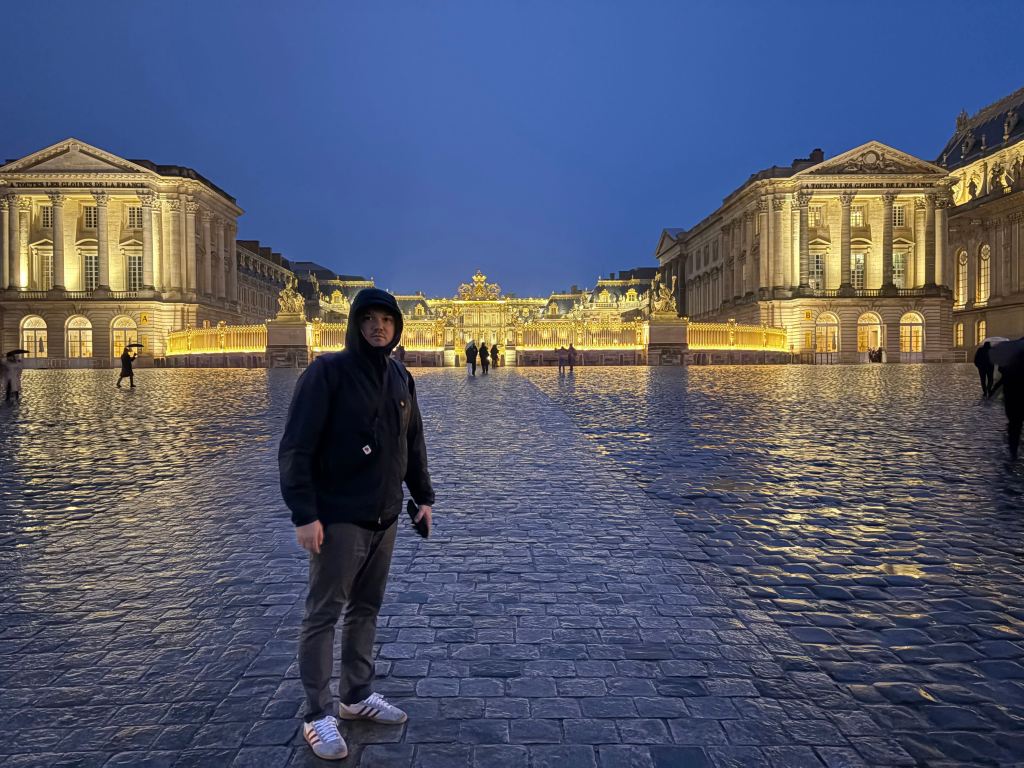
Nate Poyfair, bundled up against the cold and rain, as the group approached a beautifully lit Château de Versailles. Photo by George Ironstrack, Myaamia Center. 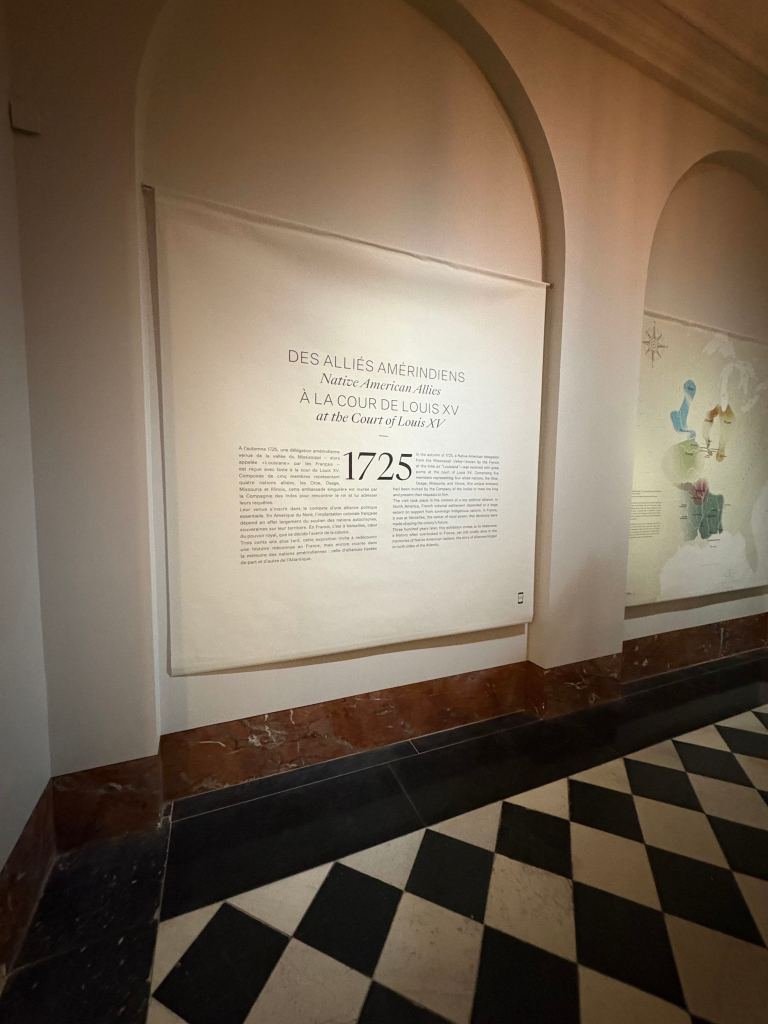
Entryway to the exhibition at Château de Versailles. Photo by George Ironstrack, Myaamia Center. 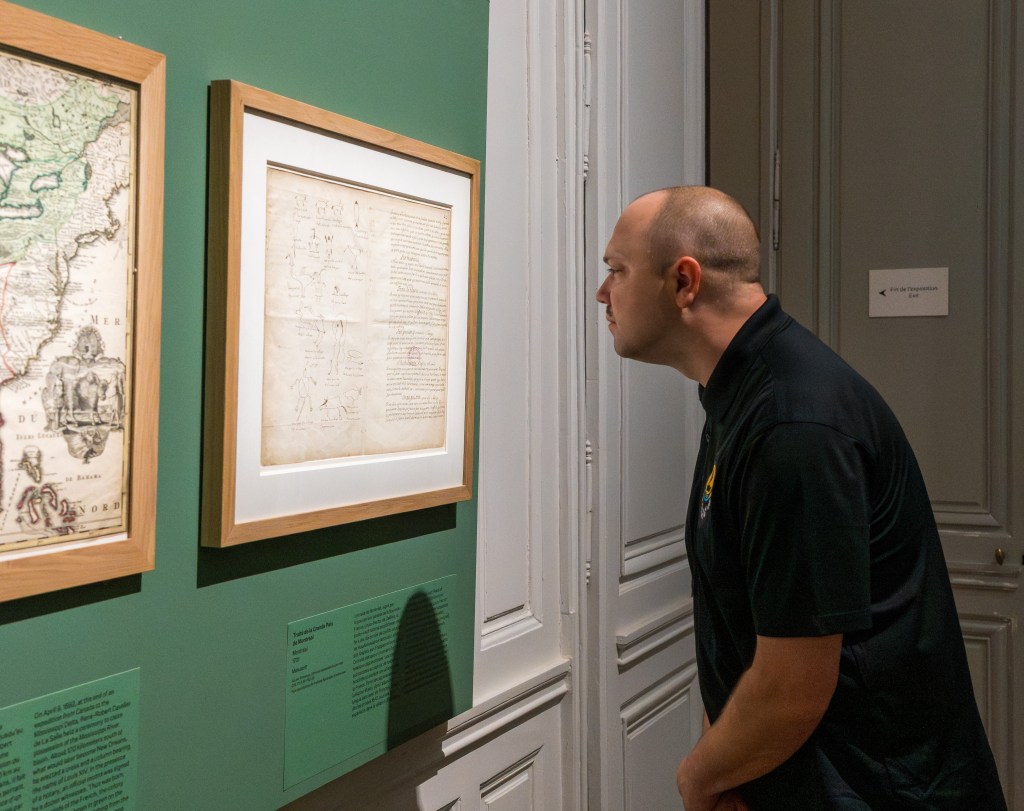
Nate Poyfair taking a close look at an original copy of the Great Peace of Montreal, which was signed by the Myaamia leader Chichikatalo in 1701. Photo by Doug Peconge, Miami Tribe of Oklahoma. 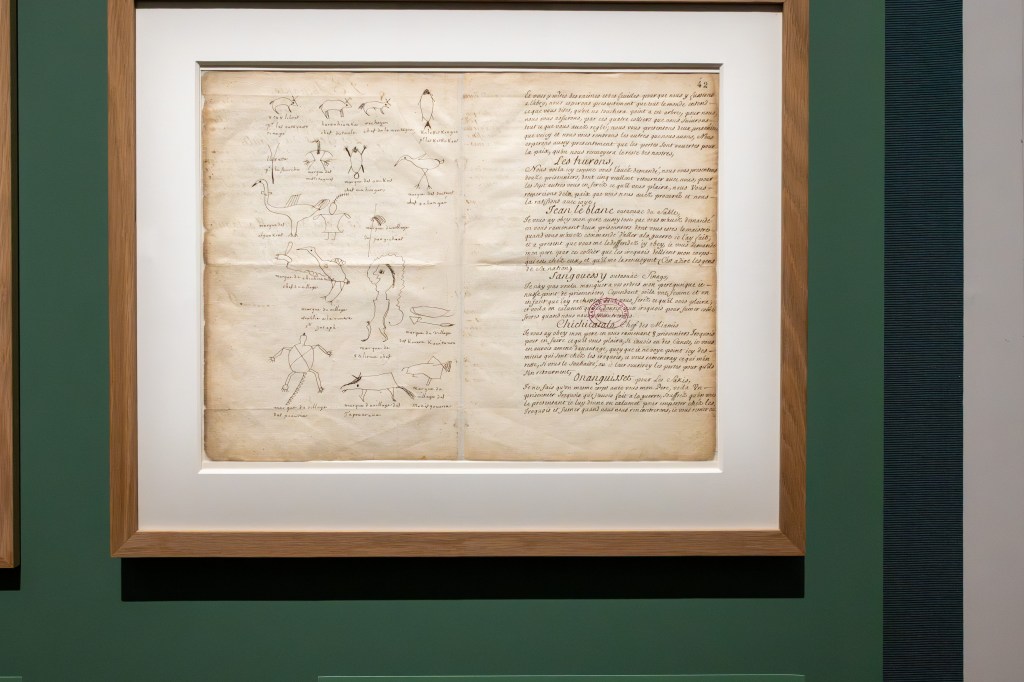
A close up of the Great Peace of Montreal, which was signed by leaders of 39 Indigenous nations. Photo by Doug Peconge, Miami Tribe of Oklahoma. 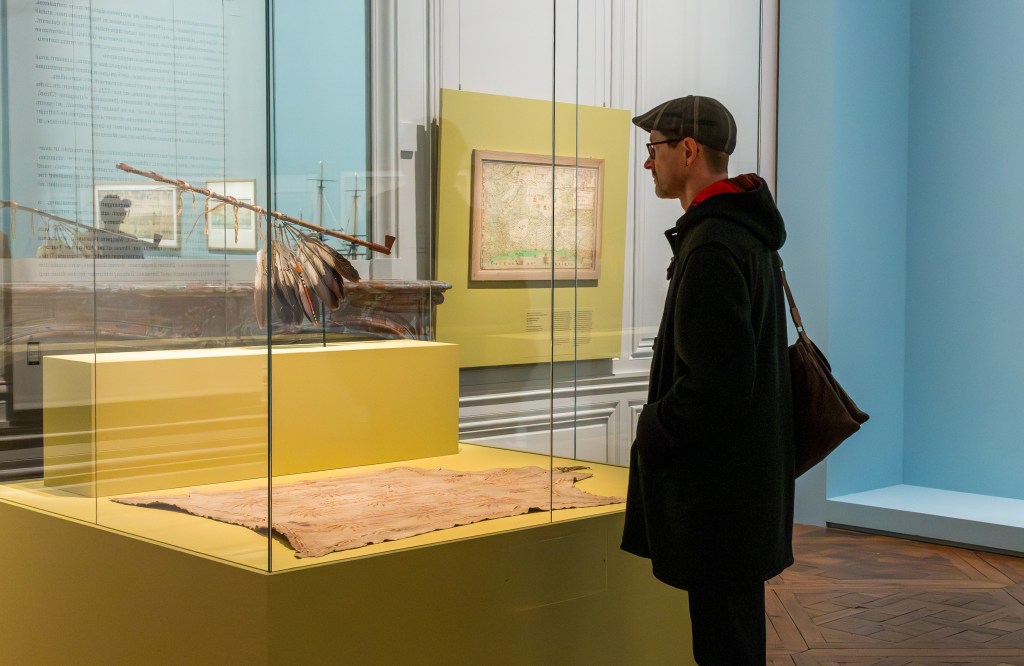
George Ironstrack spending a moment of quiet with a calumet (ceremonial pipe) and minohsaya ‘painted hide’ that are both included in the exhibit.Photo by Doug Peconge, Miami Tribe of Oklahoma 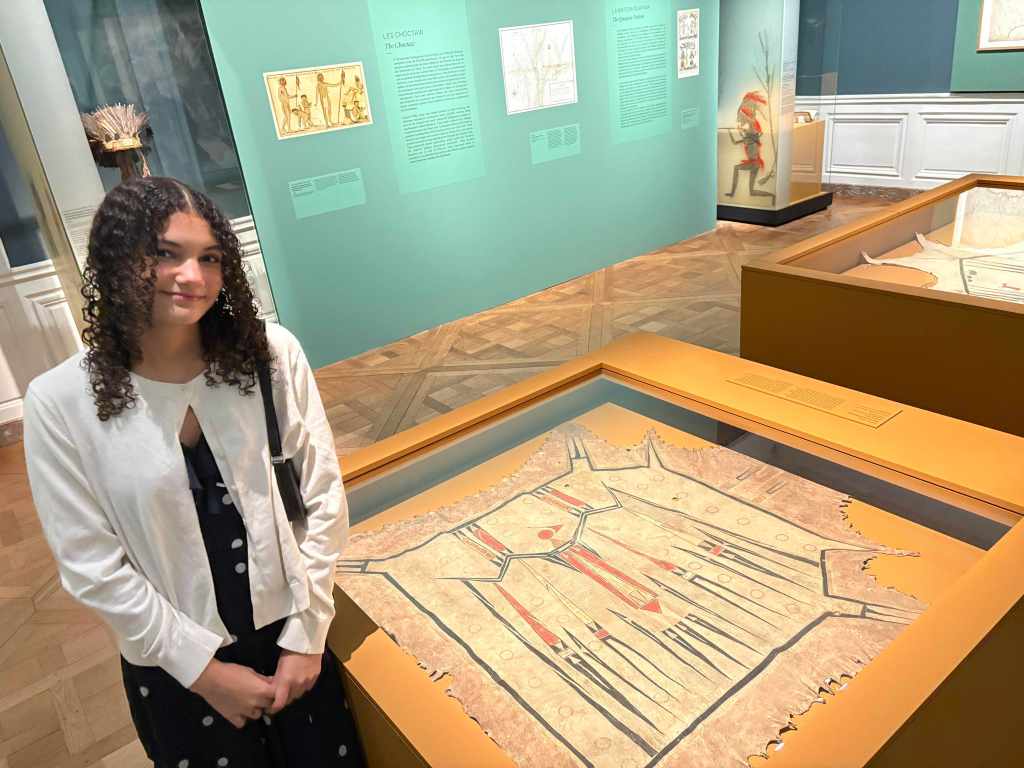
Mirin Ironstrack poses next to a famous minohsaya that includes a depiction of Ciinkwia ‘Thunderbeing.’ The robe was painted by ancestors of the Peewaali ‘Peoria.’Photo by George Ironstrack, Myaamia Center
On November 21, Logan and George attended a small private viewing of the exhibition for the community partners who collaborated on the exhibition. It was a chance for partners to spend a quiet moment in the exhibition space with momentous examples of ancestral art that were wrapped into the story of the 1725 delegation. It was a powerful moment to see years of the team’s work take physical form in a world-renowned museum.
Two days later, a much larger group of all the visiting Native delegations returned to Versailles for the public opening of the exhibition. The Native delegations were welcomed into the exhibition space about 45 minutes before it was opened to the broader public. It was exciting to share the experience of the exhibition with friends and family. We all pour so much of ourselves into this work. But it is rare to be able to share that work with our family, and George was particularly grateful to be able to spend time with his daughter and mother walking through the exhibition at Versailles.
After the first 45 minutes were up, the exhibition opened up to everyone else in attendance. The crowd was so large that there was barely any room to move within the exhibition space. It was amazing to watch the public enjoy the fruits of everyone’s labor.
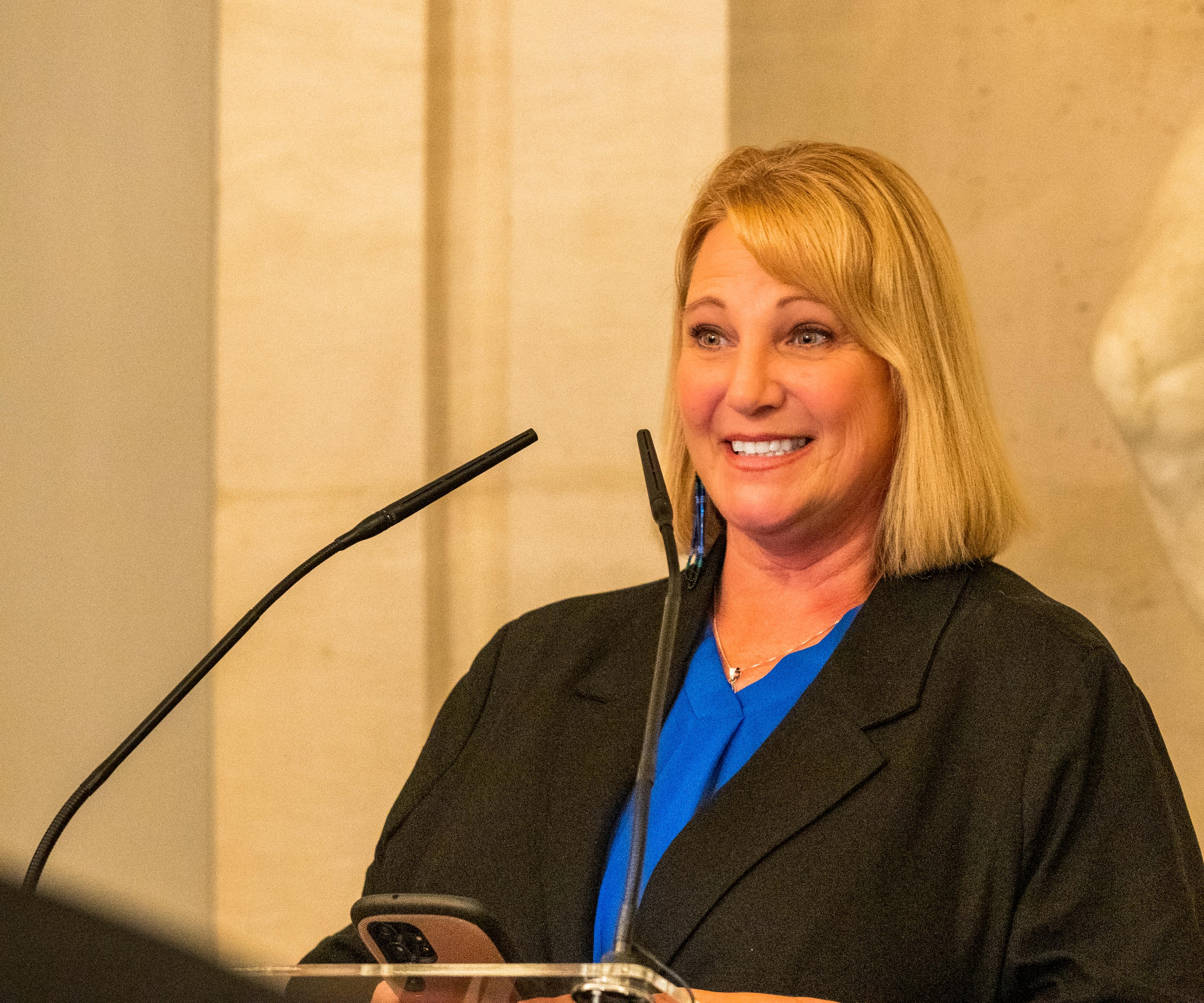
Eventually, the crowd moved to an event space within the palace for celebratory and commemorative speeches. The President of Château de Versailles Christophe Leribault and the President of the Musée du quai Branly – Jacques Chirac Emmanuel Kasarhérou both gave speeches recognizing the importance of the exhibition and their institutions’ roles in preserving this history and sharing the story. Chief Roseanna Dobbs of the Peoria Tribe of Indians of Oklahoma gave a beautiful and heartfelt speech recognizing the importance of walking in the footsteps of Akima Šikaakwa, who traveled to France and visited Versailles in November 1725. Chairman John Shotton of the Otoe-Missouria and Marla Redcorn, Director of the Osage Nation Museum, each spoke about the importance of the exhibit and the visit from their nations’ perspectives. The public celebration concluded with a toast and two beautiful songs from T.J. Redcorn (Osage, Ponca, Kiowa, & Caddo) Brent Greenwood (Chickasaw & Ponca), and Vann Bighorse (Osage). The songs were especially powerful to hear echoing through the room at Versailles. Many of us collectively wondered how long it had been since those walls had heard songs from North American Indigenous peoples?
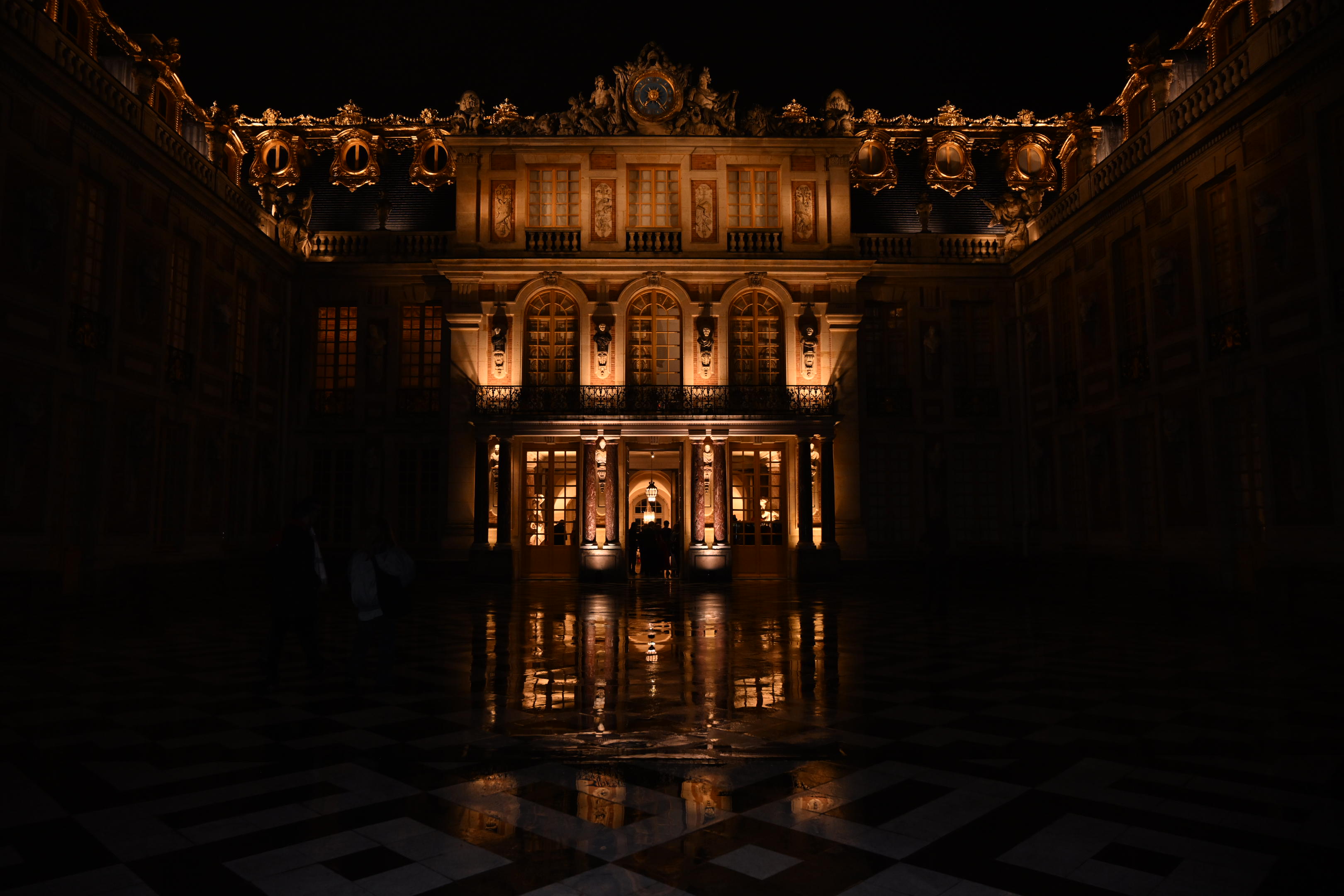
It was a cold and wet evening at Versailles, and the pictures of the outdoor spaces almost capture how beautiful the evening was.
Fontainebleau – November 25
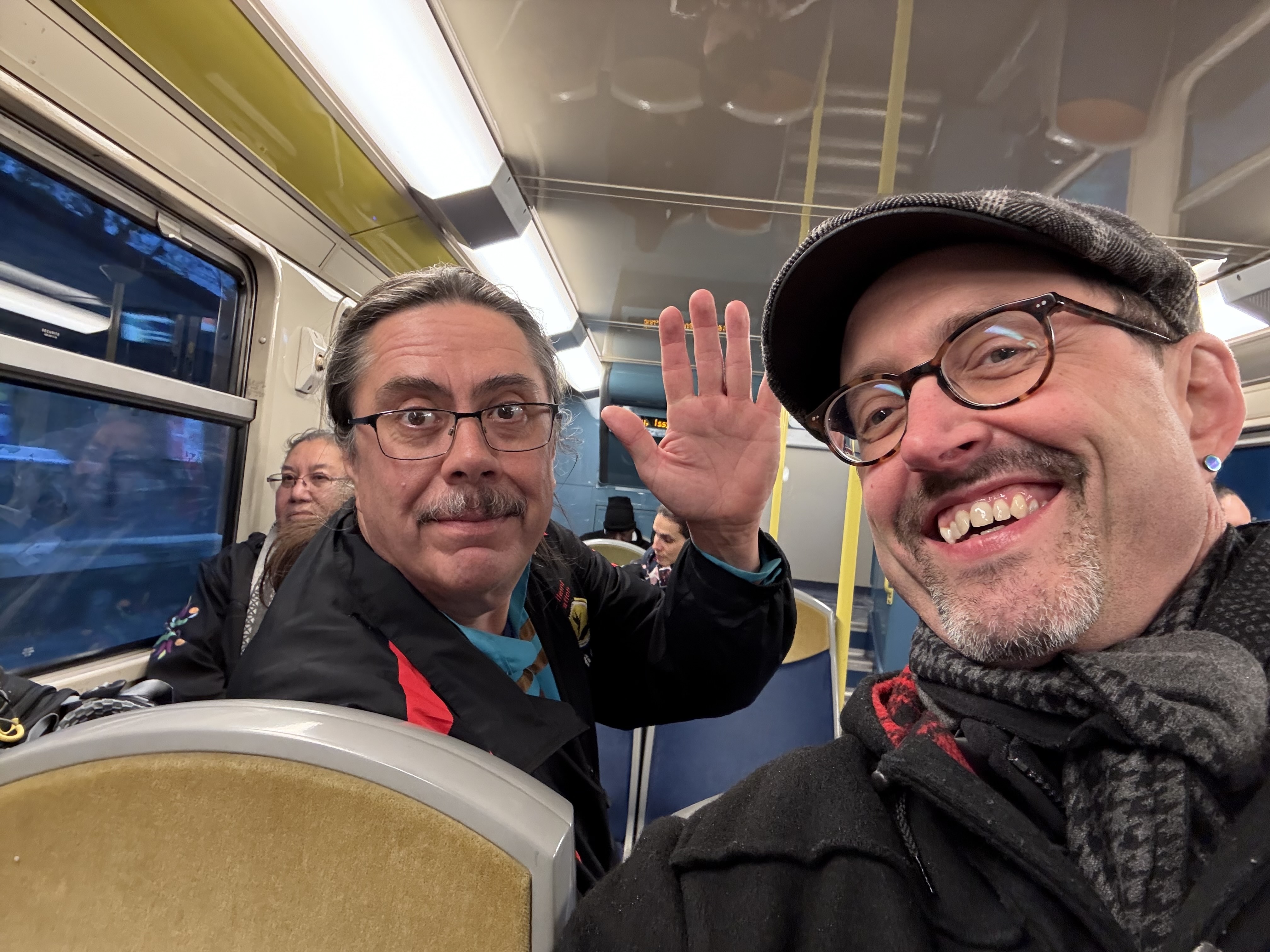
Our last day together in France took us on our longest journey via train from Paris to the city of Fontainebleau, forty miles to the southeast. Our whole group was a big fan of all the trains in France, but this ride was especially comfortable and beautiful. The regional train we rode had lots of comfortable seating and great window views for following the journey. The journey began in urban Paris, which has its own kind of beauty, but for the last 20 minutes or so of the trip we passed through a large and naturally beautiful national forest.
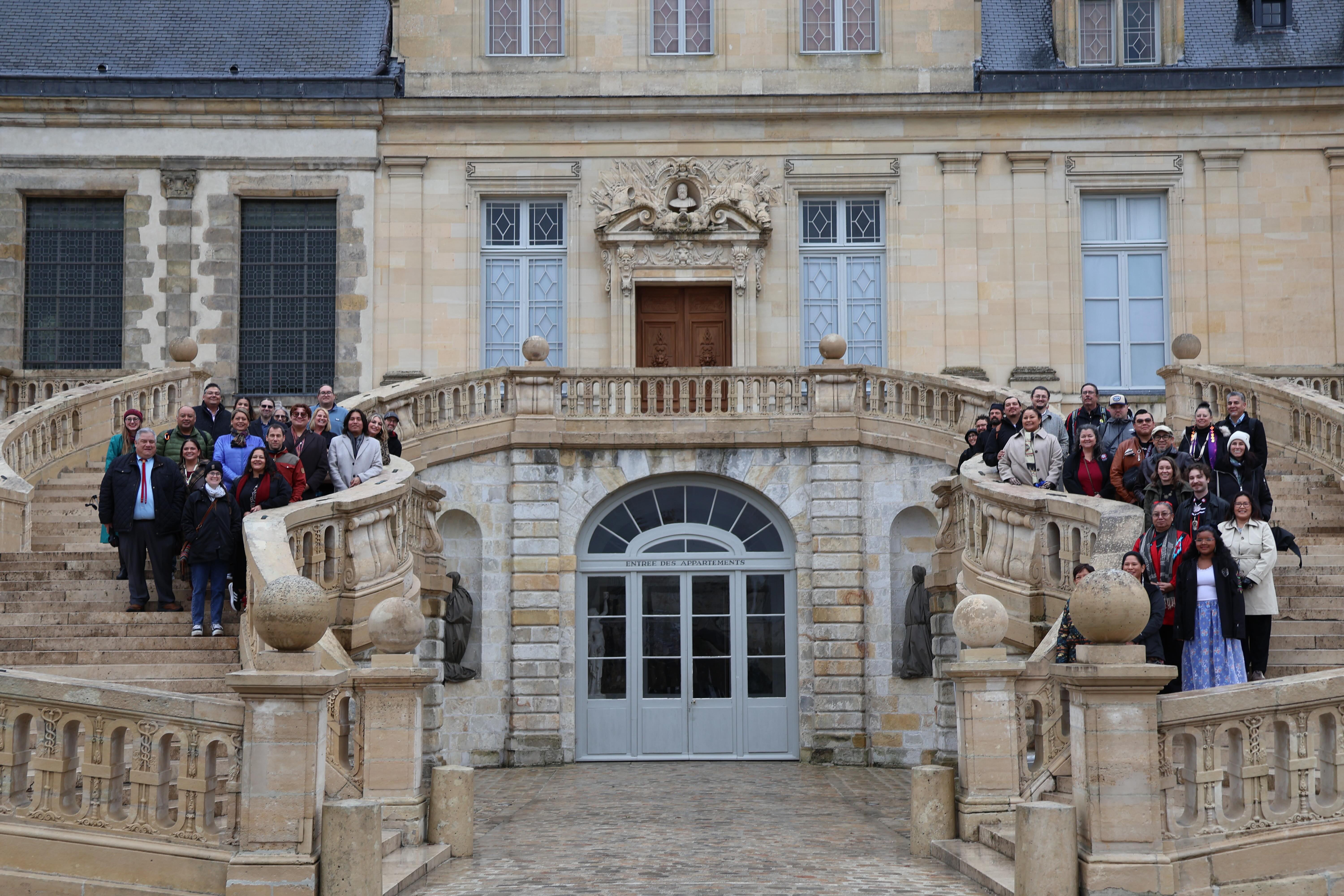
All the Native delegations, other visiting Native scholars, and our French hosts pose on the steps of the entrance to the Château de Fontainebleau. Photo by Staff of Château de Fontainebleau. 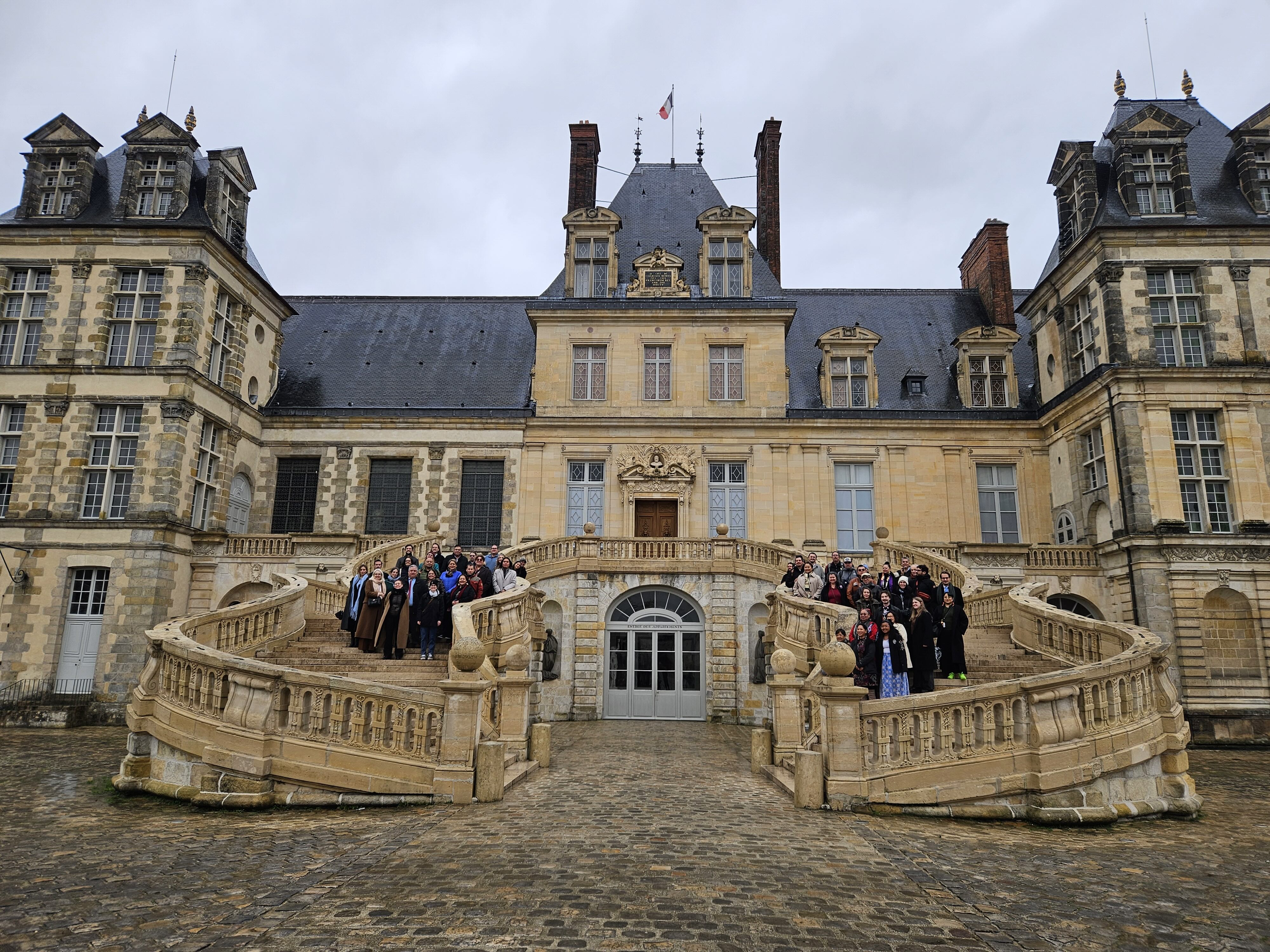
A wide frame shot of the Native delegations posing on the steps of the entrance to the Château de Fontainebleau. Photo by Staff of Château de Fontainebleau. 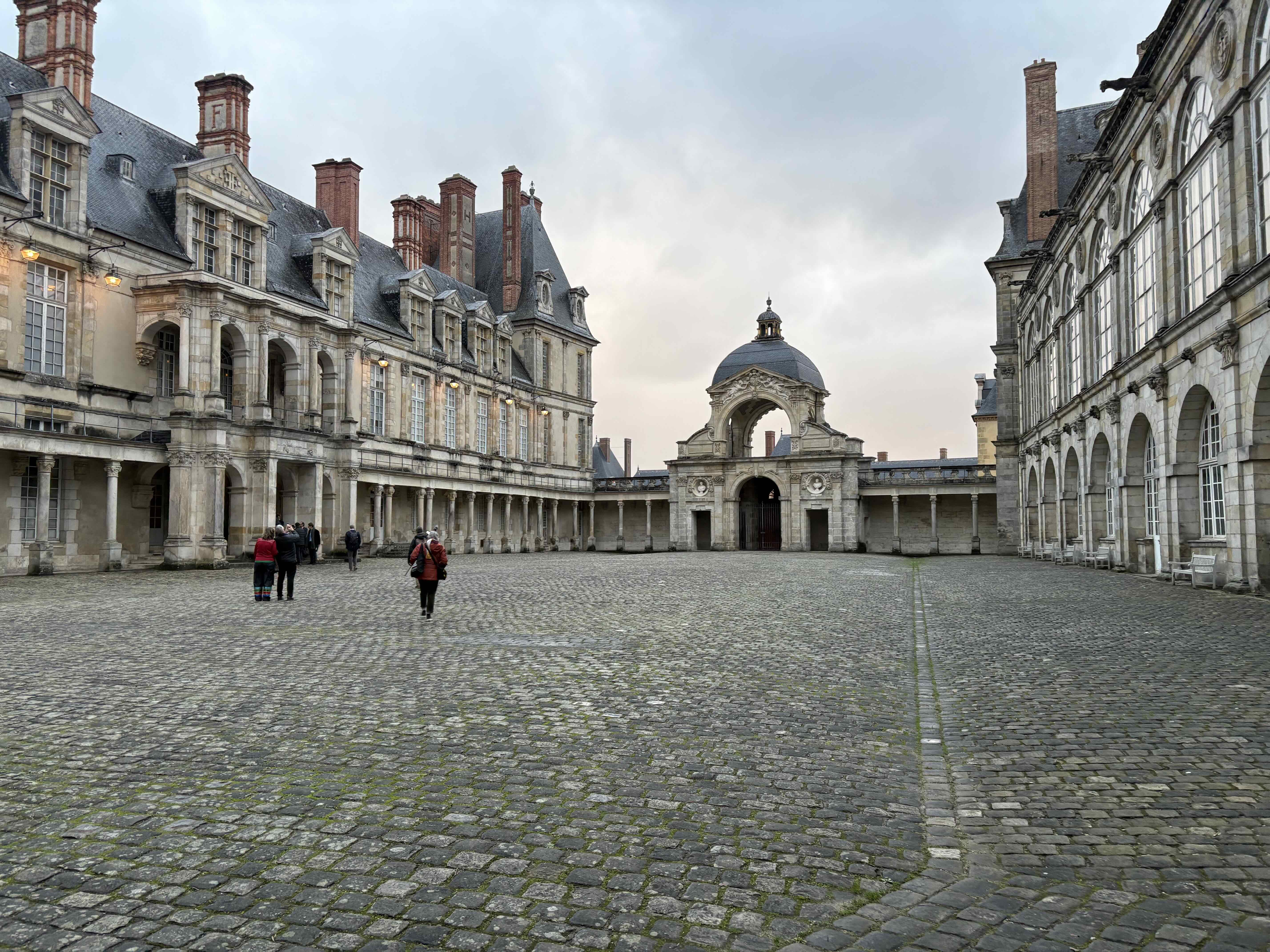
One of the large courtyards at the Château de Fontainebleau. In 1725, the Native delegations likely passed through the gate at the end of the plaza. Photo by George Ironstrack, Myaamia Center. 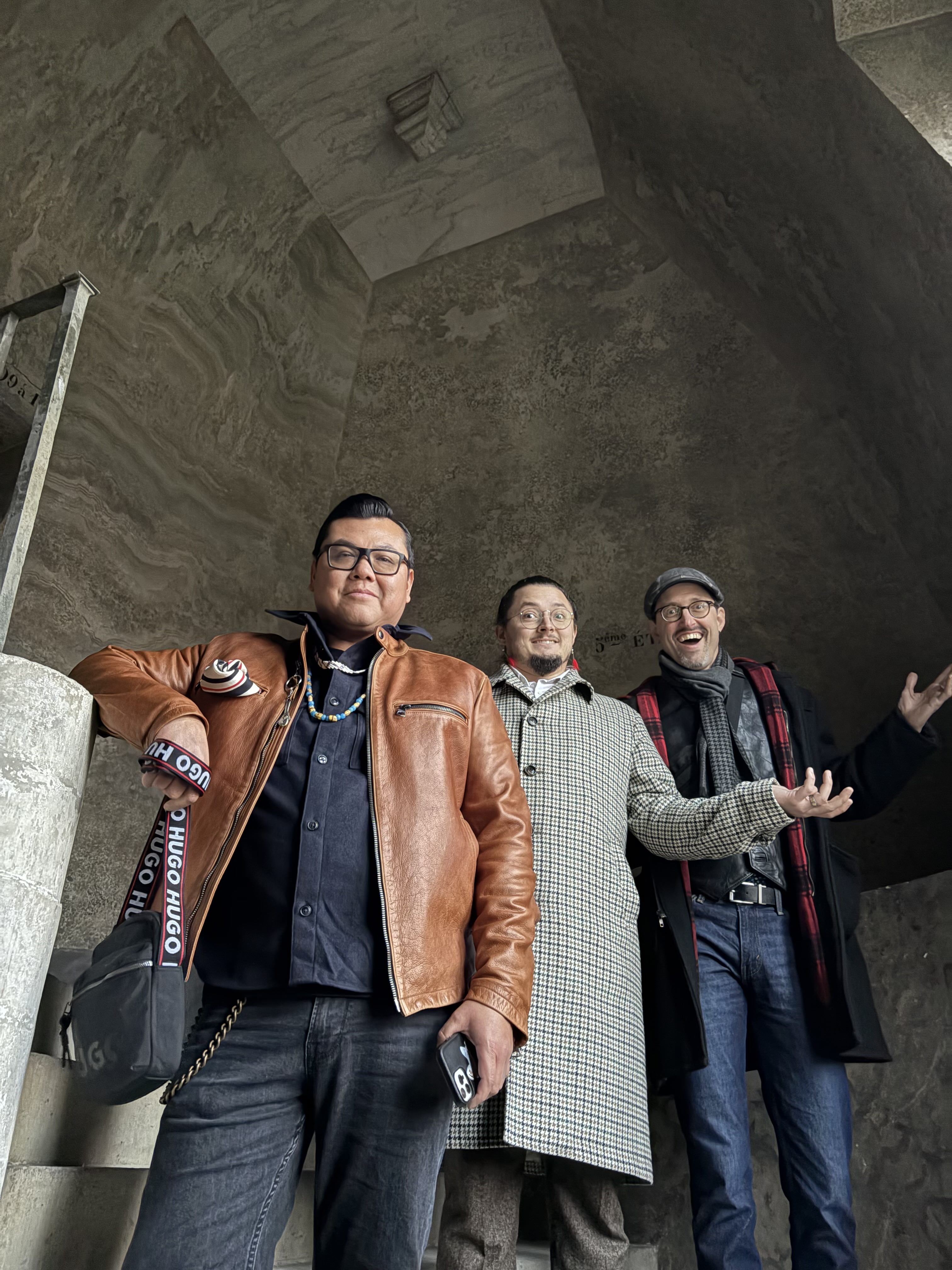
Jamie Jacobs (Tonawanda Seneca), Logan York, and George Ironstrack (L-R) pose at the top of a long winding staircase after getting lost in the Château. Photo by Jonas Musco.
On this trip we continued to follow in the footsteps of the Peoria, Osage, and Otoe-Missouria leaders who visited France in 1725. The forest of Fontainebleau, through which we passed, was a good part of the reason why these leaders traveled south in November of that year. They came to Fontainebleau because it was the palace that King Louis XV liked best when he wanted to enjoy the hunt. It was on November 25, 1725 that these leaders first met the French King at his Fontainebleau palace. A few days later, they went out into these same woods and hunted together in both the French style and using hunting practices indigenous to North America.
The staff of the Château de Fontainebleau gave our large group a wonderful tour of the palace with a focus on what Native leaders would have experienced in 1725. The palace was also a favorite of Napoleon Bonaparte, so it was also fun to learn about his use and modification of the grounds even though this was decades after the 1725 ambassadorial visit.
After the tour, the group convened in a gathering hall within the palace to officially commemorate the 1725 visit. Chairman Shotton of the Otoe-Missouria Tribe, Chief Dobbs of the Peoria Tribe of Indians of Oklahoma, and T.J. Redcorn of the Osage Nation all spoke about the importance of commemorating the 1725 visit and continuing the connections between their nations and the French people.
eewaankiaanki neehi keetwi noonki?
‘Giving Thanks and What’s Next?’
The four of us want to take time to express our gratitude to all the people working at the Musee du Quai Branly – Jacques Chirac, the Château de Versailles, the Château de Fontainebleau, and the Louvre for all their work hosting us and organizing all the programming. We are grateful for the efforts of tribal representatives from the Osage Nation, Peoria Tribe of Indians of Oklahoma, Quapaw Nation, Choctaw Nation, and Otoe-Missouria Tribe. We are also grateful to Dr. Robert Morrissey, the staff of the history department, and the Mellon Foundation – Humanities Without Walls Initiative all at the University of Illinois for their support with the Reclaiming Stories project and for their support in helping our staff make this trip. Neewe to Sven Haakanson for sharing all his photos of the week’s events. A special neewe goes to all those involved in making the exhibition at Versailles such a resounding success. We also want to personally say mihši neewe to Paz Nuñez-Regueiro, Jonas Musco, Leandro Varison, and Éléonore Kissel. Your friendship and hard work over numerous years is deeply appreciated. We look forward to the next time we can sit down together over a coffee or a café and talk about subjects deep in time as well as the deeply meaningful present day.
We hope that at some point in the not-too-distant future that the Versailles exhibition will travel to North America, specifically Indian Country in Oklahoma. George, Logan, Nate, and Doug all recognize how lucky we were to be able to make this trip and visit with these awe inspiring objects of ancestral art. We hope that Myaamiaki, as well as the publics of all involved tribes, can get a chance to do the same. The best way to ensure that this happens is to have the exhibition travel to our homelands and we will do our part to bring this dream to life.
 Aacimotaatiiyankwi
Leave a comment