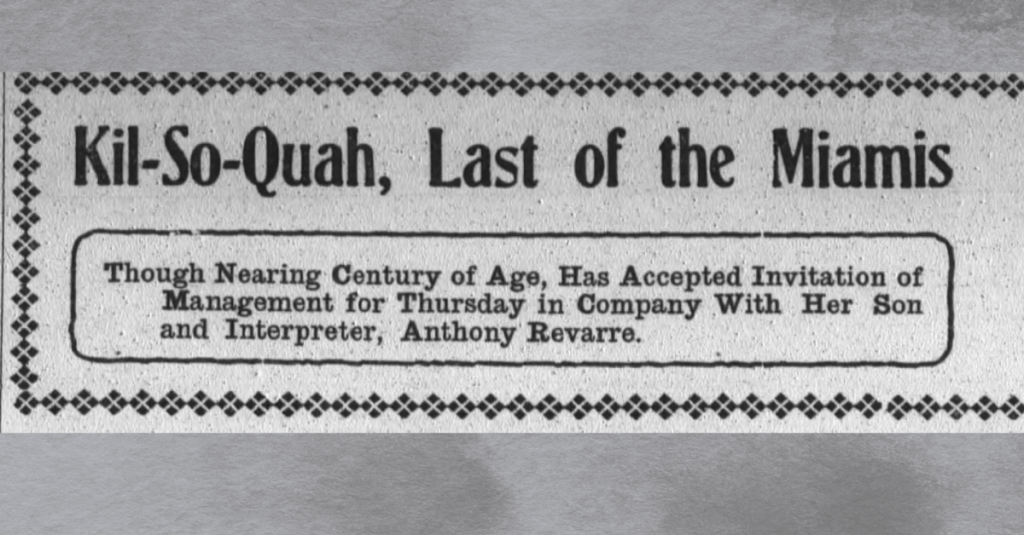
Hoci Myaamiaki! Which of your ancestors was the last of the Miamis?
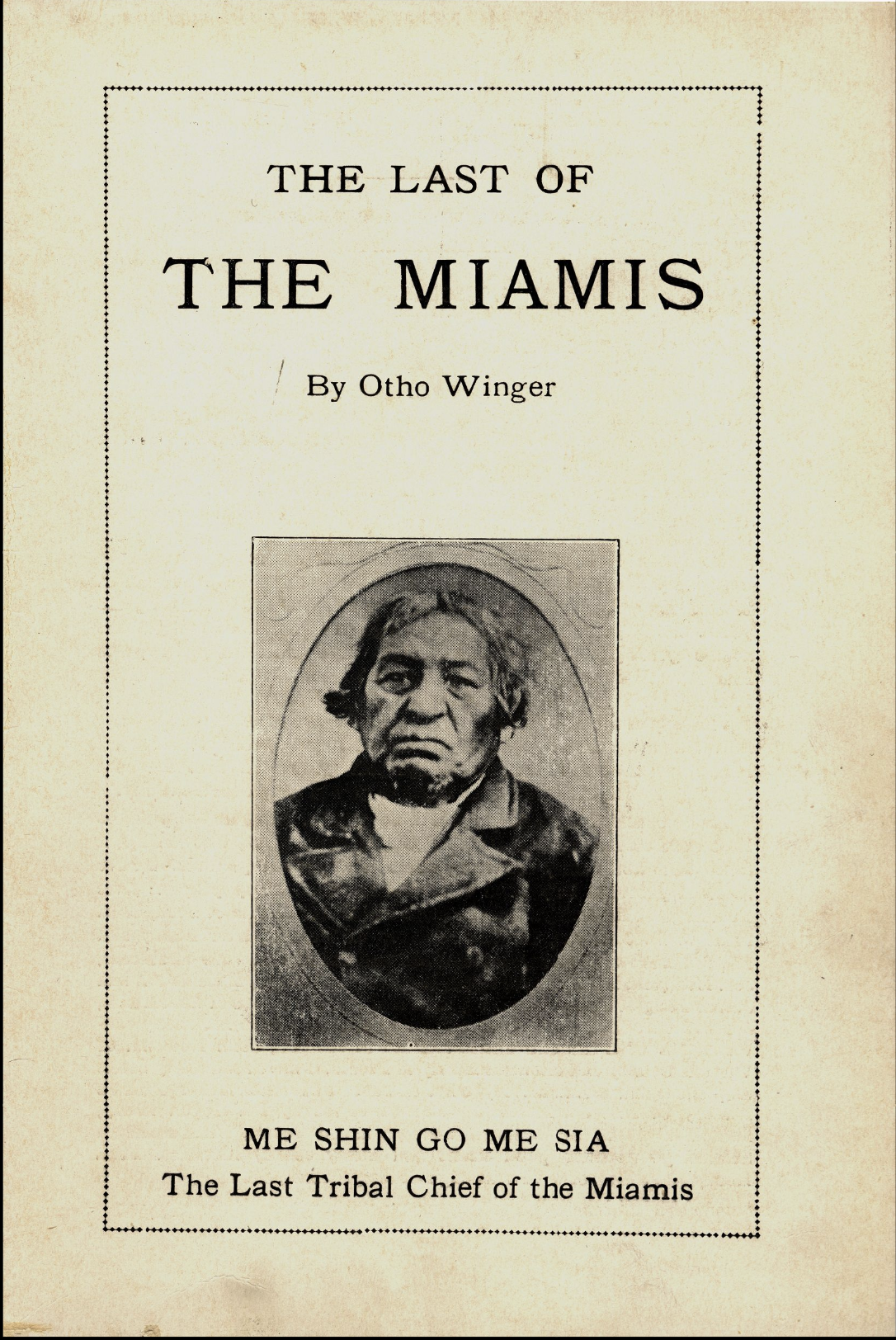
Otho Winger was an academic, the president of Manchester College in Indiana. Winger had once been a schoolteacher on the Meshingomesia Reservation. In 1935, he published a book titled The Last of the Miamis.
The title page showed Meshingomesia, an influential band leader of the nineteenth century. “The race is well nigh gone,” the author Winger lamented. Living Miami people appeared in the text, including in pictures. We see photos of Ross Bundy and Clarence Godfroy, for example, both living, middle-aged people.
Winger corresponded with Miami Tribe chief Harley Palmer to report on their enrollment numbers in Oklahoma. “Mrs. Esther Evans of Huntington has just completed eight years as county recorder,” we learn. Dessie Griggs and Isabel Evans are pictured as young women.
The Last of the Miamis included the information that “there are no full-blooded Miamis today.… There are more than five hundred persons today who can claim to have some Miami blood.”1 Put together, the evidence in the book suggests the opposite of the title. Rather than a story of an end, it is a compilation of some of the genealogies of the people who are still Miami.
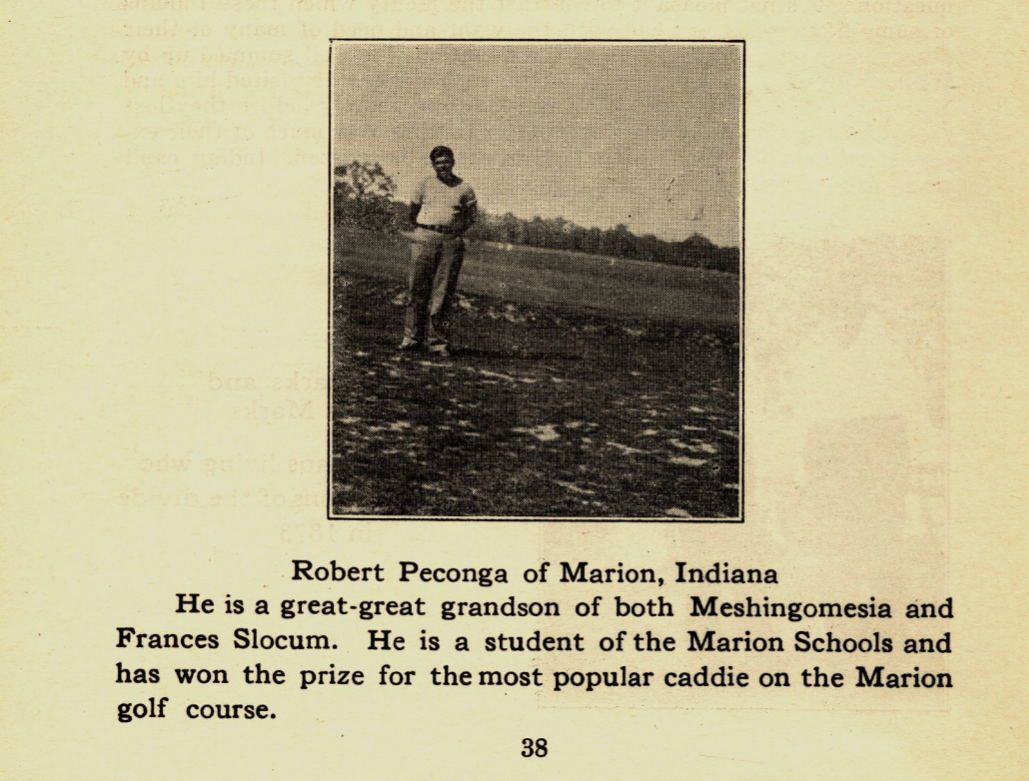
To take one example: the author tells us that Robert Peconga is a student in Marion schools and voted “most popular caddie on the Marion golf course.” Winger never accumulates any evidence that Robert was not Miami. Perhaps we are to presume that Miamis ≠ caddies?
As it happens, Robert was the great-grandson of the “last of the Miamis,” Mary (Winters) Peconga.
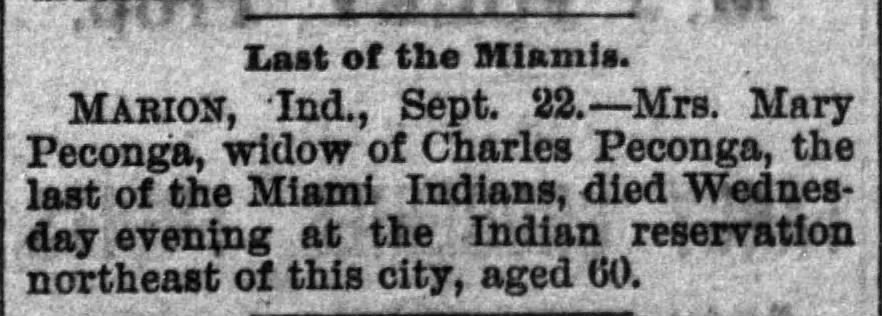
These stories were, and are, powerful. Of course, the “last of” trope pulls on the popular book The Last of the Mohicans, James Fenimore Cooper’s fictional novel from 1826. (Mohicans are still around, by the way.)
If someone is the “last of” the Miamis, then their children and grandchildren are not Miamis. But then Miami people kept on, well…continuing. After the last of the Miamis, Miamis weren’t supposed to exist. Right?

Take the example of Kiilhsoohkwa, also known as Margaret Revarre. As was common among well-known elders in the era, the local non-Miami community assigned the “Last” label to her.
In Fort Wayne, the News and Sentinel conveyed a particularly perplexing case. On the left is Kiilhsoohkwa, whom we are told is the “last of the Miamis.” To the right, adjacent on the page, is her son Anthony, also called Waapimaankwa. If she is the last, then he cannot be Miami, despite the fact that we are looking at him. The evidence stares us in the face, and we are still blinded by the narrative of vanishment.
It’s like an obituary saying: “The last human on earth has died. She is survived by…”
As a professional historian, I feel confident that human reason wasn’t invented just recently, so what was going on here?
The historian Jean O’Brien analyzed this habit in New England. She calls it “lasting.” It was (or is) a rhetorical strategy to write Native people out of existence.2
Jim Buss pointed out this phenomenon in Indiana, as well. His excellent work Winning the West with Words looked at pageants, histories, poetry, and other aspects of pop culture. Taken together, settlers consistently narrated histories in which Miamis and their Potawatomi relatives exited the stage of history.3
These powerful stories had reach. For instance, this 1909 Sunday magazine edition of the Indianapolis Star boldly proclaimed the Last of the Miamis narrative.
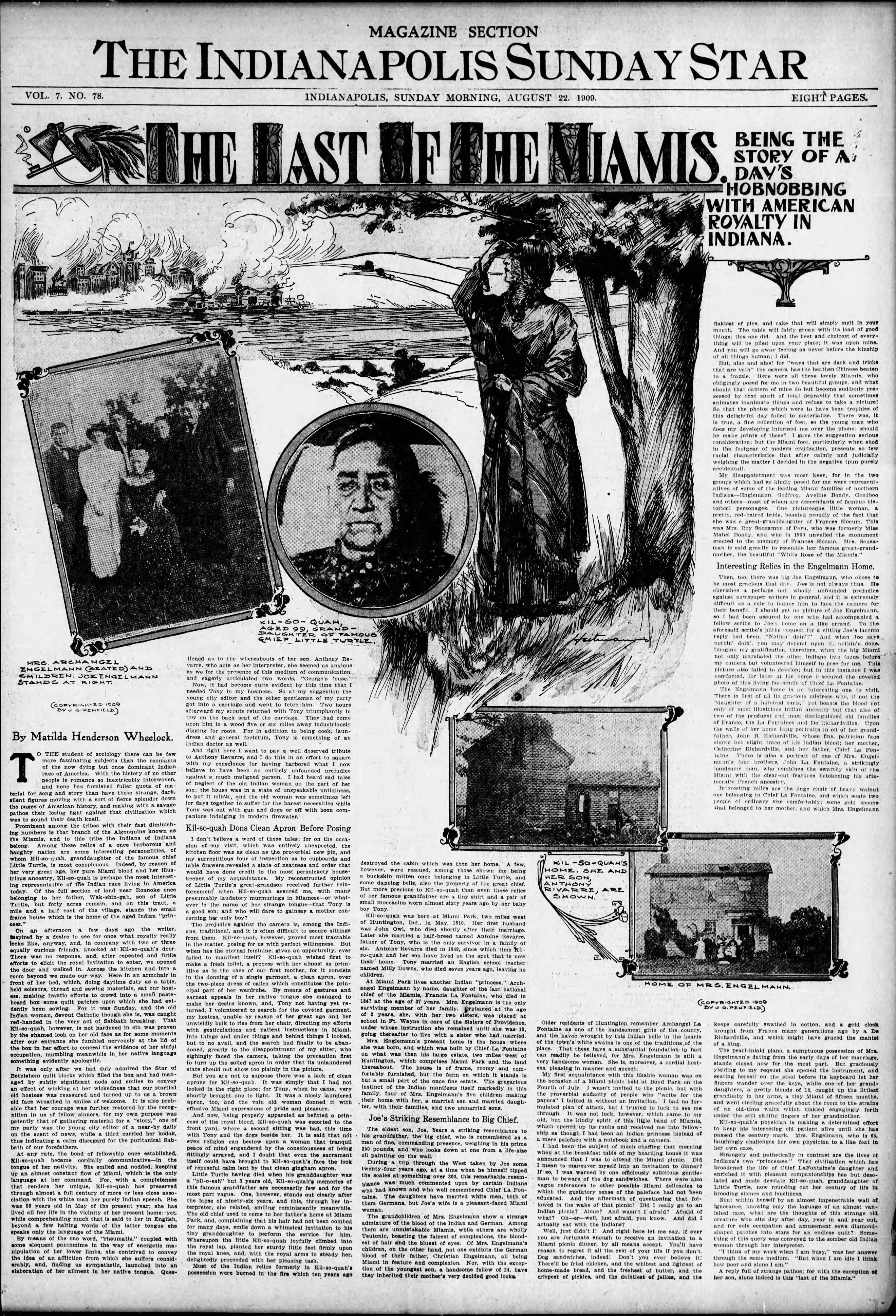
Here, a journalist joins the stories of Kiilhsoohkwa with that of Tahkamwa ‘Archange Lafontaine Engelmann.’ We learn that “Mrs. Engelmann is the only surviving member of her family,” adjacent to several pictures of her surrounded by her children and grandchildren, along with text about her five children and their families.
In the case of Kiilhsoohkwa, writers sometimes added that she was the last “full-blooded” Miami. The idea that blood carries culture or belonging is not really a Myaamia metaphor (nor is it a scientific reality), and any notions of full- (or other -bloodedness) is a subjective exercise. Let’s set that aside, because we have another story that blows up this logic, as well.
Gabriel Godfroy (Waapinaakikapwa) had thirteen kids who survived childhood. Yet, we are told in the Indiana Magazine of History that he was the Last Miami. (This was published in 1907, fully contemporary with the Kiilhsoohkwa stories that dotted the newspapers in these years.) Godfroy, “though not a full Indian as to blood, is fully an Indian in character,” we learn. In other words, the Last Miami was not necessarily tied to the “full-blood” label.
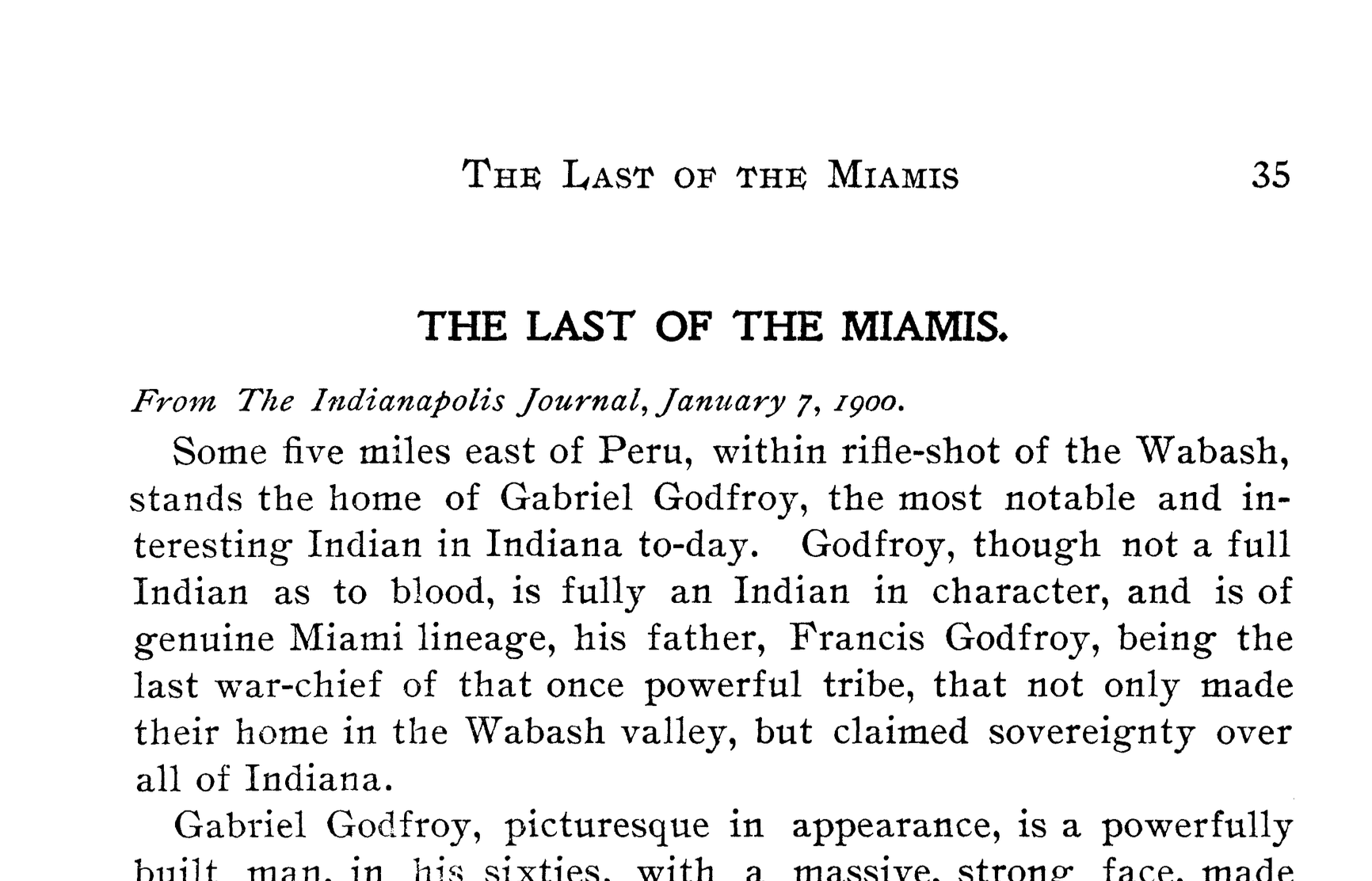
In addition to American ideas about “blood,” another variable to consider is geography. In newspapers, most of the Last of the Miamis stories originated in Indiana, in contradistinction to Kansas or Oklahoma. I suspect that the Last narrative made less sense in Oklahoma because it was so obvious that Native Americans existed and would continue to exist there.
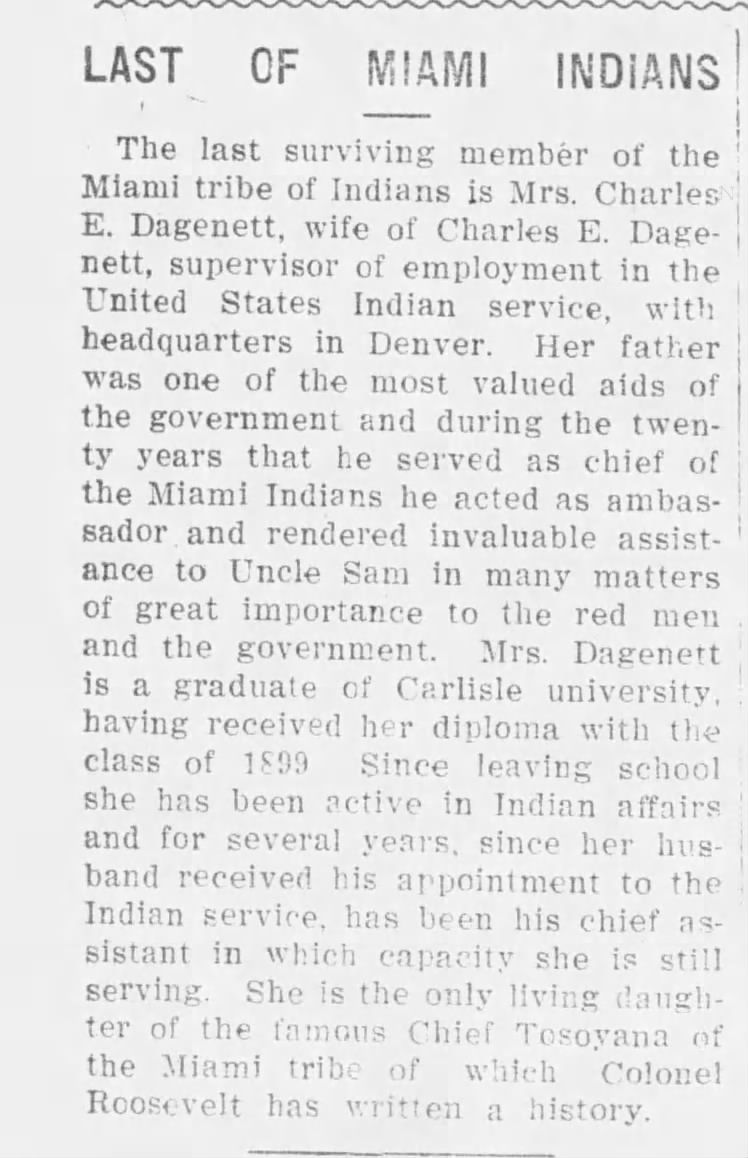
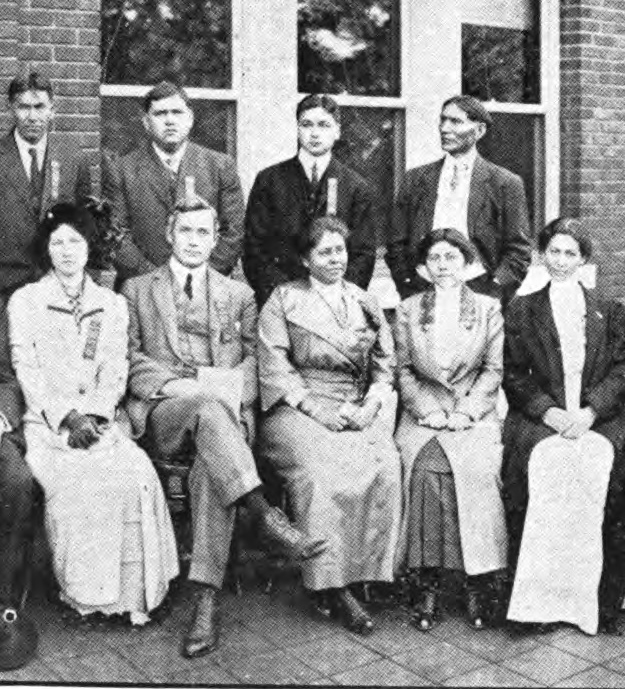
Yet even so, the rhetoric appeared in the Western context, too. Esther Miller Dagenett was an important intellectual in her time. An allottee in Oklahoma, she and her Peoria husband had started a newspaper in Miami before traveling for work, first as educators, and then as BIA administrators. During her lifetime, papers across the country reprinted a series of reports claiming that she was the Last.
There is logic to these stories, but we can and should question them. Americans, and perhaps a few Native Americans too, have accepted the position that change equals loss for Indian people. In this way, Native folks have been rhetorically locked out of modernity–stuck in the past, but not allowed into the present or future. A modern Miami may be an oxymoron to some. Change = loss.
But change is a human condition. It is necessary, universal, and unavoidable. In the words of historian Ned Blackhawk:
As a result of the pernicious, self-perpetuating logic of timelessness on the one hand, and of primitivism on the other, these groups remain outside of history, and any changes or adaptations they have made become only further evidence of their demise. When Native peoples adapt to foreign economies or utilize outside technologies, they are assumed to abandon their previous–that is, inferior–ways while in the process losing part of themselves; they lose the very things that, according to others, define them. Once adaptation becomes synonymous with assimilation, change over time–the commonplace definition of history–becomes a death knell. The more things change, the greater the loss.4
Or, as Jean O’Brien wrote, “Indians can never be modern.”5
Perhaps that is why Last Miami stories persist even when the evidence is so obvious that the Miamis continued.
- Otho Winger, The Last of the Miamis (North Manchester, IN, 1935); see also Patrick Wolfe, “Settler Colonialism and the Elimination of the Native,” Journal of Genocide Research 8, no. 4 (2006): 387-409; Cameron M. Shriver with Bobbe Burke, Our People Believe in Education: The Unlikely Alliance of the Miami Tribe and Miami University (Lincoln: University of Nebraska Press, 2025), 59; ↩︎
- Jean M. O’Brien, Firsting and Lasting: Writing Indians Out of Existence In New England (Minneapolis: University of Minnesota. 2010). ↩︎
- James Joseph Buss, Winning the West with Words: Language and Conquest in the Lower Great Lakes (Norman: University of Oklahoma Press, 2011). ↩︎
- Ned Blackhawk, Violence over the Land: Indians and Empires in the Early American West (Cambridge, Mass.: Harvard University Press, 2006), 4. ↩︎
- O’Brien, Firsting and Lasting, 107. A corollary to modernity is wealth–American pop culture expects Native Americans to be poor, and thus Indigenous economic success can be viewed as somehow in-authentic. A further corollary is language–how can Miami people speak a language that has been deemed extinct? See Alexandra Harmon, Rich Indians (2010), Jessica Cattelino, High Stakes (2008), George Ironstrack, “nahi meehtohseeniwinki: iilinweeyankwi neehi iši meehtohseeniwiyankwi aatotamankwi ‘To Live Well: Our Language and Our Lives’” in Buss and Genetin-Pilawa, eds., Beyond Two Worlds (2014), 181-208; Wesley Leonard, “When is an ‘Extinct Language’ not Extinct?: Miami, a Formerly Sleeping Language” in K. A. King, ed., Sustaining Linguistic Diversity: Endangered and Minority Languages and Language Varieties (2008), 23-33. ↩︎
Updated: 4/22/26 11:15 a.m.


Leave a comment