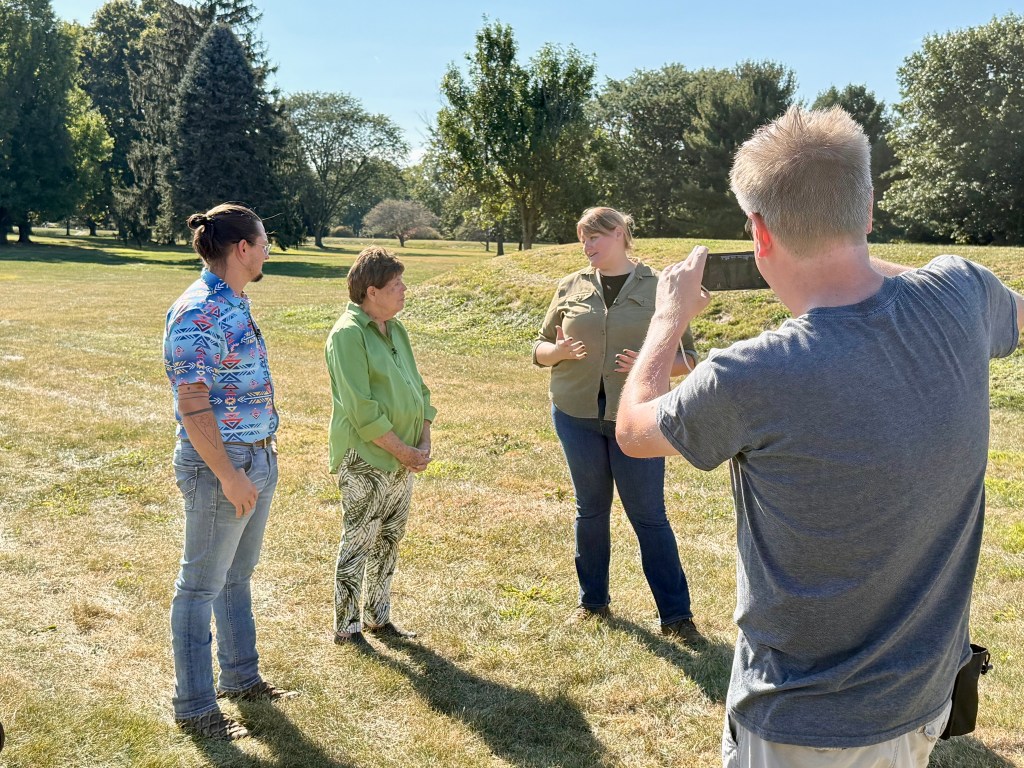
Written by: Logan York, Tribal Historic Preservation Officer, Miami Tribe of Oklahoma
UNESCO’s World Heritage Committee approved the Hopewell Ceremonial Earthworks for inclusion on the World Heritage List during its meeting on September 19, 2023, in Riyadh, Saudi Arabia.
Five nations were sent to represent the sites: the Miami Tribe of Oklahoma, the Wyandotte Nation, the Eastern Shawnee Tribe of Oklahoma, the Seneca Nation of Indians, and the United States. Given the complexity of world politics, there was no guarantee that our submission would be accepted or that our presentation would go smoothly. The presentation before ours resulted in an argument that lasted almost two hours, during which two countries accused each other of war crimes.

In our case, the years of preparation and collaboration completed by the delegation members worked in our favor. After our team presented the submission for the Hopewell Earthworks, UNESCO voting members praised our presentation. We waited for questions, and none came. Within three minutes, the Hopewell Earthworks were added to the World Heritage List! In those brief moments, the world’s leading historians, archeologists, anthropologists, and ambassadors acknowledged the uniqueness and significance of these sites, recognizing them as remarkable achievements of human genius. They understood that the human story cannot be complete without including these monumental sites. The swiftness of the decision was a testament to the team’s lifelong efforts and commitment to the preservation of Indigenous history and culture.
The phenomenon we call Hopewell today was unlike many archaeological “cultures” in that it was not a single or related group of people displaying similar cultural attributes, but rather a spreading religion that spanned different cultures and had connections across North America. Hopewell got its name from the landowner, Mr. Hopewell, when Squire and Davis visited what they called “the Hopewell Mound Group.” Originally, the name “Hopewell,” did not have any connections to the actual Native people who built these places. Today, archaeologists use the term Hopewell as a shorthand for the people and the continent-wide interaction sphere that participated in and were centered at these earthworks. The Hopewell built the greatest concentration of earthworks anywhere on earth. We use the term earthworks because not all earthworks are mounds; some are walls, effigies, or even viewing platforms, and calling them mounds can give the impression that they are just piles of soil rather than carefully engineered structures built in a highly ceremonial context.
After we successfully secured the Hopewell Earthworks’ inclusion on the World Heritage list, we realized that was only the beginning. Our next challenge was to put in place the necessary infrastructure to handle increased visitors and reflect the site’s new World Heritage status. Equally important to this was the long, arduous task of helping local people and the broader public understand the true importance of these sites.
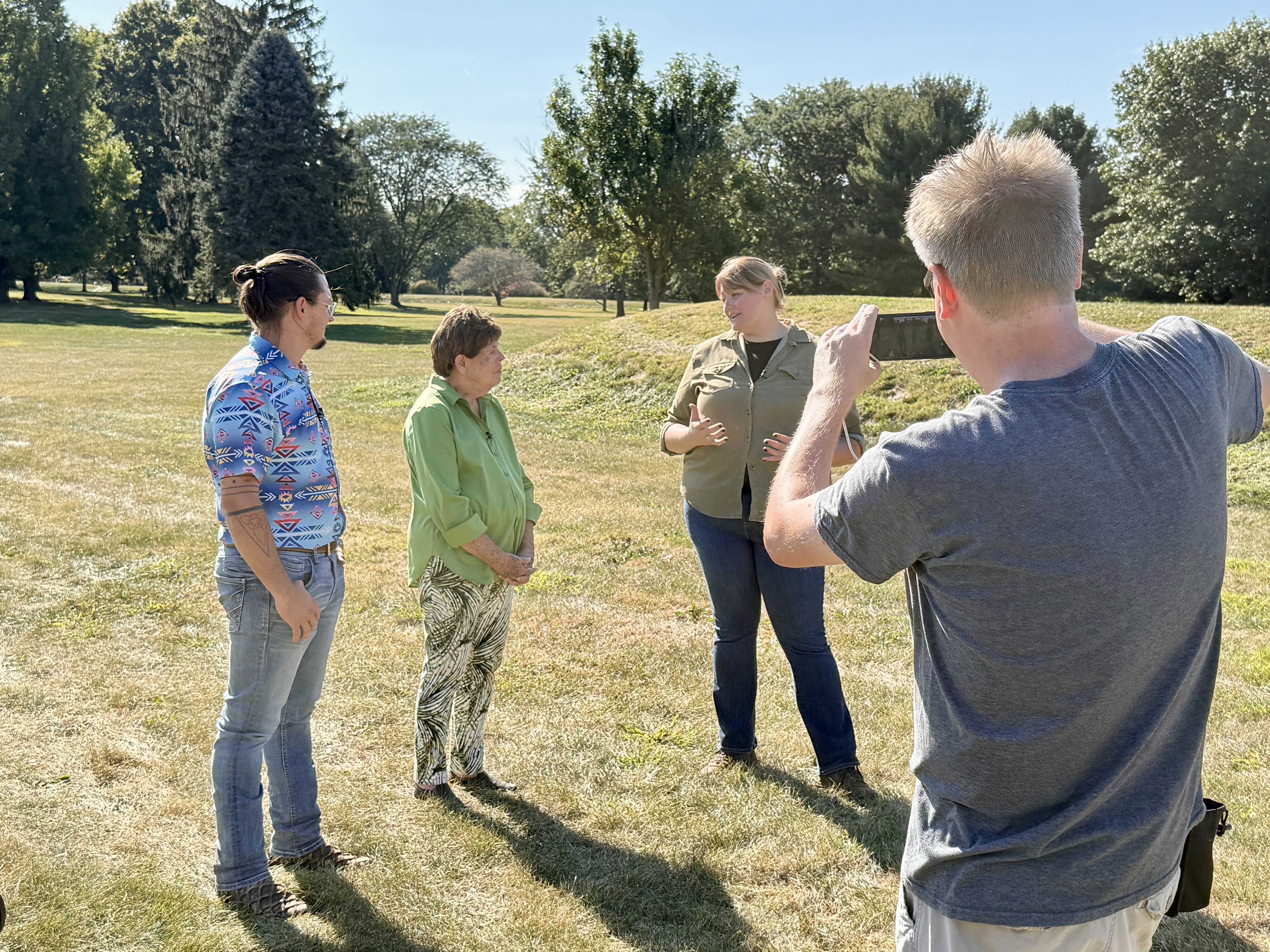
WOSU Public Media, an NPR and PBS member station in Ohio, is a leader in this initiative, filming a digital documentary series about the Hopewell Earthworks that features both archaeological and tribal experts. The aim is to tell the most comprehensive and holistic story possible.
During this process, I (Logan York) was invited to host the documentary, both as the Tribal Historic Preservation Officer (THPO) for the Miami Tribe of Oklahoma and as one of the delegates sent to Riyadh. While it was obvious that the THPO perspective would be important to the project, I also wanted to include my own cultural understanding and background as a Miami Tribe citizen. This dual perspective is essential for gaining a deeper understanding of what these places truly were; it allows us to formulate new answers—and, perhaps more importantly, new questions.
For example, during the filming at Seip Earthworks, a simple question arose: Did the workshops that some earthworks were built over have windows for people to work in? As far as we can tell, no one had ever asked that simple question in 150 years of study on the wooden structures on site. Instances like these remind us that new perspectives and drawing from different knowledge pools can lead to new inquiries and, therefore, new discoveries. From an archeological and historical angle, having a tribal perspective on artifacts can be invaluable. For instance, items like Water Drum Marbles or cattail mat needles, which an archaeologist might mislabel, could be easily identified by a native person familiar with their historic and contemporary uses.
While this documentary series embraces this collaborative approach, interpreting cultural practices is inherently more challenging than analyzing physical artifacts. Distinguishing between a stomp, a social dance, or something similar performed 2,000 years ago via archaeology is extremely difficult. However, combining descendant knowledge with archaeological findings is the closest we can get to a true understanding of these sites.
Throughout the documentary, we visit all eight earthworks in Ohio inscribed on the World Heritage List, accompanied by leading archaeological experts at each site. We also engage with descendant communities of the Hopewell people. This included attending a Shawnee stomp dance in Wyandotte, Oklahoma, something that might be very similar to dances performed at or near the Hopewell Earthworks. The topics discussed include leading theories about the wood henges and structures present at these sites, exploring fascinating aspects like the monumental recording of the 18.6-year lunar cycle, and correcting misconceptions that have persisted since the early to mid-1800s—misconceptions that were disproven by archaeologists even as they were being created.
Archeology today recognizes that structures built all over the world, similar to the Hopewell Earthworks, have been centered on astronomy, significant agricultural events, and other important cultural events. Archeology today also recognizes that structures built in relatively close geographical spaces are interconnected.
In our case, the Hopewell Earthworks in Ohio have been found to be related to additional Hopewell Earthwork sites across the eastern woodlands, using astronomy and oral traditions to provide directions between people and places. Our ancestors were more than capable of astronomical observations and organizing large-scale workforces to construct these sites. They were human, and that means they were astronomers, mathematicians, mothers, workforce planners, religious leaders, fathers, farmers, hunters, and engineers; anything and everything that humans do, we did too. They were capable of uncommon feats of genius, and these earthworks reflect that.
Conversations with professional archaeologists shed light on how and why this was possible. It is important to note that constructing these sites was not simple or easy. It required tens of thousands of hours of labor and careful planning. The builders had to feed all the workers involved, many of whom traveled from various regions to contribute to these extraordinary sites. The earthworks are not just piles of soil; they are deliberately engineered. The soil did not necessarily come from nearby; it had to be brought from elsewhere, featuring clay bases and alternating colors and types of soil that reflect the worldview of the people who created them.
Something that you see a lot in Hopewell art is alternating colors of light and dark, like black and white, red and yellow, probably reflecting an overworld and underworld or life and death. We are not quite sure how related this cultural trait is to later ideas of overworld and underworld, but by looking at later cultures, we might get a little closer.

These earthworks also reflect geometry in their construction. The different sizes and shapes; square footage can be divisible from each other; they had a standard measurement used across the entire Hopewell time period. Some of the square footage of different-shaped earthworks is exactly the same, even if it is a square to a circle, or specifically divisible with each other. Seip, Liberty, Works East, Baum, and Frankfort Earthworks are all made of a small and large circle and a square. When Squier and Davis mapped and measured these five earthworks in the 1840’s, each square was the same size: 1,080 feet on each side, which works out to 27 acres. The square footage of both the Great Circle and Octagon Earthworks (1,054 feet) matches that of other Hopewellian structures. The recording of alignments at these monumental scales would have taken generations of knowledge. They would have to pay attention and record across multiple generations to make sure that their alignment calculations were correct before they would build these places. They truly were uncommon geniuses.
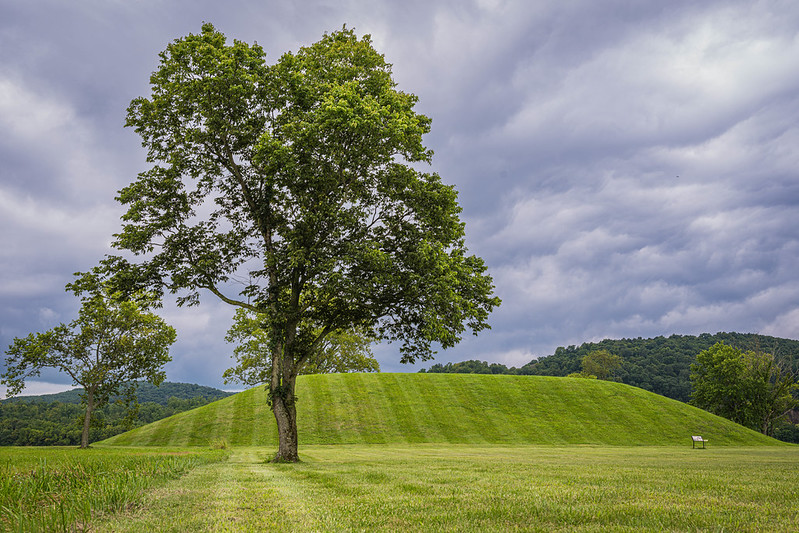
Photo Courtesy of Don Sniegowski.
My hope is that the documentary, this article, and other works like it will keep spreading the incredible story and research behind the Hopewell Earthworks. Our ancestors were capable of amazing things, and it is through our oral histories and modern research that we can attempt to understand them and the people who built them on a deeper level.


Leave a Reply