America250, you may have heard, is happening this year. It (whatever “it” is, as we wrestle with below) is an attempt to mark the passage of two and a half centuries since rebels signed the Declaration of Independence from Great Britain in July 1776. In the main, events are organized and managed by each state independently by state organizational committees. (Here is how Oklahoma, Indiana, and Ohio express their participation.)
As a historian, I had heard plenty about how states were, or were not, effectively managing discourse about civics and history. As a historian at the Myaamia Center, where our efforts focus on Myaamiaki ‘Myaamia people’, I had not heard much at all about how the Miami Tribe or its citizens were engaging in these conversations. So I asked my friends and colleagues to help me think about this commemorative process. The following engaged in a relatively wide-ranging discussion:
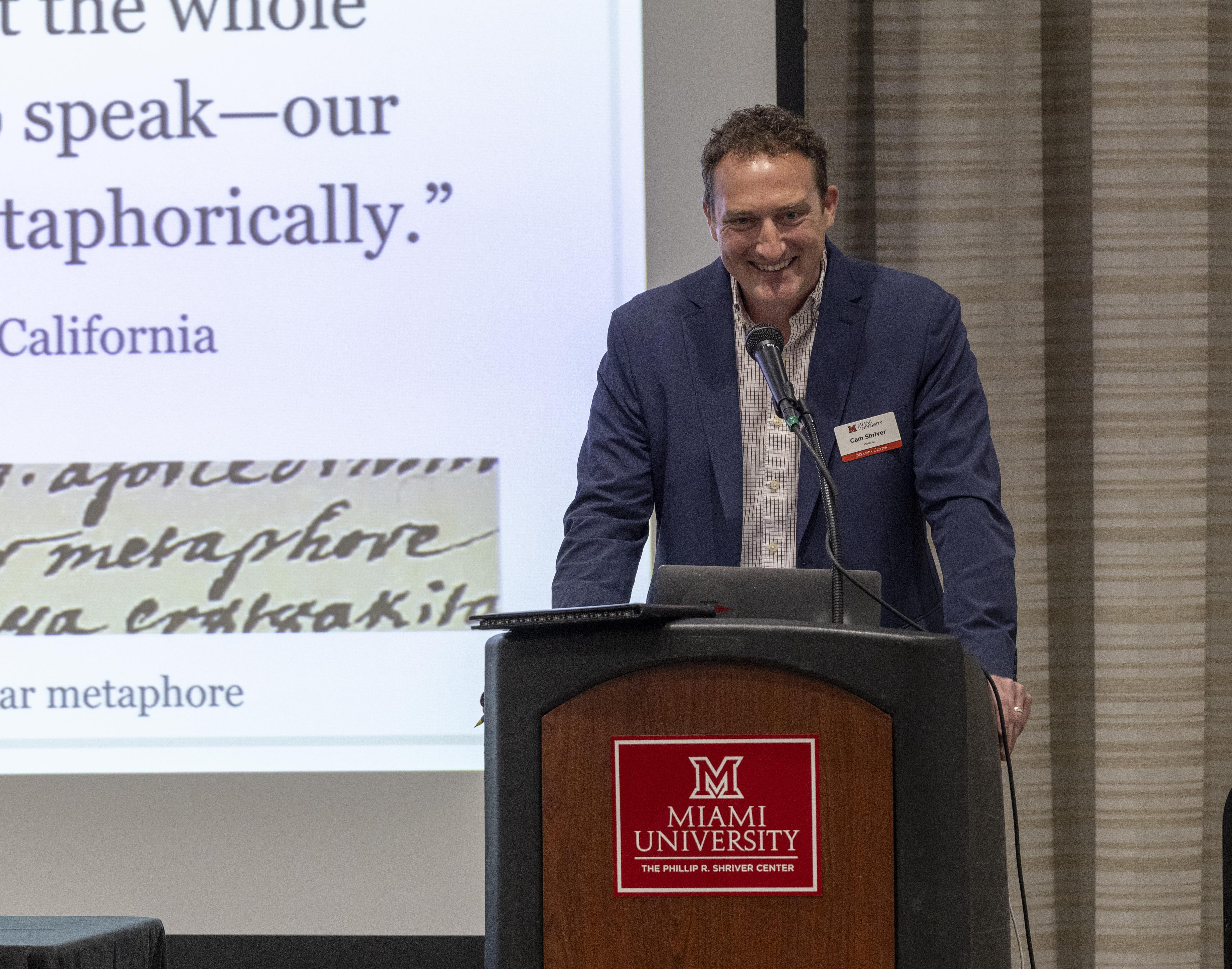
- Logan York, Myaamia Citizen, Tribal Historic Preservation Officer of the Miami Tribe of Oklahoma.
- George Ironstrack, Myaamia Citizen, Associate Director of the Myaamia Center in Oxford, Ohio.
- Morgan Lippert, Curator of Exhibitions for the Myaamia Heritage Museum and Archive, Cultural Resources Office, Miami Tribe of Oklahoma.
- Cam Shriver, historian at the Myaamia Center in Oxford, Ohio.
Below is a transcript of our discussion, lightly edited for readability. This post has been separated into several sections for readers who wish to jump to the information on a particular topic:
- Miami Tribe Participation in America250
- Engaging with Myaamia History
- Were Myaamiaki ‘Myaamia people’ part of the Rebellion?
- Reactions to America250
- Patriotism and Myaamia History
Miami Tribe Participation in America250
Cam Shriver: Let’s talk about America250. I have experienced America250 in Ohio as more or less a reason to put on patriotic celebrations; local-based celebrations, such as parades. That’s about it. Some of us have been asked to do Ohio250 events, such as a history of the Ohio region in the era of the American Revolution, which probably had about 100 people attending via Zoom, which is great. I think that America250 is about the revolution, but it’s not really about the revolution. So I wondered what your experiences were as museum, history, and education professionals.
Logan York: I can say that I’ve been involved in a couple of different America250 things, so there was that Zoom presentation series that Ohio was doing. I think that was a little more history-focused. I think that was good. And then I got invited to do an America250 thing up at the Fort Wayne Historical Center. And that went fairly good. I bet there was a hundred and something people there. Generally what I do is, you know, I’m asked to go give a talk about something, and then I’ll talk about what I want to talk about, and then I kind of just twist the end to be the theme. So I basically gave our standard Miami history talk. And then at the very end, I had one slide with America250 on it, and then I just, you know, did a little speech about it, and then I was like, let’s… now let’s talk about that, and kind of opened it up.
Because one of the questions you would get in that scenario is, why aren’t you celebrating this thing? Well, I told you why for the last 45 minutes. So that’s how I’ve been involved. I have a couple of other things coming up, which I will most likely follow the same format where I’ll talk about Miami history and how we got to where we are today, and then kind of explain that in relation to America250.
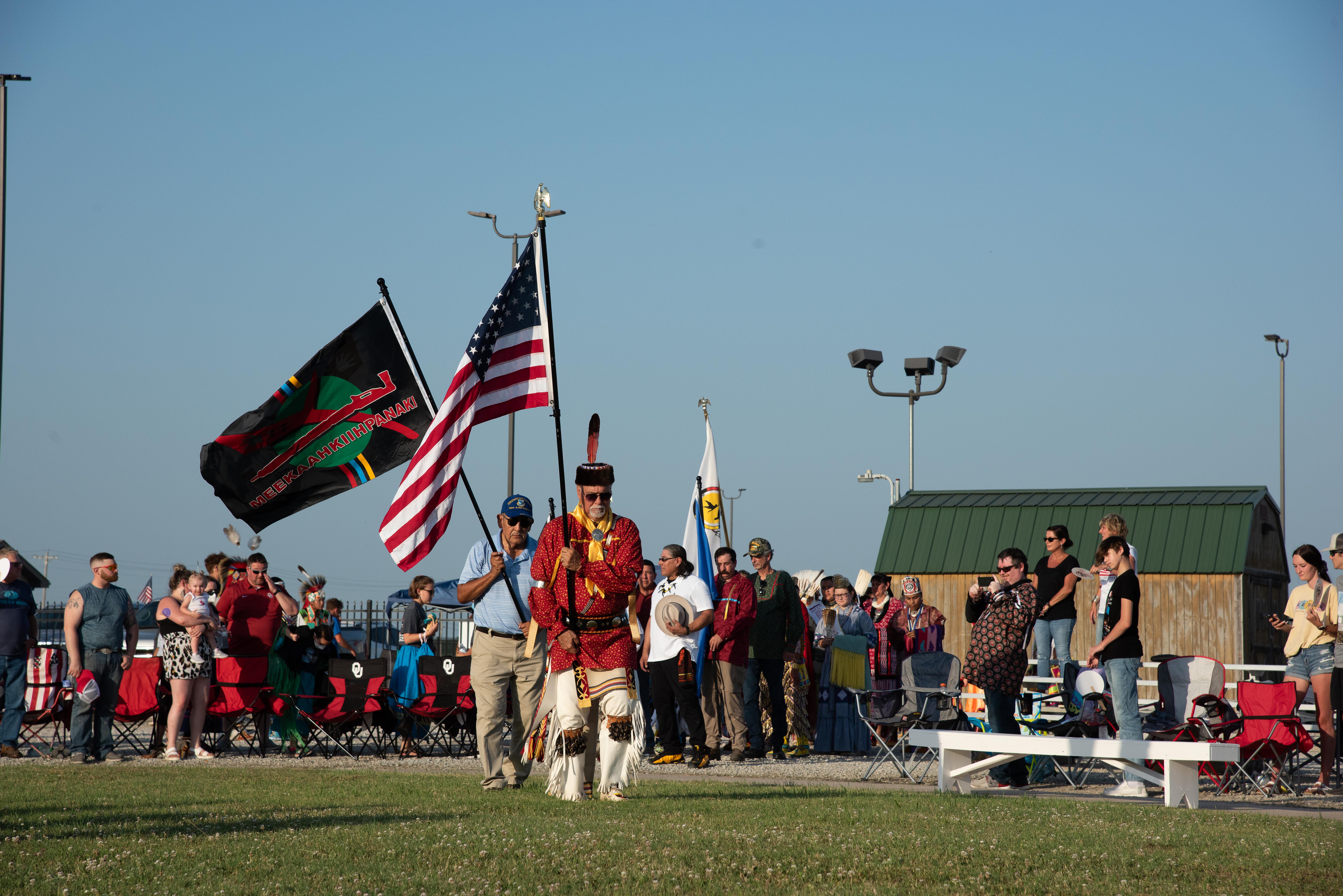
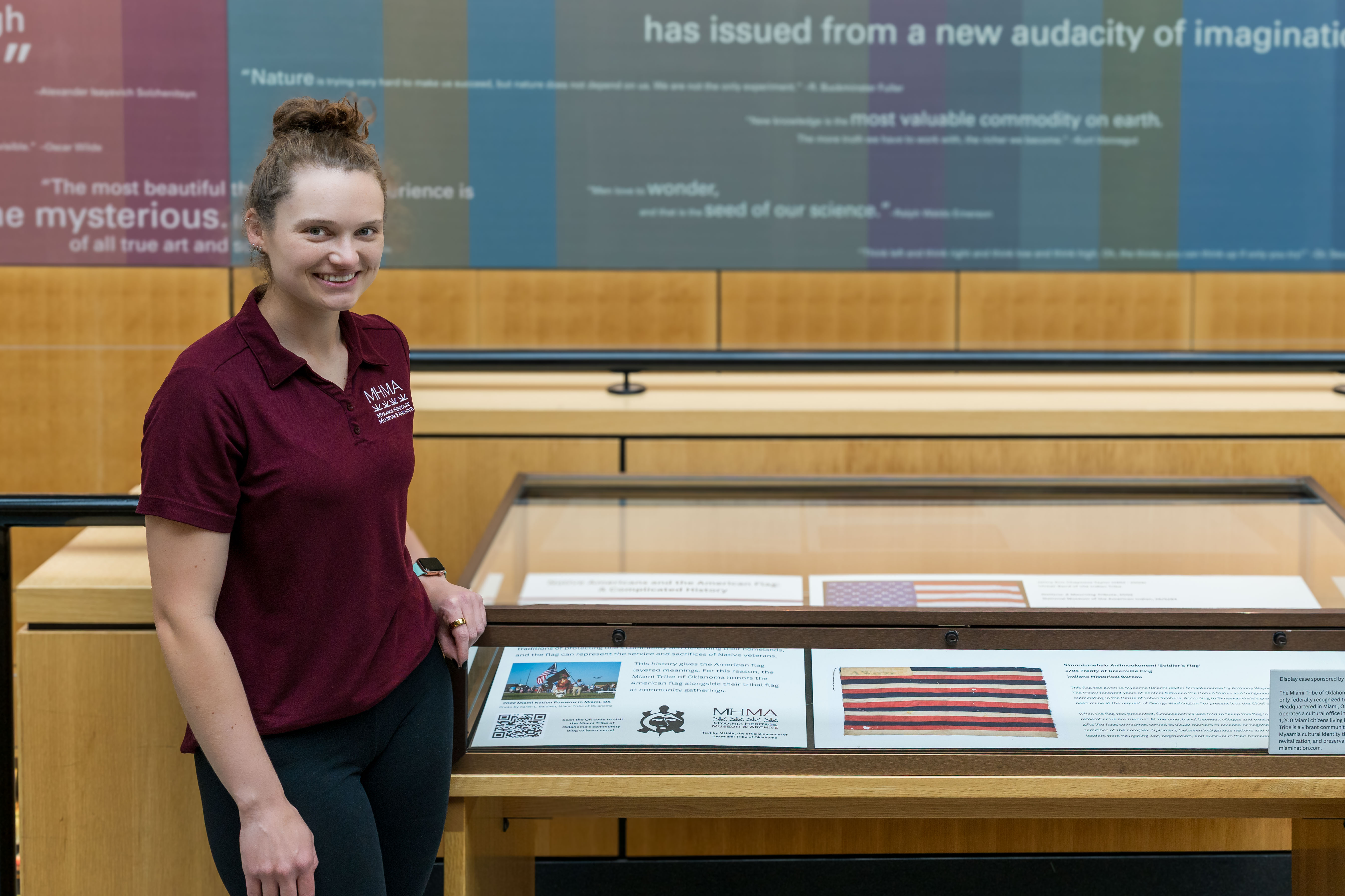
Morgan Lippert: In my experience for America250, I’ve sent a lot of requests to Logan. Sometimes people reach out to the [Myaamia Heritage] Foundation, but I still send requests to Logan. The Allen County Public Library, their main branch, through the Daughters of the American Revolution, they wanted the tribe to do a… they had a bunch of glass exhibit cases on their second floor, and groups in Fort Wayne each got an exhibit case to put stuff in for America250. Meghan [Dorey] and I, and Logan consulted on it, but, Meghan and I decided to not do that. Instead, one of their requirements was to have a red, white, and blue theme in the exhibit. So we did. The little mini-exhibit was about complicated feelings and histories with the American flag itself and Native communities, like, how we see the American flag at powwows, and it’s with tribal flags, or in veterans’ dances, and so there’s this complicated relationship with the American flag and Native communities, and the fact that Native people serve in the military at higher rates than the average American, and why is that?
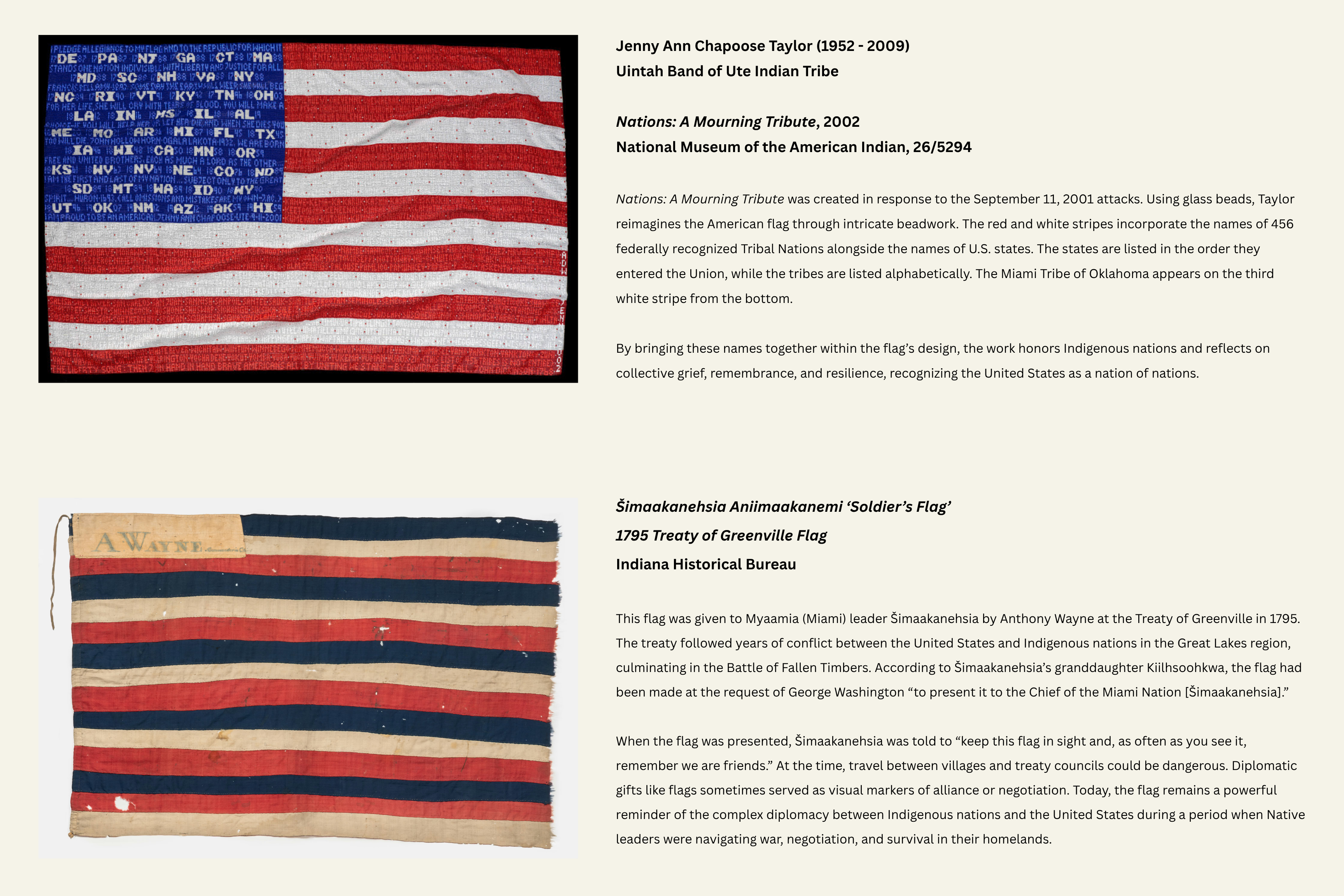
I don’t think we even put America250 in the text at all. I had two photos of two American flags. Jenny Taylor–this is in the Smithsonian, but I think I saw it at FAM [First Americans Museum], in one of their rotating exhibits. It’s tribal nations beaded into the American flag. She did this in response to the 9-11 attacks. And so, Meg and I were just thinking that you see America250 imagery, and the American flag is everywhere, you know? We wanted to take an angle about how the American flag has kind of shown up in different ways. It’s just this kind of… I don’t want to say dual identity, but she puts in…like, with liberty and justice for all. It was a very interesting piece that we brought. Then we talked about the Soldier’s flag, using the blog post about that.
Long story short, similar to Logan, we didn’t really do what we were supposed to do. Yeah, a complicated history. We showed the veteran’s flag with the American flag, together there, but just talking about the complex history and, you know, what does it mean to fight under a flag that holds so much complicated history?
Cam Shriver: It seems to me that sometimes we’re choosing not to engage with America250, but I’m not sure.
George Ironstrack: Yeah. I started having people from my OHC [the Ohio History Connection, the state’s historical society] connections reaching out over two years ago, when the commission was formed here in Ohio. And I think from the very beginning, I was like, I don’t really want to be involved in this. I think Logan’s mission is different on behalf of the tribe. I’m not seeking every place I can to project a Myaamia voice, and I was on the Ohio Commission to commemorate the 200th of the War of 1812, and that was extremely disappointing. I realized by the end of that that given the amount of time I put in, my impact was negligible, maybe even negative. And so I just… I didn’t see any purpose for myself in my current role, and for me as a person participating at all. I think I immediately said to people like Todd [Kleismit] from OHC, you know, Ohio wasn’t a part of the United States 250 years ago. And they’re like, yeah, yeah, yeah, we know; we want to have Indigenous voices. It’s like…No. With the War of 1812, most of Indiana wasn’t a part of the U.S. during the War of 1812. And yet, the way they commemorate is as though Indiana was always a part of the United States. There’s a failure to think about the commemorative date, and then the growth that happens after that date, and that growth–for us anyway–is experienced through conquest, and then through treaties and forced removal, and I don’t think they really want to hear that story. Again, to continue just focusing on our own community, and do the work there was more important, for me and my work.
I don’t think there’s a problem with the United States commemorating 250, I think it’s about how it’s done. In one of the blog posts I wrote about reflecting on the Mihši-maalhsa Wars in the beginning, as I’m listening to 4th of July fireworks. You know, the Declaration of Independence is something to commemorate. There are transformative ideals within it. But there’s also horribly racist text, and so you have to confront and recognize both, and I’ve yet to see the country do that, in terms of concerted effort that’s broad throughout the whole United States. It’s too caught in the culture wars to have that kind of conversation.
To me, commemorations are really valuable. Celebrations are, to me, for celebrating my kid’s birthday. When you get at the national level, celebrations very quickly become toxic. Or…illusionary? Delusionary? Whereas commemoration, if it’s honestly commemoration, it forces a balanced reflection. And unfortunately, I don’t think the United States is in any shape, culturally, to do that constructively. I sure wish it was.
…Maybe at the 300th?
Engaging with Myaamia History
Cam Shriver: There’s a lot of research about what Americans think about history, and Americans tend to think that American history is really important, and that everyone should be learning it and be civically engaged. The question becomes, well, what is history, and why is it important? So let’s say that a lot of people think that it’s important to engage with history. On the America250 website, they want to engage all 350 million Americans in the 250th anniversary. Usefully vague, problematically vague, of course.
Obviously there is no single American experience or American viewpoint, but how do you see settlers engaging with history or Myaamia history, versus, in a Myaamia context, how people think about long-term history, or commemoration, or… Is there a difference or not really? Do you calibrate things or get feedback differently?
Logan York: Are you saying how the general public absorbs Myaamia history versus American history? Yes. Okay.
Cam Shriver: Miami history, or just history in general.
Morgan Lippert: I think that growing up non-Indigenous and in non-Indigenous spaces, American history was very much rose-tinted glasses, you know? You talk about, what was the Revolution like, what was it for? You know, it’s this thing to take pride in, and like George said, it’s a celebration, it’s not a commemoration, whereas maybe in other countries, there can be a little bit more nuance. At least from my perspective, when non-Indigenous people talk about American history, it’s like something they take pride in, and it’s something they can own. And then you try and talk about Native history, and bringing that to the present. I think that there’s a barrier. They’re like, well, that’s in the past.
That’s what I’ve come to learn, I guess. And Logan, I don’t know if you’ve experienced that. People want to talk about history, they love history, but they make it about them. Like, we’re American, and we have all this great history, and then you try and talk about Native history, and it’s like, well, that’s in the past, that’s over with, like, why can’t we just get over it? I think that also gives people a reason to not engage with Native communities today, if you keep saying, well, that’s in the past, that’s in the past. I think that’s where I see a little bit of a difference, at least from an outside perspective, of those engaging with those two different types of history, I guess.
Logan York: I certainly would agree that something I encounter relatively often is people say, oh, that’s in the past, that’s done now, yadda yadda, as if these things were a really long time ago, and that they don’t affect us anymore today. I’m like, you know, that’s two lifetimes ago. That’s it. It’s crazy that, when you actually sit down and think about it, how very little time has passed since the Revolution, or removal in 1846, and all these important dates. These very much still affect people today.
And I understand that a lot of people have a hard time grasping that. If I talk about Myaamia history, when I’m just doing that regular talk, and I go up into the 1840s, how it goes through when we moved down to Oklahoma in ‘67, and how boarding schools and allotments and all these things affect us, then that makes sense, because I’m going in a timeline, and audiences can see, that really only stopped 50 years ago? Or did it really stop 50 years ago? So, I think that when you can walk them through a timeline, it makes more sense for people.
When people are encountering history, they want to look at it as a story, not something to learn from. History is a story. It should be entertaining and educational. But yes, I think that is something I do encounter pretty often. It’s almost like a cognitive dissonance. When audiences think about history, it’s like this, you know, rose-tinted story, and it doesn’t affect us anymore, and it’s not until you actually talk with them for an hour and actually walk them through how these things very much are still relevant, that people really start to understand it. And whether they absorb that or not afterwards, I don’t know.
George Ironstrack: The United States is a country that is still very young. And it leads to this sense that I think both Morgan and Logan are talking about, that people don’t have a sense of their history. They both think it’s long ago and at the same time, it’s all still there for them if they want to engage with it. It’s there. The stories are all over the place in commemorations and on the land, but I think unlike some other countries I’ve been in, people here have moved around so much, they don’t have a sense of it.
There are exceptions. People who have, for generations, lived in the same place, tend to at least know their local history in a “dirt under the fingernails” kind of way. But I think for most Americans, their families have lived all over the place and don’t really have an embedded sense of the story of the country. All they have is the textbook, either an extremely thin or overly imaginative version of U.S. history.
And just as a young country, then, I think the country’s still struggling to understand itself. I hope that that comes with time, because again, I think what we’re suffering right now, culturally, is because the United States hasn’t looked after its own culture. Most countries actually have a department that’s in charge of maintaining the culture of the place, and for reasons we’re all aware of, I think, in lots of different ways, the United States has not done that, and whether it has to be official or not, you have to care for your culture. Minoritized peoples have to do that, because our cultures won’t survive if we don’t.
And oftentimes, majoritarian cultures can be kind of thoughtless about their culture. And it’s not true everywhere, but I think the United States has largely been thoughtless with how it maintains these cultures. Most non-Native students that I deal with at the university would say that they don’t have a culture. And that’s insane. Of course you have a culture. I don’t think you can be a human being without a culture. And why, then, when you go traveling in Europe, do people look at you for ten seconds and say, “Oh, you’re an American?” Despite my identity being multifaceted, they look at me, and they say, oh, you’re an American. And it doesn’t matter your race, it doesn’t matter your socioeconomic status, you go to another country and they’re like, “You’re an American.” They can tell right away, usually. And I think that lack of a cohesive understanding of culture continues to affect countries like the US, and their ability to take a commemoration and do something useful with it.
And, at least in the Myaamia community, I don’t see a big interest in the Myaamia take on America’s 250th. I think Myaamia people do want to know about the Mihši-maalhsa Wars, or about specific people, but I don’t really sense in our community that there’s an interest in, for example, really understanding the War of 1812, or really understanding the Mihši-maalhsa Wars even. They want to know a little bit about it. They’re much more interested, I think, in how they and their families connect to ancestors, ancestral places, and then they really want to be about the community and the culture today. I think that’s what I see from our community.
I don’t think I’ve had a single Myaamia person ask me about America’s 250th, except for people who I work with professionally, who are all getting the same requests externally. I don’t know if, Morgan or Logan, if you’ve had other Myaamia community members ask you, but I have not.
Morgan Lippert: No, no one’s even asked, like, are we doing anything for that? No one’s brought that up to me at the CREO [Cultural Resources Extension Office in Fort Wayne], or anything like that. I don’t want to say it’s not on their radar, but I also…maybe they don’t expect us to do, like, you know…
But, George, you brought up something really interesting about Americans saying, “I don’t have any culture.” And I think that is maybe why sometimes this patriotism of America250 is trying to develop an idea that we’re all in this together, we’re all this thing, because, you know, with immigration in the late 1800s, early 1900s, you have Irish, Polish immigrants. My family came from a very poor Irish family coming in. I don’t know that much about Irish culture, so, my family was very much, well, we’re American, and we’re red, white, and blue, you know? And I think that’s true for a lot of Americans. There’s a sense that we don’t have culture, we’re American. And maybe that’s how people really lean then into this red, white, blue, America250 parade, fanfare, because they’re missing that.
I don’t know if that makes sense, but I’ve thought about that a lot as I have started to try and figure out at least my own genealogy. So, it’s… it is very interesting what happens when there’s a vacuum, I would say.
George Ironstrack: I think wrapping oneself in the flag is actually a key part of American culture. When you travel to places, people don’t do that in other places. You don’t sing the national anthem at a sporting event unless it’s an international sporting event. You don’t fly military jets over every single soccer match in Europe. These are all things that are a part of American culture, but I don’t think people recognize that these are all cultural choices that we’re making. They just… they just do them, which is a part… a lot of culture’s innate. But I think this is the point of a commemoration is to ask: what does the flag symbolize? And listen to people’s responses. What does the whole text of the Declaration of Independence mean, and listen to people’s responses, and allow for there to be different responses, right? And that’s, I think, a lot what the United States is struggling with. And something that in the Myaamia community, we say over and over again, everyone has a right to their own individual interpretation. You don’t have the right to hurt your community, but you have the right to interpret our history however you want to as a Myaamia person. And we’re in a place right now in the United States where I think you don’t have the right to interpret things a certain way.
Were Myaamiaki ‘Myaamia people’ part of the rebellion?
Cam Shriver: Hmm. Thinking about some of the states that would interest our readers: Ohio, Indiana, and Oklahoma. If you had asked the average Joe on the street in 1776, “Hey, did you hear about this rebellion?” People generally might have understood that there was a big imperial shift happening at some point in the 1770s or 80s. Maybe the flow of goods was messed up, or, prices fluctuating, or some troop movements, but probably not. But you know, if 99% of Ohio, Indiana, and Oklahoma are Indigenous people in 1776, what does the revolution 250 years ago have to do with those people or those places? The state-based organization of America250 means we are thinking about territories as much as peoples.
It’s a difficult question for the majority of the 50 states. Because each state has to find a way to commemorate 1776. Or the Revolution that happens not in 1776, by the way, like, the revolution didn’t happen in one year. But that’s a different discussion.
Morgan Lippert: Yeah, that’s driven me crazy, too.
Cam Shriver: Yes, we have, like, a decade of this, right? Nope, I think it’s just gonna be parades for this one calendar year.
But in the 1770s or 1780s, Miami people exist, and the revolution exists, but what do they have to do with each other? It requires us to stretch, or bend our timelines to say, eventually they would have something to do with each other, of course, because here we are 250 years later, but when and where and why? I think it’s difficult for most people, most of us, including the four of us here, to grapple with.
Another way of putting it might be: does the American Revolution have anything to do with Miami history?
Logan York: I think you can say the effects of the revolution have to do with Myaamia history, because once the Revolutionary War is kind of over, maybe even before that, the impacts of American expansion immediately start. That’s part of that whole thing with the 1783 British Treaty [and Proclamation of 1763] and going west of the Appalachians, like, as soon as the revolution happens, westward expansion explodes. So, maybe while the event itself had very little to do with us, as George said in one of the blog posts, it was a non-event for us, but the impacts that it had on us cannot be overstated.
George Ironstrack: I think I still stick with it, that 1776 especially is a non-event in Myaamionki. But let’s say Indiana as a state wants to commemorate this. The key event, probably, that you can commemorate that happened within your state that’s connected to the American Revolution is Clark’s invasion of Myaamionki [in 1778], right? The first officially endorsed American invasion, and, you know, granted, his goal was to really take Detroit, but if he could have taken and held a whole swath of our homelands, he would have. And, that’s the only, that I’m aware of, the only official American action that happens in the state anywhere around 1776. My guess is Indiana didn’t do that.
You know, La Balme’s [1780] raid is a little bit different, because there are still questions about how official that was, or whether he was kind of a pirate operating sort of outside the law. But he was certainly operating, despite being a Frenchman, operating on American hopes and dreams of pushing the British out of Detroit. But also a little bit of French dreams about returning a French presence in the Illinois country. You know, I don’t fault the general American public for not knowing much about Clark’s campaign, or La Balme’s invasion, but people in charge know these things, but they know what the mission is, and it’s a politically fraught moment to push back against that mission.
Morgan Lippert: This is kind of like a side note, but at least in the museum side of things, I know that the AAM [American Alliance of Museums] and all these different consortiums of museums that have been wrestling with how to tell the story of America250 in all these different places, like you said, that would not have been involved in the Revolution in 1776. But something that I’ve been thinking about is the way in which the public views museums as the source of truth. There have been a ton of studies that show that people trust museums more than social media, than their newspapers, than their politicians, because, well, if it’s in a museum, it must be true. It’s on display. Museums have wrestled with that with America250. It’s a little hard now because there’s been so much censorship in the museum field, especially at the Smithsonian, but, as libraries and museums think about the stories they’re telling, and how these cultural institutions talk about America250, is it shaping people’s perceptions differently? I don’t know. You know, I… Meghan and I made a conscious choice to not… like you said, Cam, it was a conscious choice to not engage in that, because we knew that when people would walk by that case, oh, well, if it’s in a case, then it must be true. Like, they must know what they’re talking about, you know? From my understanding, long story short, I have not seen museums engage with America250 as much as I thought they would. And I don’t know if it is because they don’t want to say what they want to say, I don’t know, I just… I thought there would be a lot more.
But apart from local things, I haven’t seen any big names have anything related to do with 250, and I’m wondering about that conscious choice as well. And whether, if things were different, what that might have looked like. I don’t know. It’s just something I’ve been thinking about.
Cam Shriver: And it’s related to your earlier point, in a roundabout way, of engaging with the idea of America250 to tell a story that you want to tell, not a story that the general public expects. There’s funding involved, so there’s funding for Ohio250, there’s funding for Indiana250. In an era when humanities institutions are chronically underfunded, how can we grab hold of some of that funding and use it for research or education, rather than propaganda purposes? That’s one of those tensions, such as Logan said, when you’re asked to give a talk, and you’re going to deliver the information that you want, not the information that was necessarily sought. It’s kind of a wrestling or tension between institutions that have money or platforms, and then, the education, the research that we want to do, what we think is important as researchers and educators, and to grab hold of that funding without then giving up our liberty to actually pursue truth, or something close to it. I had thought 250 could be an opportunity for us to do something–an opening to talk about the Revolution, what actually happened and what it may mean for us today–but then we have to engage with it carefully because 250 could take and not give.
Logan York: Yeah. I would say that’s kind of where we’ve come at it from this office. I use it as a platform to reach more people. But I’m not really talking about America250. Or, you know, I’m hinting at things that people don’t want to talk about when I’m talking about America250. Or I’m talking about it in terms of how it affects us today, and looking forward, rather than celebrating this relatively imaginary thing. We use it as a platform, but not a background. I think that’s a good analogy.
Morgan Lippert: For some museums or historical sites, their way of using 250 is to try and connect it somehow locally. For instance, I’ve been doing a lot of research on house museums, and maybe the resident of this house was one of the signers of the Declaration of Independence, for example. Instead of doing an America250 thing, we’re going to focus on him being involved in some way, so it’s taking what you were going to talk about anyways, but just using America250 as kind of an excuse. Which I support, you know.
But something I will say, that… this was probably three ATALMs [Annual Meeting of the Association of Tribal Archives, Libraries, and Museums] ago, I think. We had someone from America250 who was Indigenous–I don’t remember what nation he was affiliated with, but he gave a presentation about America250, and he was urging the audience to get involved and all these things, and it was really a very tense presentation, if you can imagine. People were, like, yelling and being like, well, why would we want to get involved in that? And I’m just sitting there, like, taking notes. And this was during the Biden administration, but he said, you know, they’re gonna talk about [America250] anyway, so it’s either join in or be left out. And it seemed like almost half of the room thought, we don’t care if we’re left out, we don’t want to talk about it. And I can see both sides, I respect both sides completely. Now, looking back, I don’t know how much success he had in recruiting people. It did seem, though, that there were some, at least, representatives of some communities that were like, we’re not even touching that with a 10-foot pole.
Reactions to America250
George Ironstrack: I think there’s something that is coming out of our conversation that’s really important for tribal scholars and for people working for tribal nations to talk about, so this is not for the purposes of educating our publics, but for the purpose of educating ourselves and preparing our nations. When I was a public school teacher, I taught social studies, history. The general theory of American history was about the growth of freedom, the expansion of the marketplace of freedom. People didn’t use the “Empire of Liberty,” but yes, of course, the Declaration of Independence didn’t include women, Blacks, Indigenous people, but what you see is the growth of that freedom across United States history until, by the end of the Civil Rights Act, we’ve climbed that mountain, and now everyone is free, right? And that was the story, and that was how you accounted for the excluded folks at the very beginning of the story. And it was gradual, incremental, painful… but it was also more or less true. And people could be patriotic about that.
That narrative is dying. And there’s actually now an open question, are we a … is the United States a creedal nation anymore? Or is it about blood and soil? And I think what’s happening is, for people who are arguing for a blood and soil version of U.S. history, is they’re indigenizing themselves. And that is dangerous for Native nations. And this is why I’ve become increasingly careful about how I use the word Indigenous, because I think it’s becoming more and more cloudy what it means.
As Native nations, there is a danger in this moment as the United States shifts from this growth of freedom and this kind of inclusive narrative of being a nation where, like, after 1924, Native people are citizens too, you know? You have citizenship within your tribal nation and the United States, that if the perspective is shifting, or at least becoming more influenced by folks who believe a very different version of how the U.S. grew, that’s going to affect us because that culture shift is going to bump up against our cultures. That culture shift is going to affect Supreme Court rulings eventually, it’s going to affect legislators. So I think it is important for the intellectuals–every nation has them–within a community to use this time to talk about that, and prepare ourselves for what could be coming. We can’t predict it, and we don’t control it, but there’s a potentially large culture shift at work in the United States. In the past, I think when those shifts have happened they haven’t always worked out the best for Native nations. Sometimes they have, sometimes they haven’t.
It’s dramatic, from my perspective. You know, I was trained as a teacher in the 1990s and first started in the classrooms in 2000, and it is very, very different today. Not just in terms of the feelings of censorship, but I think that attitudes about what the United States is have shifted pretty dramatically in those 25, 26 years.
Cam Shriver: There are maybe two important things that happened there in your comments. One is coming back to the idea that Americans think they don’t have a culture, or are confused about what it should be. To put it differently, a symptom of that lack of American culture is that we say that we’re a nation of immigrants, and it’s important to say that we’re not all immigrants, but, 98% or 99% of the people here are immigrant descendants or settlers. So, a nation of immigrants that doesn’t want immigrants. Like, a nation in which the vast majority of us are immigrants, but we don’t like the idea that immigrants are coming. That’s an interesting… I don’t want to be psychological about it, but that’s an interesting issue. As Logan said, a dissonance.
A different thing that you touched on is a question of narratives. Is history an upward trajectory or a declension? And so, the way that I think we have been civically patriotic, that American history is important for American citizenship, is that the seeds of freedom and liberty were at least planted in 1776. Whether that’s radical or conservative, historians will debate, but it allowed the fluorescence of freedoms by the 20th century to happen here. And so that’s a narrative of upward trajectory, that things are getting better, generally speaking. It seems that there’s a much larger segment of the American population than I realized that actually think things were really free or good in the past, and then, governments have been adding restrictions, so it’s less free now than it was at some point in the past. And those are pretty different versions of change, of where we’re going and where we’ve been, and they seem at odds. I’m not sure if people that hold these views really strongly are able to talk to each other about what the narrative is. Are things getting better? Are things getting worse? And we can point to different politicians or public thinkers that are espousing these views, in slogans and other things. I don’t know which side is winning in that culture war, but one side has made great strides in pushing their narrative into public policy recently.
George Ironstrack: It makes sense, but I just want to add that I think…whether the narrative is a sort of declension or the projected growth curve of freedom, I think Native nations have always been kind of cynical about both stories. Not dying is good, and not having militaries trying to kill us is good, but…was the Indian Citizenship Act good? Most tribal people would be like, well… maybe yes maybe no. In comparison to, I think, African Americans who might talk about the Civil Rights Act, and they might say, that was good, even if it came about for terrible reasons, and even if it didn’t work out perfectly, the Civil Rights Act was good. So I think, again, minoritized cultures are going to respond differently to these narratives, but I don’t know, again, if our average tribal citizen, thinks of it that way.
Patriotism and Myaamia History
Cam Shriver: Then the question also becomes, do Myaamia people… this is too broad, vague or simplistic… do you suppose people think about American history and Miami history in the same frame, or are they separate? As trajectories. Like, there’s my tribe’s history, and then there’s American history. Are they joined? Or are they separate? Like, I got my American history in school, and then, in a Myaamia context, I get that history over there in Myaamia community. Are they linked? I… I don’t really know.
Logan York: I have not spoken to enough Myaamia people on this topic to know the answer to that question, but if I look at it in terms of just the broader public that I’ve talked to, it exists in two different spaces at the same time. Even if they’re the exact opposite of each other.
Morgan Lippert: I’m seeing a few different things going on. I see tribal citizens wearing, like, you know, red, white, and blue American flag stuff at annual meeting, or God Bless America shirts. I always found that very interesting, but I think it’s hard when you have 7,000 tribal citizens, they’re all going to be coming from different areas, different engagement with the community. If their only engagement is coming to annual meeting to vote, that might be a different understanding of Myamia history if they don’t read the blog, or if they don’t come to Winter Gathering and listen to presentations. I think you’re gonna get different responses. Or from the community members in Oklahoma may have different thinking of Myaamia history versus people in Indiana. I don’t know. That was more of an open-ended question, but, something that I’ve noticed, I guess.
Logan York: Yeah, I think you’ve got a good point with wearing very overtly patriotic things to cultural events. You know, part of it is that a large majority of our citizens are rural Americans, who generally are more overtly patriotic, at least in terms of what they’re wearing and especially if they are not super culturally active, or maybe even if they are. That is also another part of the culture that they live in. Is that significantly more… outwardly patriotic.
I would say that’s just another little hint without polling, that, yeah, I think they exist in two different places, even if they’re contrary to each other, but I bet in people’s mind they’re both true at the same time.
George Ironstrack: I agree with that. I think humans are really good at living with contradiction. And my sense of how we teach is actually maybe intentionally creating a separate lane, because if you step in front of people and you go to war with the kind of history they’ve learned, they’re not gonna listen to you. And so we oftentimes start by just teaching Myaamia history, almost, you could say, to a fault, or in isolation. But that’s so you can plant some seeds, build some foundations, and then get people to an intellectual place where then they can wrestle with the contradictions. But if you start with what sounds like an anti-American message, people are just gonna tune us out. It’s the same with culture and language and Christianity. If you start with a message that will… not that it’s not anti-Christian, but will rub Christian-minded folks the wrong way, they’ll tune you out. And so we stayed away from things that were religious in our various early years of language revitalization on purpose. We didn’t create that kind of conflict for people. Now, I think, folks are a little…again, we’re not anti-Christian, but we’ll talk a little bit more about things that move into the realm of spirituality because there’s enough of a foundation. People can handle it now, I think, inside the cultural Myaamia community. But for history, yeah, I think everyone’s saying it runs in two separate tracks, until you get to a certain point, and then people start to make the connections themselves, and they’ll ask questions, and we know different individuals in our community who fully understand that Myaamia history leads one to be at least a little bit less patriotic in terms of United States patriotism.
Cam Shriver: I was at a conference once, that was called why you can’t teach U.S. history without American Indians. For my generation of historians in the field of Native American history one of the big issues has been, how do we integrate Native history into, or make it a foundational part of American history, not a separate part. Not two lanes, but, like, it’s all one lane, man. The prominent historian Jean O’Brien said, how can you teach American history without American Indians? It’s really easy. Here’s an example, here’s an example, here’s an example. You could teach American history without mentioning Native Americans, and we’ve done that for the first, you know, 200 years of American history. It’s very easy. The inverse is not true. So it would be very difficult, I think, to give a Myaamia history where U.S. history is unimportant. It’s so obvious to everyone that American history is foundational to Miami history at some point. I don’t think that’s true in 1776, but my point is, it is easy to ignore Myaamia history in an American history frame of mind. The inverse is not true. If I were Myaamia, it’s obvious that American history has a lot to do with me. If I’m a non-Native American, Native or Miami history doesn’t have much to do with me.
And to return to a through-line about narratives and stories and why this matters: what does this have to do with me? I think that I would assume that if Logan or any of us are giving a talk to a predominantly non-Native audience the response is some version of, that’s interesting to hear your perspective about your history. That doesn’t have anything to do with me. And it’s hard to convince people that this does have to do with you. That we’re all…whatever words we want to use, I often come back to “we’re all treaty people,” our government signed the same treaties as the Miami government, and we’re both still living under those governments today.
Logan York: But is that because America is so big, or because it’s an imperial history. Its whole foundation was taking over other people’s history. In the same way when you’re talking about Roman history. You don’t really talk about how integral the Etruscans were to them, even though they very much were culturally. So especially with the idea of 1776 and Native peoples, we would have played a huge part, interacting, and how government’s forming, and all that. But I wonder, in another 50 years, how it will have changed, as we move at least on paper, further away from when the U.S. was, “not an empire.” If we are moving away from that anyway, how will that affect the way we view our own history, or how American people view their own history? Because I think we, once again, have these things in two separate ways. You know, we’re the big freedom country; we’re gonna ignore all the very unfreedom things that we did until 1960 or whenever to make that happen.
Cam Shriver: We’ve gotten to some interesting stuff, so hopefully it’s useful for people to read about. I knew we weren’t gonna solve anything, but that’s good.
Morgan Lippert: Maybe next meeting.
George Ironstrack: I’m gonna make a calendar invite for 50 years from now, for us to have part two.
Morgan Lippert: Right. We’ll have it all figured out by that point.


Leave a Reply