Written by: Hunter Lockwood Thompson
Before you pick up your forks for pileewa akiišikomi ‘Thanksgiving (Turkey Day)’, let’s pick up our dictionaries and dig into some delicious grammar.
Word Pairs Illustrate a Deeper History
So I just said that the word for Thanksgiving is pileewa akiišikomi, which literally means ‘the turkey’s day’…
…But you might notice that according to the dictionary, pileewa means ‘chicken’, and the official word for ‘turkey’ is waapipilia. The word waapipilia is made up of two parts: waapi- ‘white’ and pileewa. So then is a turkey just a white chicken? Not so fast! Before we get into all things chicken and turkey, let’s first answer a simpler question:
How does pileewa turn into -pilia? It turns out that this exact change happens all over the place in Myaamiaataweenki!
Starting sometime in the 1700s (Costa 2003:4), longer words that used to be written as ending in -iiwa and -eewa start to be written as if they end in -ia. For example, myaamia was written as myaamiiwa in the oldest records; aakootia ‘soft-shelled turtle’ was aakooteeewa; ciinkwia ‘Thunder being’ was ciinkweewa. That sound change did not affect shorter words. That means we see pairs of words where the shorter one, like mahweewa ‘wolf’, still ends in -eewa, but the longer one, like lenimahwia ‘coyote’, ends in -ia (leni- means something like ‘a certain type, a particular kind’, but that’s a story for a different day!).
And that’s how you get -pilia from pileewa.
Talking pileewaki
So what’s going on with turkeys and chickens, and what does pileewa really mean?
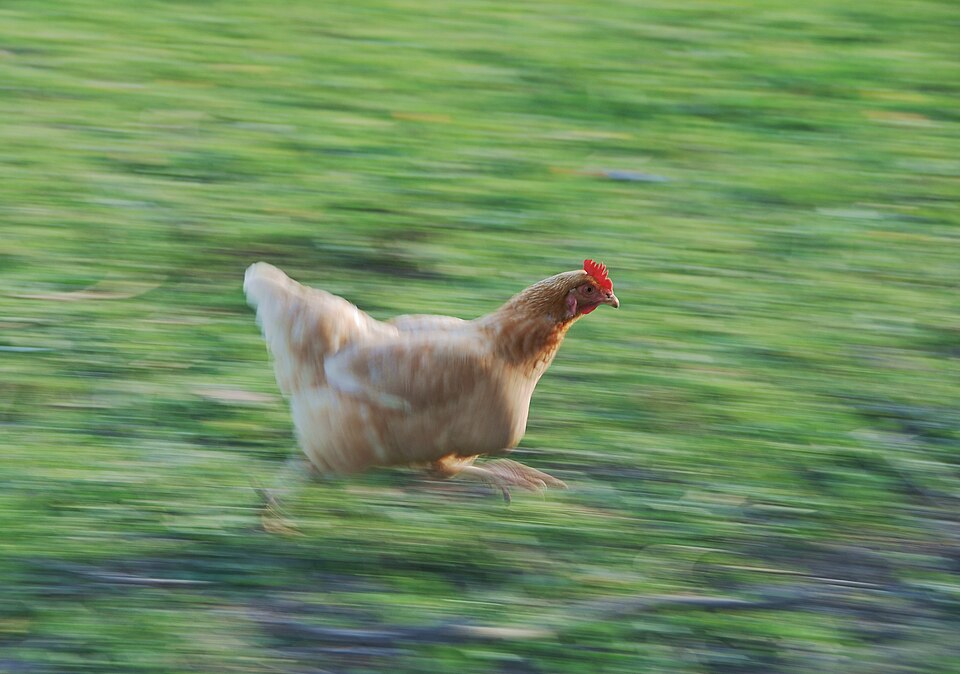
In the entry for the verb stem wensw- ‘boil him/her/it (animate)’, you’ll see the example sentence noonki pileewa winswaataawi ‘Let’s boil the chicken now!’
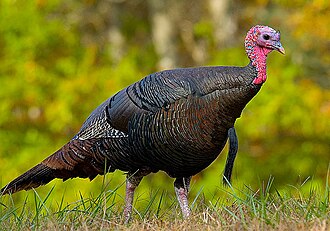
But in a few other places, we say pileewa when we definitely, absolutely, unambiguously mean ‘turkey’. The word for ‘wild turkey (Meleagris gallopavo)’ is nalaawahki pileewa — nalaawahki attaches to plants and animals to indicate they are wild or feral. The word for a turkey’s feather is pileewaankana — -waankana or -aankana attaches to bird words to mean ‘feather’, like in the words ciinkweewaankana ‘Thunder being feather’, šiihšiipaankana ‘duck feather’, and others. We also use pileewa to mean turkey in an example sentence for the verb natoneehw- ‘hunt him/her/it (animate)’: noonki šayiipaawe neetoneehwaki pileewa ‘I am going turkey hunting this morning’.
This isn’t a case of inconsistency; Myaamia people had a number of different ways of talking about turkeys, and they have overlapped with the names given to chickens and other birds that spend a lot of their time walking (as opposed to flying).
More Birds Here Than Just Chickens
Chickens weren’t always roaming around North America, but were introduced by settlers. On the other hand, turkeys are native to this continent. So we see a lot of variation in the historical records when it comes to bird words.
In the mid-19th century, Charles Handy asked Kansas speakers what waapipilia meant, but according to him, they didn’t say ‘turkey’ — they said ‘goose’! This is a personal favorite of mine, because I can totally see the logic. Geese aren’t terrestrial game birds like turkeys and chickens, but they do spend an awful lot of their life waddling around on land.
The word pileensa literally means ‘little pileewa‘, and we define it in the online dictionary as ‘chick, baby chicken’. But just like ‘chick’ in English can refer to the young of any bird, the speakers that Charles Trowbridge consulted in the early 19th century said that it meant ‘a young turkey’ — this same usage is also recorded by Largillier’s dictionary more than a century earlier.
In fact, in the oldest records — the Jesuit dictionaries of the late 1600s and early 1700s — pileewa generally means ‘turkey’. I stress “generally” here, because (unhelpfully) the Jesuits sometimes just translated pileewa with terms like ‘hen’ (la poule), which, in French and in English, can technically refer to just about any landfowl, from turkeys and chickens to partridges and grouse.
So for a very long time, it seems to me that Myaamiaataweenki speakers used pileewa to refer to whatever the most relevant landfowl is for their everyday life. And we don’t see this getting narrowed down to chickens until relatively recently, when they became more familiar to Myaamia people.
And actually, if you check out sister languages of Myaamiaataweenki, you’ll see that same pattern extending far and wide. In many Algonquian languages, their version of pileewa can mean almost any terrestrial bird.
In Ojibwe, for example, bine is defined as ‘partridge’ or ‘ruffled grouse’; Menominee speakers use pena͞ew to refer to partridge, grouse, and quail; and Plains Cree speakers say pihêw when talking about prairie chickens, grouse, and partridges.
Summing up: in Myaamiaataweenki, we sometimes use pileewa to mean ‘chicken’ and other times use it to mean ‘turkey’ precisely because that’s how speakers have used it for centuries.
Finally: Why waapi-?
So we’ve established that the precise meaning of pileewa changed over time and even today is fairly flexible. But there’s still an unanswered question: in waapipilia, what does waapi- mean?
…honestly? I have no idea.
Some domesticated turkeys are indeed totally white, but that’s not the most common kind that you’d see in nature.
Other types of turkeys have very strong white features, like white heads or a distinctive pattern of white bars on their feathers. Still other turkey subspecies have iridescent feathers, which almost seem to shine in the sun. Maybe they didn’t literally mean ‘white’, but instead were using waapi- to describe that iridescence, like how the name of the Wabash River, waapaahšiki siipiiwi, describes that river’s reflective shininess?
We’d love to hear your theories in the comments — and, as always, let us know if you want the story behind any other words!


Leave a Reply